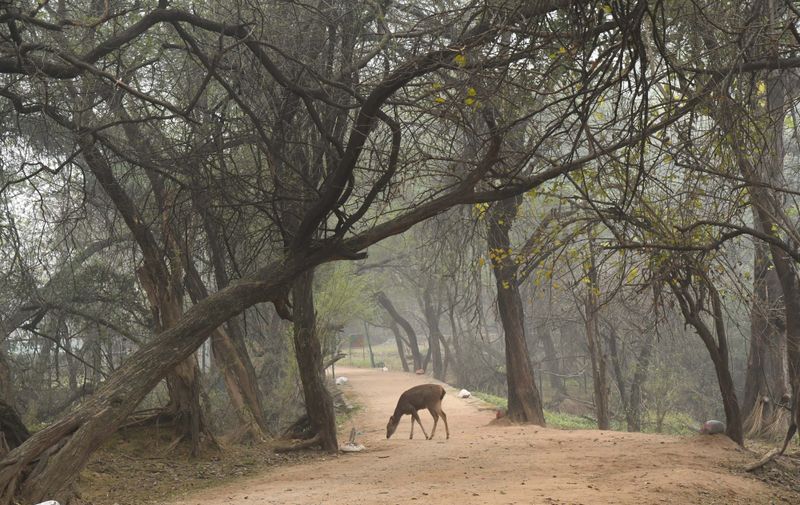

India’s overall forest and tree cover has improved, but a green deficit persists in the agrarian states of Punjab and Haryana.The country’s total forest and tree cover has reached 8,27,357 sq km, accounting for 25.17 per cent of its geographical area, according to the latest India State of Forest Report (ISFR), the government informed Parliament this week in response to a question by Punjab MP Sant Balbir Singh.Prepared biennially by the Forest Survey of India under the Ministry of Environment, Forest and Climate Change, the report shows while the national figure has improved gradually sharp regional disparities remain. Despite being among India’s most agriculturally productive states, Haryana and Punjab are witnessing a persistent decline in green cover. Haryana has only 7.48 per cent forest and tree cover, while Punjab records an even lower 6.59 per cent.The decline is linked to intensive farming, urban expansion, infrastructure growth and limited scope for natural forests. Unlike forest-rich states, both rely heavily on farmland, leaving minimal space for dense ecosystems.Environmentalists caution that inadequate green cover will worsen heatwaves, air pollution and groundwater depletion. Cities such as Gurugram, Faridabad, Ludhiana and Amritsar already show signs of ecological stress due to rapid urbanisation. In contrast, neighbouring Himachal Pradesh benefits from conservation policies, with 29.52 per cent forest cover, while Chandigarh stands out with 40.51 per cent thanks to planned urban forestry and strict land-use controls. This demonstrates how policy intervention can offset geographical constraints.The North-East continues to dominate India’s green landscape, with Mizoram (88.03 per cent), Arunachal Pradesh (80.11 per cent) and Meghalaya (78.86 per cent) leading the charts. Central states like Chhattisgarh (46.12 per cent) and Madhya Pradesh (27.81 per cent) also maintain substantial forest resources, aided by traditional conservation practices.To address deficits, afforestation and agroforestry are key. National programmes such as the Green India Mission and compensatory afforestation schemes provide frameworks, but experts stress Punjab and Haryana need tailored strategies. Suggested measures include promoting agroforestry on private farmlands, creating urban green belts, protecting fragile ranges like the Aravallis and Shivaliks, and incentivising tree-based farming. The biennial FSI assessment offers states a chance to monitor progress and recalibrate policies.