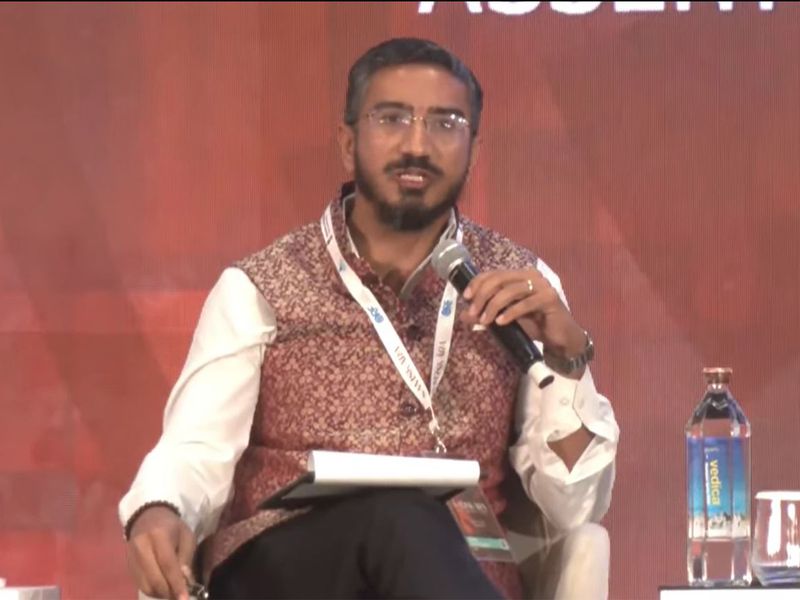

New Delhi [India], March 6 (ANI): Highlighting the complexities of global diplomacy, ORF America Executive Director Dhruva Jaishankar said the international community must prepare for “unexpected kinds of arrangements” as major powers attempt to balance geopolitical competition with global economic stability.Speaking at Raisina Dialogue 2026 during a session titled ‘Beyond Strategic Ambiguity: Rethinking Deterrence in the Taiwan Strait’, Jaishankar addressed the evolving nature of international relations amid the ongoing Russia-Ukraine war and conflicts in the Middle East.He noted that even in high-tension environments, nations are likely to seek “carve outs” to prevent economic collapse.”So I think we will see, whether it’s the conflict as it goes on in the Middle East, whether it’s now the fourth year of the Russia-Ukraine war, or even in the context of when China has 90% of the processing capacity for graphite, again, something that every economy needs, there are going to be, even in the midst of conflict, various kinds of carve outs given to balance global economic cultures on the one hand versus geostrategic competition on the other hand,” Jaishankar said.The foreign policy expert said this balancing act is an unavoidable consequence of the modern era, where strategic rivals remain economically interdependent.”And I think that’s just the reality that we are all going to have to contend with. So we’re going to see some very unexpected kinds of arrangements being made,” he added.Dhruva Jaishankar also pointed to the pragmatism of the United States regarding energy security. He suggested that despite sanctions and strategic rivalries, Washington remains aware of the need to maintain stable global markets.”Because, again, even in the height of a conflict, the US is conscious of the global energy market, oil particularly, and gas to some degree. So I think that’s good. We’re going to have to live with these contradictions in the face of crisis,” he said.The discussion, which explored the shift away from strategic ambiguity, featured a panel including Bonnie Glick of the Foundation for Defence of Democracies, Helena Legarda from the Mercator Institute for Chinese Studies, I-Chung Lai of the Taiwan-Asia Exchange Foundation, and Jonas Parello-Plesner, Director of the Alliance of Democracies. (ANI)(This content is sourced from a syndicated feed and is published as received. The Tribune assumes no responsibility or liability for its accuracy, completeness, or content.)