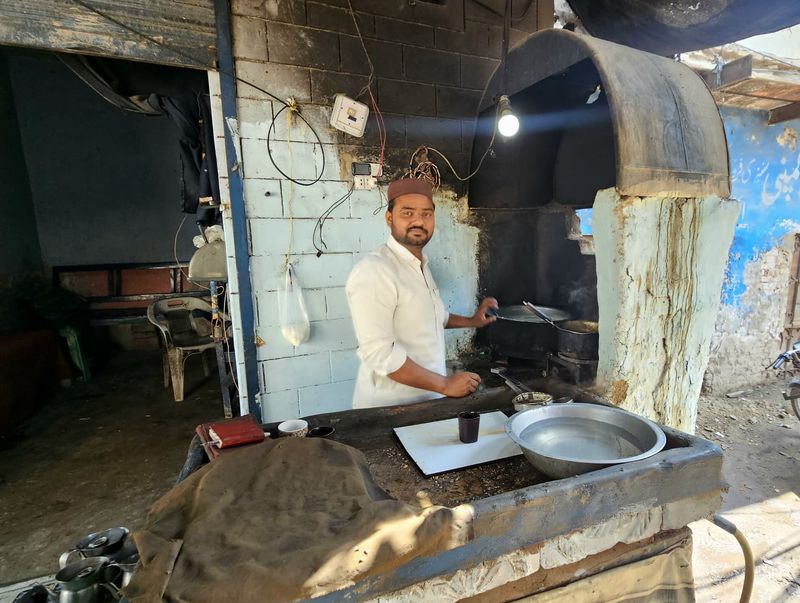

Mehrabpur is a small town that blossomed when the Karachi-Peshawar railway line was laid in the 1860s by the British imperial power.It had a majority Hindu trading population at that time, which left for India to the east in 1947. On the other hand, Panjabi Jat Muslim families (who had converted from the Sikh faith in the early 1900s) from the rural areas of Dhuri, especially the village of Qila Raipur, moved here.They waited for several months after partition to move to the newly created state of Pakistan, and so when they arrived at Lahore, they were not welcomed as other refugees had already settled there.They moved south by train till they arrived at Mehrabpur in Sindh – a culture alien to them. Even here, they were not welcomed, and in the end, they had to put up in a Hindu shamshan ghat (funeral place) outside of the town.Their resilience has now led them to being well integrated into Sindhi society while still maintaining their Panjabi linguistic and cultural identity, so much so that Mehrabpur is now a mini-Punjab of Sindh.The other groups of refugees settled here are Muslim Ranghars from Haryana, who are Muslim Rajput converts from Hindus from the early 1900s, and they still speak their native language, Ranghari.There is also a significant indigenous Sindhi Muslim and Sindhi Hindu population here. People of many faiths, ethnicities, cultures, and both genders freely walk and shop in the bazaars – you hear people talking with each other on top of their voices in Sindhi, Punjabi, Ranghari, and Urdu.Today is the last day of Ramzan – the month of fasting in Islam. I wanted a cup of tea, but hesitated to ask my host family as they were fasting. So, I stepped out of the 1950s home of my Muslim friend, which was built over a Hindu community funeral site by his great-grandfather, village head Lala Allah Dita Kamboh, who had moved here with the entire Muslim population of his native village of Qila Raipur. I turned left and then right until I reached a small tea shop, which I was surprised was open during Ramzan.The tea shop owner, Muhammad Bilal, was making tea. He is a Ranghar Muslim Rajput but spoke with me in Panjabi. As I walked over to him, I saw that his TV was playing the news. On closer inspection, I was surprised to find that it was news in Hindi, not Urdu. On asking, he told me that it was Hindi news from Bombay. He added that his customers enjoy hearing Hindi news on TV from the other side of the border.Muhammad Bilal, tea shop owner.I asked for a cup of tea without sugar, and he asked, “Panjabi or Sindhi chai?” I retorted with ‘Sindhi chai,’ as I am fond of experiencing different cultures.I sat down on a two-person bench in front of the shop as I watched the 10-minute or so process of him making one cup of unsweetened Sindhi tea. Bilal used a small cup to remove boiling tea from the pot, then poured it back in a long stream till the tea was ready.The cup of tea was brought to me, so I got up, picked it up, and walked over to the shop counter to add Splenda, an artificial sweetener, due to diabetes.As I was mixing it in the tea, I saw an older man in shabby clothes, who could hardly stand, coming towards the shop with the help of his corroded metal walker. Clearly, he was coming towards me. He was not well and trembled – he spoke in Punjabi, but I could not understand his slurred words. However, I could tell that he was welcoming me to Sindh with “Sat Siri Akal.”His body language was warm, even though he could hardly walk. He came and sat next to me on the bench. Once he sat down, he remained silent – it seems he was exhausted. After about 5 minutes, he managed to get up with great effort, and as he wobbled past me on his walker, he asked me to pray to “Vaheguru” for his health. I told him I would do so, and he then disappeared into the alley, wobbling his way.I finished my cup of tasty Sindhi tea and opened my wallet to pay Bilal. To my surprise, the shop owner said that the old man had already paid for my tea. It melted my heart to see such hospitality from a stranger whom I had just met.The language of love and respect has many forms, and this is one of them. I left a tip for the shop owner and gave him a few extra hundred rupees to buy chai for the old man the next time he came there. I did ask Bilal to ask the old man to pray to “Allah” on my behalf.I am quite sure that the old man who graciously paid for my cup of tea assumed I was Indian. It hardly mattered then that I was an American. This incident has further affirmed in Sindh what I have observed elsewhere in Pakistan – “Pakistani people love the people of India, but the Indian government is a different matter.”In my extensive travels in Pakistan, I have to date not met a single Pakistani who hates Indians. We must work together towards better days ahead for South Asia, building multicultural societies that honor difference and hospitality.I will look for the old man on Eid at the tea shop. Maybe we will pray together to the one God, known by many names such as Vaheguru and Allah.