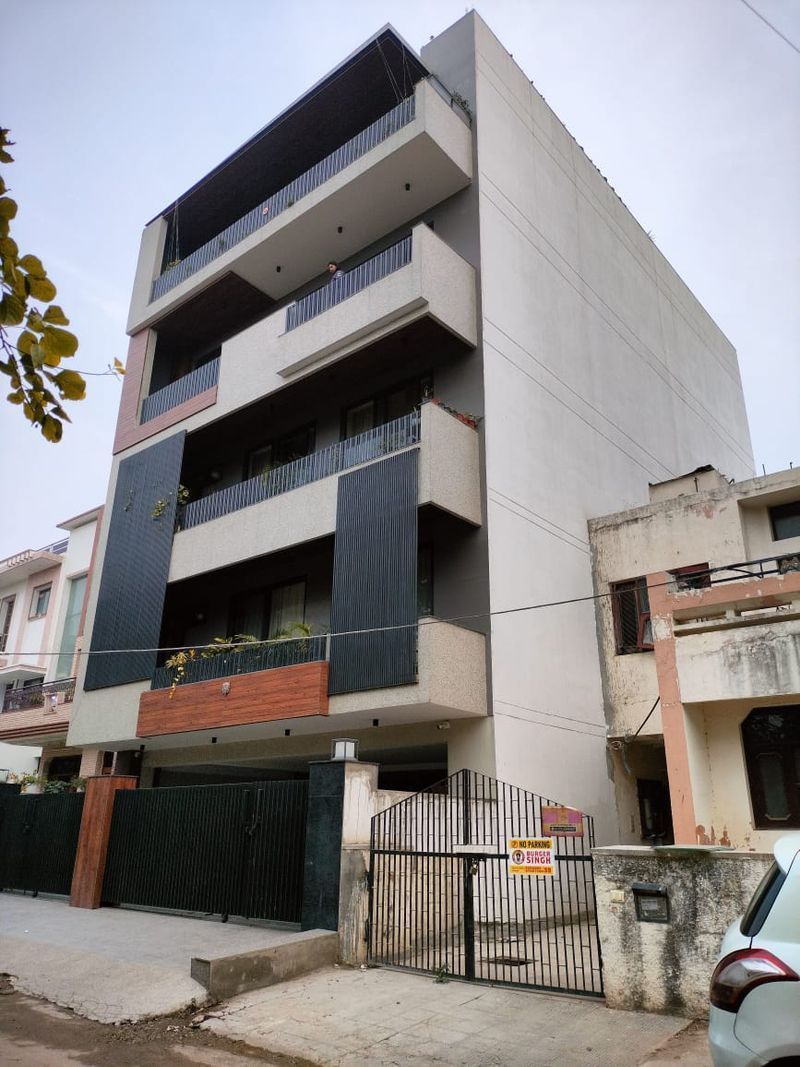

Less than a week after the Punjab and Haryana High Court stayed the operation of Haryana’s ‘stilt+4 floors’ policy for residential plots, a Division Bench on Wednesday directed the continuation of the order at least till April 17––the next date of hearing in the case.Related news: HC halts Haryana’s ‘stilt-plus-four’ policy operation, citing ‘revenue over public safety’The matter was listed before the Bench of Chief Justice Sheel Nagu and Justice Sanjiv Berry today for further hearing, but remained inconclusive “due to paucity of time”. Adjourning the hearing, the Bench directed the continuation of the interim order.The Bench on the previous date of hearing had held that the state had apparently prioritised revenue over public safety while ignoring basic infrastructure realities. Coming down heavily on the state’s approach, the Bench had asserted: “It appears that the State of Haryana merely to earn more revenue has put the safety and security of members of general public at stake.”The Bench had added that the state and its functionaries gave a go-by to the all the “important aspect of conducting ‘infrastructure capacity audit’ before implementing the stilt+4 policy” while turning a Nelson’s eye towards the desperate shortage of infrastructural requirement in Gurugram city.“It thus seems that the state has abdicated its constitutional duty of ensuring clean and healthy urban environment for the citizens of Gurugram,” the Bench had added.Among other things, the PIL-petitioner had challenged notification dated July 2, 2024, issued by the Additional Chief Secretary, Town and Country Planning Department. It permitted the construction of stilt-plus-four floors on residential plots—raising the earlier cap of stilt plus three floors—and also introduced a composition mechanism even where building plans had not been approved.Clarifying that the stay was being granted without expressing a final opinion on the policy’s legality, the Bench had asserted: “Since, the arguments are taking long time to conclude, it is deemed appropriate by this court, at this stage, without commenting on the validity of the impugned order/notification to pass interim directions.”A crucial factor that had weighed with the court was the stark mismatch between planning norms and ground realities. During final hearing, the Bench took note of photographs prima facie showing narrow internal roads in DLF Phase-I, Sector 28, Gurugram. This led to the appointment of a local commission to verify the actual road width.The report revealed that while the prescribed width of internal roads was 10 to 12 meters, the “motorable road area available for plying of traffic and pedestrians is only 3.9 meters to 4.8 meters.” Referring to the causes, the Bench had observed: “This shrinkage is attributed to various reasons, which essentially are lack of adequate infrastructure of sanitations and sewerage, over-population, defective town planning, inadequate garbage disposal, blocking of aquifers by indiscriminate paving of roads, rampant construction activities thereby preventing recharging of ground-water etc.”