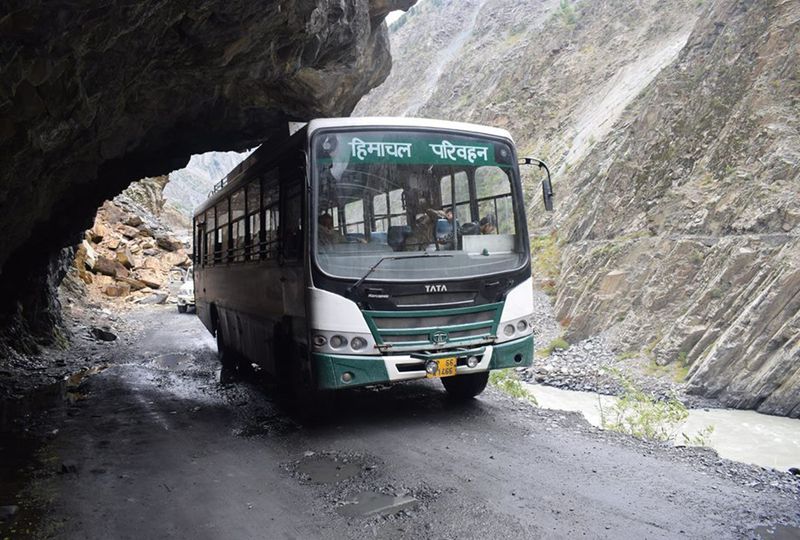
This was to be a good commercial assignment. Something that would keep the wallet warm for a while. A coffee table book was being planned for an organisation that had crossed a major milestone. The brief was spelt out in the first salvo: “You are a professional and know what to do. All I’m concerned with is that my boss should like it and be happy.” Nice and simple. Except that it wasn’t.A few months of work went down the drain and the wallet remained miserably unfed as both the boss and the commissioning person moved on to other (and better?) things. In a manner of speaking this was just as well, as the moment all this work wound its way to the rubbish bin, something else came along.Within of course and outside the state too, there are two things that are instantly recognisable as Himachali. The first being the distinctive round ‘pillbox’ caps of the state. A political inflection has been given to them by the colour of the velvet band that decorates them. This, one surmises, is only because the leader of a political party favoured a particular colour, so needless to say, the other party had to drape itself with another. Meanwhile, for persons non-political, fashionable and for those who couldn’t care less, this has led to a host of other designs and myriad colours adorning these caps.The second instantly recognisable ‘Himachali thing’ are the Himachal Roadways buses that ply on numerous routes across North India. You’ll find them on both highways and on narrow roads. At about this time of the year in 2024, I was commissioned by the Himachal Road Transport Corporation (HRTC) to put together a coffee table book to mark its golden jubilee.As happens in assignments of this nature, one sometimes ends up learning more than what one may impart. Or expect. However, unlike many other similar assignments, where one is handed a task and often enough is expected to bumble one’s way through, here the head of the organisation and many others who were a part of this remained completely involved in the process. The word I should use is ‘proactive’.The result was that one had far greater access to the material one wanted or may even have missed, and the working remained smooth. Along the way, putting together the pages, one grew to admire the men, and now women, who work in adverse conditions and often enough hazard both life and limb on treacherous routes and in dangerous situations.On the times that one walked across to the roadways’ office, for reasons unknown, a dog who lived en route would accompany me and wait on the slope and then, walk back with me for some distance. One doesn’t quite know if he was an unofficial-guardian or appointed-greeter of the transport office — but he was there every time one went. Expectedly, he’d stop some distance away from the racing traffic on the highway, wag his tail and then park himself in a sunny spot.If one was more superstitious than one is, one could almost consider that canine as a harbinger of good things. That dog, like most, seemed to have an individual character. As I was told: “Vehicles too have individual character. Ask any HRTC driver and he will tell you which six-wheeled princess takes well to the roads, which queen throws tantrums and has emotional breakdowns, and which king should be retired.”Today, for many of us, aspirations have gone far beyond a bus ride and the time when the fare between Chandigarh, where I studied, and Shimla was a princely Rs 7.50. Despite the endless times one has been up and down that highway, one was prone to travel sickness. “Just swallow a tablespoon of diesel and you’ll never be travel-sick again” was a piece of advice that was ignored.Reminiscent of an earlier time when buses were a rare commodity in rural India, there remain pockets where the arrival of a bus is still a cause for celebration. This was recently testified by a news report of the moment that the first bus arrived in the village of Tammun, in the Karsog area of Mandi district. It was welcomed the way a groom would be welcomed on his wedding day — complete with a ceremonial gateway, garlands and a host of Instagram and Facebook reels.There was a time when an entire village could turn out to welcome the arrival of a bus. People would gather to see who was getting off and later, check who was getting in. The driver and conductor were heroes of sorts. They would be feted and welcomed. If there was an overnight stop and the bus had to turn around the following morning and leave, both the driver and the conductor would be hosted by someone. They were liberators of sorts. They held the means to move to the outside world — or to return home.— The writer is an author based in Shimla