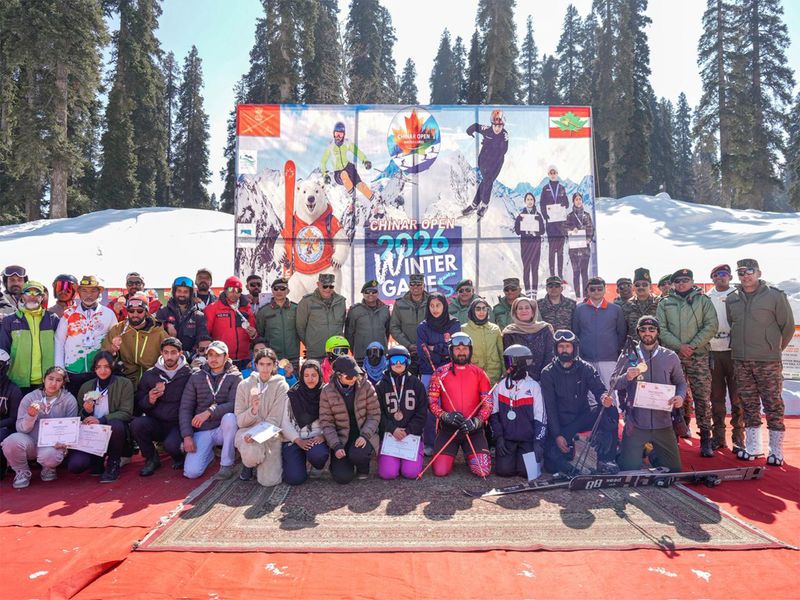
Gulmarg (Jammu and Kashmir) [India], February 22 (ANI): By the time the bugle echoes across the frozen valley, the contest is usually already decided.From the high-altitude rinks of Leh to the powder-white slopes of Gulmarg, one constant has defined the modern era of the Khelo India Winter Games – the quiet, disciplined dominance of the Indian Army.As the Gulmarg leg of the sixth edition of KIWG unfolds on Monday, the Army’s story at KIWG is no longer about participation. It is about supremacy. Launched in 2020 under the Government of India’s flagship Khelo India initiative, the winter games were designed to mainstream snow and ice sports in a country more fluent in cricket than cross-country skiing, as per a release from KIWG.Yet in just six editions, the Games have carved out an alpine mythology of their own. And in that mythology, the Army is the protagonist – not loud, not theatrical, but relentless.The first three editions of 2020, 2021 and 2023 were hosted and won by Jammu and Kashmir. With Gulmarg’s pristine slopes and Leh’s frozen expanses serving as both battleground and home advantage, the hosts capitalised on familiarity and altitude. The Army was competitive then, but not yet imperial. That would change soon.The 2024 Khelo India Winter Games saw the ‘coup’ as the Army stormed the standings with authority, winning 10 gold, 5 silver, and 6 bronze. It was not just a medal haul. It was a declaration. The institution that trains at altitude, competes in extremes and treats endurance as doctrine had found its sporting theatre. Snow and ice were not obstacles; they were natural habitats. It wasn’t just a victory. It was a blueprint.By the fifth edition in 2025, the Army had evolved from contender to benchmark. They topped the table with 18 medals, winning 7 gold, 5 silver, and 6 bronze. Himachal Pradesh matched the total medal count with 18 medals, but gold decides championships in the KIWG’s team format. The Army had more.Yet 2025 was also a tournament of breakout narratives. Telangana’s 15-year-old prodigy Nayana Sri Talluri won the first gold of the games in the women’s 500 metres short track and completed a hat-trick in speed skating. Alpine skier Aanchal Thakur struck double gold in slalom and giant slalom in Gulmarg. But while the spotlight chased youth and flair, the Army quietly stacked podiums.Gulmarg was painted white with snow. The podiums, however, turned olive green.In the Nordic skiing events at KIWG 2025, the Army executed one of the most clinical sweeps in the Games’ short history. They claimed every medal in all three men’s Nordic skiing races – the 1.4 km sprint, the 10 km race, and the 15 km race.In the 1.4 km sprint, Manjeet won gold, Shubam Parihar silver, and Sunny Singh bronze. The pattern repeated in the 10 km and 15 km races. No gaps, no surprises, just the system. In men’s Alpine skiing, Sunil Kumar clinched gold.Kumar credited the ecosystem: “The Army backs its athletes fully – financially, structurally, and psychologically. In endurance sports where oxygen thins and lactic acid burns, belief is as crucial as balance.”On why the Army has been dominating the Khelo India Winter Games, Indian Army coach Nadeem Iqbal Mirza said, “It is possible due to the year-round rigorous training schedule and the full support of the institution of the Indian Army to the athletes.”Mirza said that in summer, when snow melts from the Pir Panjal, Army athletes switch to punishing conditioning that includes roller skiing, gym work, and altitude endurance cycles.”The Army’s infrastructure, like snow groomers, snow scooters, and ski lifts creates near-European training environments in Himalayan terrain,” Mirza said. “We also send our athletes to train outside the country. During the last three years, we sent our athletes to train in Italy and Sweden.”Preparation is not seasonal, it’s institutional. Local skier Arif Ahmad offers a simpler explanation: terrain familiarity and adaptation.”Soldiers stationed for years in Kashmir and Ladakh understand the slopes, the snow behaviour, the weather shifts. They live in the altitude others visit,” Ahmad said.There is also rivalry. The Indo-Tibetan Border Police (ITBP) often pushes hard in women’s events, creating an institutional duel that adds edge to the games. But in men’s disciplines, the Army has largely dictated terms.The sixth edition of Khelo India Winter Games began on January 20 in Leh, Ladakh. The Phase I featured ice hockey and ice skating, with figure skating added for the first time. At the Nawang Dorjay Stobdan Stadium, the Army retained its men’s ice hockey crown, edging Chandigarh 3-2 in a dramatic final.The Army does not relinquish territory easily – on ice or otherwise. Phase II now shifts to Gulmarg’s Kangdoori Phase 1 and Golf Course Club, where alpine skiing, Nordic skiing, ski mountaineering, and snowboarding await. If history is any guide, the snow leg is where olive green traditionally tightens its grip.Across just the last two completed editions, the Army won 39 medals, 21 in 2024, including 10 gold and 18 in 2025, including 7 gold. With 17 gold medals in two years, no other institutional team has matched that sustained dominance in the games’ brief history.On Friday, Gulmarg witnessed another olive-hued assertion of sporting outreach. The Chinar Open Winter Games 2026, a flagship initiative of the Indian Army, concluded amid the snow-clad expanse of the resort town under the aegis of the Dagger Division of Chinar Corps.Drawing a record 660 participants, including 166 women and 494 men across eight disciplines, including skiing, snowboarding, and skating, the event underlined the Army’s widening grassroots base of winter sports in Kashmir.Beyond medals and podiums, the games reinforced the Army’s sustained push to nurture local talent and position Gulmarg as a premier winter sports destination in the country. The tournament also served as a prelude to the Khelo India Winter Games 2026 and prepared the athletes of the Army for the big tournament, which will witness the participation of winter sports athletes from all states and union territories of the country, besides the institutional teams like the Indian Army. (ANI)(This content is sourced from a syndicated feed and is published as received. The Tribune assumes no responsibility or liability for its accuracy, completeness, or content.)