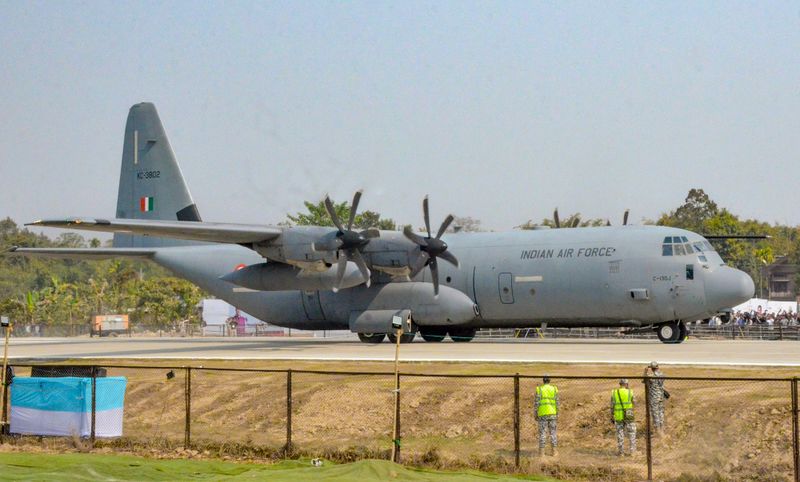
When Prime Minister Narendra Modi made a historic landing onboard a C-130 at India’s newest Emergency Landing Facility (ELF), a specially converted highway stretch in Assam’s Dibrugarh district on Saturday, it marked a strategic addition to India’s growing push to develop dual-use infrastructure that would give the Indian Air Force (IAF) greater operational flexibility.The IAF’s C-130J Super Hercules special mission aircraft, a large four-engined turboprop with a maximum all-up weight of about 74,000 kgs, touched down at Moran on National Highway-37 about 300 kms from the border with China.Constructed in collaboration between the Ministry of Defence and the Ministry of Road Transport and Highways, the ELFs enhance the Indian Air Force’s strategic flexibility, allowing rapid response, quick refueling and rearming of aircraft and facilitating logistics by airlifting troops, equipment and supplies. Since airbases can be targeted in war, these temporary landing strips offer redundancy and operational surprise.Over the past few years, India has been developing sections of certain national highways and expressways as emergency airstrips. The designated stretches serve as temporary runways for military aircraft, including frontline fighter jets like Su-30 and Rafale, in contingencies such as war, when regular airbases may be unavailable for use, or for humanitarian assistance and disaster relief (HADR) operations.While the ELF at Moran is the first in the north-east, several such facilities are already operational in other parts of the country. The IAF has already demonstrated successful operations by fighters and transport aircraft from such stretches of converted highways.As many as 28 sites for Emergency Landing Facilities have been identified by the Indian Air Force in 11 states and union territories, according to information shared by the Ministry of Defence with Parliament. These include 11 in the western theatre, nine in the east, five in south India, and three in the central sector.As far as states are concerned, five designated ELFs are in Assam, the highest number amongst all states, followed by four in West Bengal. Andhra Pradesh, Gujarat, and Rajasthan have three such sites, while Jammu and Kashmir, Bihar, Haryana, and Tamil Nadu have two each. Punjab and Uttar Pradesh have one ELF site each. Many of them are already functional and have been used during exercises.Beyond military use, ELFs can also be used by civilian aircraft in case of an in-flight emergency or for a specific purpose such as medical evacuation or ferrying in a special team or equipment.Emergency Landing Facilities are specially designated and engineered sections of a straight stretch of a highway that could be over four kilometers long. While their primary use is for regular civilian vehicular traffic, the physical and structural specifications need to meet standards required for aircraft operations. Structures on either side that may pose flight safety hazards are also removed.These feature a high-strength surface capable of bearing the weight and pressure of high-speed and heavy aircraft touching down, reinforced pavements with fences and barriers to prevent the ingress of humans, animals, or vehicles during operations, and proper drainage.Despite being much wider than a conventional highway, the ELF stretches cannot have a lane-dividing median. These also carry typical runway markings to assist landing and take-off by aircraft.ELFs, according to defense experts, are a smart and cost-effective way to build dual-use infrastructure that boosts the military’s operational preparedness while serving civilian transport requirements.The concept of ELF, which emerged during the Cold War, is widely used in many countries, particularly in Europe, that faced concerns over airfield vulnerability due to enemy proximity or terrain that imposed restrictions on construction or limitations in the availability of land.Finland, Sweden, Switzerland, Germany, and Poland are among the most active users of dual-purpose highways. Indonesia, Singapore, Taiwan, Russia, China, Pakistan, Australia, South Korea, Estonia, Bulgaria, and Bosnia are other countries that have experimented with this concept.