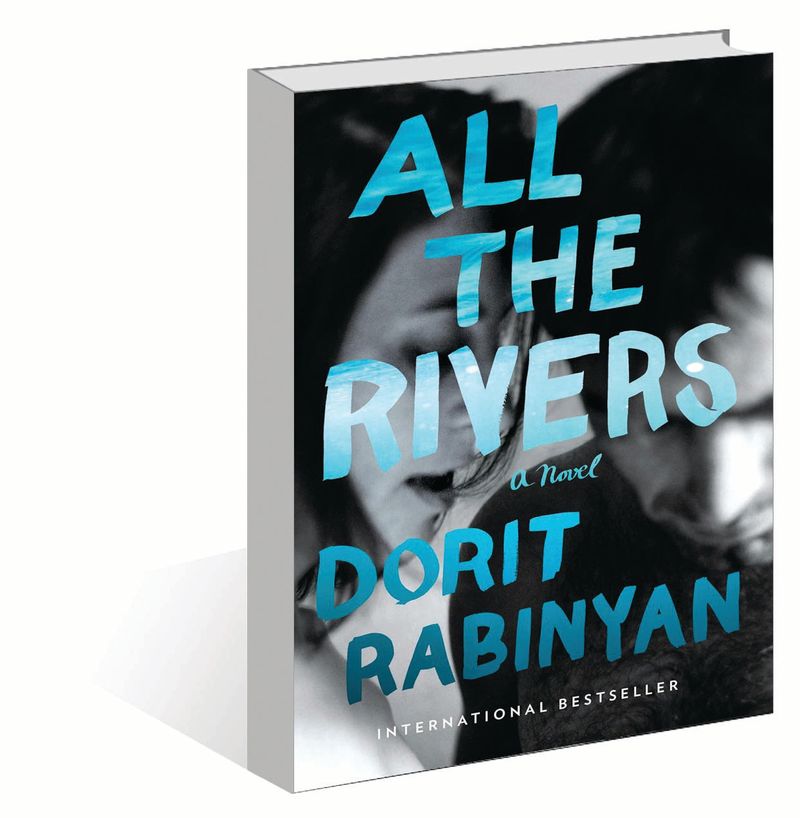

Over a decade ago, Israeli writer Dorit Rabinyan wrote a novel that would seem almost surreal — perhaps even impossible to write — in today’s climate. ‘All the Rivers’ (also published as ‘Borderlife’) tells the story of an Israeli Jewish woman and a Palestinian Muslim from the West Bank who meet in New York and fall in love. The novel was partly inspired by Rabinyan’s own relationship with a Palestinian artist, which ended tragically with his untimely death.When a group of teachers recommended the book for inclusion in Israel’s high school curriculum, the Ministry of Education vetoed it, deeming it dangerous for young minds. The objection was telling: the novel, it was argued, promoted assimilation or intermarriage between Jews and gentiles, thereby threatening to “subvert distinct Jewish identity”.The decision sparked a wide public debate on identity, nationalism, Zionism, literary freedom and, inevitably, the perennial Israel-Palestine conflict. Rabinyan herself captured the perplexity of being thrust into this storm in a New York Times essay: “That was my first glimpse of the public storm that would leave me, blinking in bewilderment, at its centre; the raging whirlwind that would transform my novel into a symbol of the threat to freedom of expression; the unforgiving jungle peopled with aggressive politicians and entangled with egos and agendas.”Her shock was not misplaced. The then education minister — who had not read the book — claimed that it portrayed Israeli soldiers as “criminal sadists” and that it depicted a romance between a “Palestinian security prisoner” and an Israeli woman. None of this was true.What emerges here is a familiar pattern: literature is first misread, then morally framed and finally transformed into a symbolic threat — allowing it to be curtailed without ever being seriously engaged.Persepolisby Marjane SatrapiA similar dynamic can be seen in ‘Persepolis’, the autobiographical graphic memoir by Marjane Satrapi, which remains banned in Iran. The book traces the life of Marji, a spirited and outspoken girl growing up in Tehran during and after the Iranian Revolution. She witnesses the fall of the Shah and the rise of the Islamic Republic, as everyday life is reshaped by surveillance, segregation and the imposition of religious codes — most visibly, the compulsory veil.As a child, Marji tries to make sense of these shifts, absorbing political ideas from her parents, teachers and surroundings, often misunderstanding them in ways that are disarming. Later, when she is sent abroad during the Iran-Iraq War, she encounters new distortions — of how Iran is perceived from the outside — as well as a deep sense of loneliness and unbelonging. What distinguishes ‘Persepolis’ is not simply its subject matter, but its method. By narrating revolution through the lens of childhood and memory, Satrapi resists the rigid coherence of official history.Rabinyan’s novel and Satrapi’s memoir reveal something fundamental about literature in societies shaped by conflict. At a time when both Israel and Iran remain entangled in tensions, these works suggest that the most enduring truths of conflict are not found in official discourse, but in individual lives — in the small, everyday negotiations through which people make sense of the world. At the same time, the reception of these texts shows how public discourse tends to harden into binaries: black versus white, us versus them, loyalty versus betrayal.It is precisely these binaries that both works quietly unsettle. Rabinyan’s novel was not deemed dangerous because it misrepresented reality; it was dangerous because it imagined a form of intimacy that political discourse disallows. It humanises the “other”, finding points of resonance where only division is expected. These lines from the novel show how the binaries dissolve for the lovers in a foreign country: “Everything around us was iron and concrete, asphalt roads and stone hulls, but we were rhapsodising about olive trees… The similarity between us, that shared destiny, must be what they mean when they say that man is imprinted by his native landscape.”‘Persepolis’, similarly, is not threatening because it distorts truth, but because it renders lived experience in ways that resist official narratives. The figure of the child becomes crucial here: her questions, misunderstandings and small acts of defiance expose the fragility of the systems that seek to discipline her.As writer Italo Calvino observed in ‘The Uses of Literature’: “Literature is like an ear that can hear more than politics; literature is like an eye that can perceive beyond the chromatic scale to which politics is sensitive.” Rabinyan and Satrapi remind us of precisely this capacity. Literature does not resolve conflict — it only resists its simplifications. It holds open a space where differences can exist without immediate resolution, where identities are not reduced to mere ideological positions, and where empathy can travel across lines that politics works hard to secure.— The writer is based in Bengaluru