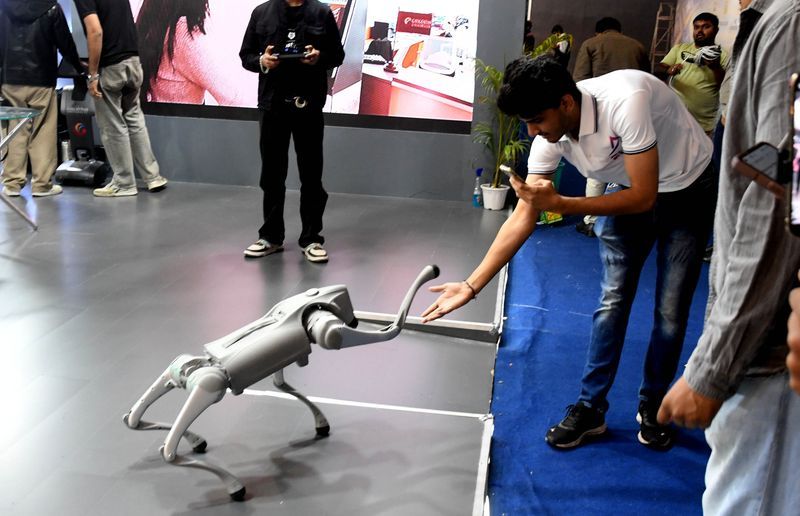
With a trade deal in its kitty and US Ambassador to India Sergio Gor’s announcement that President Donald Trump will soon visit India, Gor seems to be going out of his way to help India smoothen the rough road to the White House, writes Editor-in-Chief Jyoti Malhotra in her weekly column The Great Game Sergio Gor & Marco Rubio – Our men in Washington. Gor’s very powerful colleague, US Secretary of State Marco Rubio, will soon break bread with us in New Delhi. If India needs the US market, the Americans also need us. PM Modi must make nice with President Trump, but also decide at what cost, she writes.One interesting thing she brings to the table is Rubio’s words at the Munich Security Conference recently, when he said, “In 1945, for the first time since the age of Columbus, (the West) was contracting…” In the last leg of her article, she reminds Rubio that his reference to Columbus at Munich was actually an incomplete one. That Columbus may have “discovered” America, he was really looking for India.Bringing in a different perspective, former Governor, Manipur, and ex-DGP, J&K, Gurbachan Jagat writes in his Edit The pivot to the hard right that the centrist, liberal ideology has been pushed back by the tidal wave of a dogmatic right. Liberal democracies and liberal economies are giving way to authoritarianism in politics and economics; the world order is reverting to the nation state. The world is at the mercy of a few technocrats and authoritarian rulers like US President Donald Trump and Israeli Prime Minister Benjamin Netanyahu, among others. Great technological advancements like AI are coming at a time when liberalism in politics and government is giving way to the hard right, he feels, and AI can become an ‘uncontrolled fire’ if countries don’t get together to introduce a system of checks and balances.India hosted the mammoth AI Impact Summit in New Delhi last week that brought together heads of state, policymakers, industry leaders, researchers, startup owners and civil society from around the world to explore how AI can advance economic growth, ethical governance and social development. Evaluating where India stands in the arena of frontier technologies — AI, semiconductors, robotics, genomics, quantum computing —we lag behind in capital allocation, writes Lok Sabha MP Manish Tewari in his Edit piece A quantum leap is a distant dream. He supports his argument: China spent $38 billion on semiconductors in 2025, while India has committed to spend $0.12 billion in 2026-27. India’s total National Quantum mission budget is around $670 million over eight years; China’s estimated investment is $15 billion. Japan committed $7.4 billion in 2025 alone. The human capital crisis is deeper. India produces over 91,000 graduates annually in fields relevant to quantum technology. This places us second globally, behind only the EU. Yet this statistic masks a rot. These graduates are not being converted into quantum engineers. The reason is brutally simple: there are no jobs, he writes.Previous AI summits in the UK and South Korea were driven by fears about AI. The Paris Summit balanced fears with opportunities. In New Delhi, opportunities were the leitmotif, writes strategic analyst KP Nayar in his Oped article Small AI may matter more for jobs than Big AI.Not to miss the unexpected controversy of Galgotias University showcasing a robotic dog, calling it an indigenous innovation, actually developed by a Chinese company. The hype and overemphasis on startups have resulted in our institutions making tall or fake claims, as Galgotias has done, writes science commentator Dinesh C Sharma in his Op-Ed article Robot dog debacle raises tough questions. If the government is interested in promoting research and innovation, it cannot afford to neglect the basics — support to both fundamental and applied R&D and enforcement of academic and quality parameters.In his three-day official visit to India, French President Emmanuel Macron focused on strengthening cooperation in different domains, including defence, trade, innovation, and AI. Against this backdrop, former chief of naval staff Admiral Arun Prakash (retd) assessed one part of India’s defence requirements in his Edit piece The long wait for indigenous engines. A major dampener on India’s enthusiastic claims of Atmanirbharta in the defence sector has been the persistent absence of domestically designed and manufactured ‘prime movers’ (the engines that power major military platforms). None of the critical power plants — gas turbines, diesel engines or electric motors — is fully indigenous, he writes. We need to face the fact that arcane technologies are hard to come by, and we must acquire or purchase them from wherever available — regardless of cost — rather than struggle ineffectively, wasting time. He vouches for shedding our embedded bias against the private sector and initiate a collaborative model with private industry in the larger national interest.The Supreme Court refused to hear a petition against Assam CM Hemanta Biswa Sarma on the issue of an AI video showing him pointing a gun towards two Muslim men, and directed it to the Gauhati HC. When citizens approach the Supreme Court alleging that a sitting CM has engaged in speech targeting a vulnerable minority community, they invoke a constitutional guarantee in Article 32, writes SC senior advocate Sanjay Hegde in his Edit piece The Supreme Court shifts the onus. The Constitution says the right to move the Supreme Court for the enforcement of fundamental rights is guaranteed. The text contains no requirement to first approach the high court. It contains no clause that says the right shrinks when the cause list in any court grows longer. This selective restraint raises questions, he writes.Article 32 was designed precisely for moments when the violation of fundamental rights demands direct recourse to the highest court. It is a plea for judicial responsibility. The Court need not grant relief. It need not order an FIR. It need not pronounce on guilt. But it should hear the matter. It should examine the allegations. It should give reasons, he argues. The framers of the Constitution did not design Article 32 as a procedural maze. They designed it as a direct path.