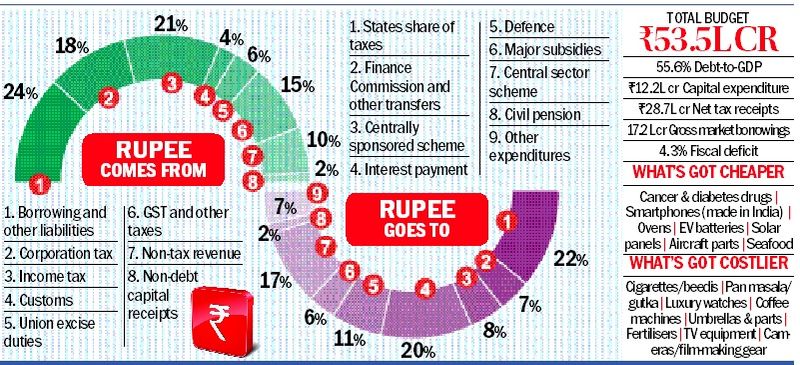

The Union Government on Sunday proposed to set up five regional medical tourism hubs, National Destination Digital Knowledge Grid, ecologically sustainable mountain trails, and a pilot scheme for upskilling 10,000 guides at 20 iconic tourist sites.“To promote India as a hub for medical tourism services, I propose to launch a scheme to support states in establishing five regional medical hubs in partnership with the private sector,” Finance Minister Nirmala Sitharaman in her Budget speech. She said these hubs would serve as integrated healthcare complexes that combine medical, educational and research facilities.She said these hubs would serve as integrated healthcare complexes that combine medical, educational and research facilities.“These will have AYUSH centres, Medical Value Tourism Facilitation Centres and infrastructure for diagnostics, post-care and rehabilitation. These hubs will provide diverse job opportunities for health professionals, including doctors and AHPs (allied health professionals).”India was ranked 10th in Medical Tourism Index (MTI) for 2020-21 out of 46 destinations of the world by the Medical Tourism Association.Medical tourism is a growing sector in the country, with maximum patient arrivals from Southeast Asia, West Asia, Africa and the SAARC region, according to a report by the Federation of Indian Chambers of Commerce and Industry (FICCI).The government had also created Ayush Visa category for foreign nationals seeking treatment through traditional Indian systems of medicine such ayurveda and yoga.The Budget also focuses on developing ecologically sustainable tourist destinations with respect to mountain trails inHimachal Pradesh, Uttarakhand and Jammu and Kashmir; Araku Valley in the Eastern Ghats; and Podhigai Malai in the Western Ghats.Turtle, bird watching trails “Turtle trails along key nesting sites will be developed in 14 coastal areas of Odisha, Karnataka and Kerala. Bird watching trails along the Pulikat Lake in Andhra Pradesh and Tamil Nadu will also be set up,” it said.The minister also announced a National Institute of Hospitality by upgrading the existing National Council for Hotel Management and Catering Technology, which will function as a “bridge between academia, industry and the government”. According to the government, the National Destination Digital Knowledge Grid will be established to digitally document all places of significance — cultural, spiritual and heritage. This initiative, it said, would create a new ecosystem of jobs for local researchers, historians, content creators and technology partners.Revamp of historic sites Sitharaman also proposed to develop 15 archaeological sites, including Lothal, Dholavira, Rakhigarhi, Adichanallur, Sarnath, Hastinapur, and Leh Palace into “vibrant and experiential cultural destinations”. A pilot scheme was also announced for upskilling 10,000 guides at 20 iconic tourist sites through a standardised, high-quality 12-week training course in hybrid mode. It will be done in collaboration with an Indian Institute of Management.“I also propose the development of an integrated East Coast Industrial Corridor with a well-connected node at Durgapur, creation of five tourism destinations in Purvodaya states and the provision of 4,000 e-buses,” she said.The Purvodaya scheme is a government initiative focused on the accelerating the development of the eastern region of India, encompassing states like Bihar, Jharkhand, West Bengal, Odisha and Andhra Pradesh.Buddhist circuits To be developedSitharaman proposed to develop Buddhist circuits in Arunachal Pradesh, Sikkim, Assam, Manipur, Mizoram and Tripura. The scheme will cover preservation of temples and monasteries, pilgrimage interpretation centres, connectivity and pilgrim amenities.The announcements stand crucial with the BJP-led Centre’s thrust on developing the tourism industry.The reduction of tax collected at source (TCS) on overseas tour packages, from up to 20 per cent to a flat 2 per cent, is expected to ease cash-flow pressures and give an impetus to Indian travellers. Wider investment in transport and infrastructure, including seven proposed high-speed rail corridors and expanded inland waterways and coastal shipping, is also expected to get high returns for the tourism industry.