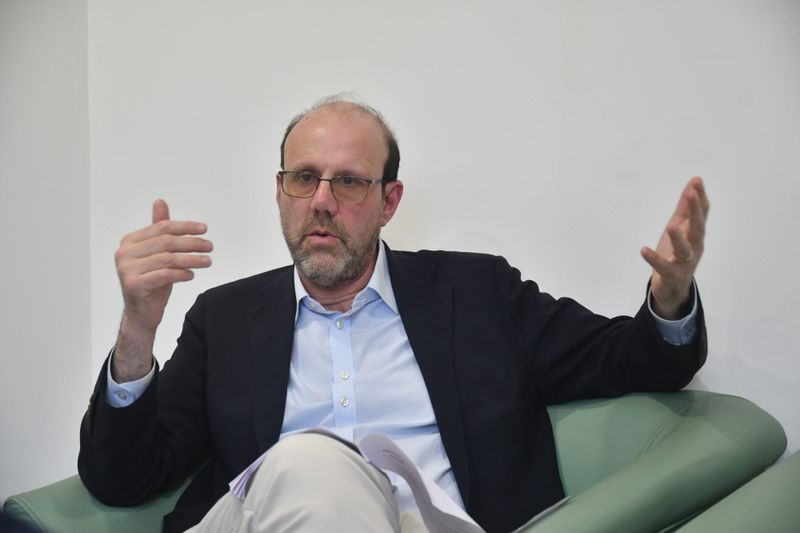

A Nobel laureate in Economics, Michael Kremer, says that artificial intelligence (AI) has the potential to impact public services, and India is well on track to use it for larger public good, be it in agriculture, health or education.Kremer was in the city to speak on “Economics and Policy Innovation in India” at a seminar organised by the Centre for Research in Rural and Industrial Development and the Chandigarh Citizens Foundation. He said India had historically been recording data, which has helped the country leapfrog onto the AI bandwagon much faster than many other countries.In an exclusive interview with The Tribune, Kremer said AI had immense potential in the agriculture sector. “From the real-time weather forecast to pest forecasts, the AI solutions can help a farmer make informed decisions about his crops. In 2025, when the northward progression of the monsoon was delayed, it helped farmers decide on which seed variety would be most favourable in areas where farmers had received advanced information about the weather pattern. They upgraded to using hybrid seeds and opted for transplantation of paddy, rather than direct seeding. When farmers are able to adjust agriculture to match weather patterns, it helps save them money,” he said, adding that farmer incomes increased manifold because of these advance warnings on weather and pest attacks.The eminent economist said though unavailability of data to address problems could deter efforts to usher in an AI revolution, it was not necessarily true for India. “When India had adopted Aadhaar, the data collected for the purpose then has helped the country introduce several AI-based applications now. The Government of India is providing AI-informed monsoon onset forecasts to 38 million farmers. India’s Met Department had been collecting data for decades. I am relatively optimistic that AI methods will continue to upscale agriculture here,” he said.When asked about other areas where AI is being used for larger public good, Kremer said the driver testing software from 3,50,000 drivers, had helped reduce incidents of unsafe driving by 25-30 per cent across India. “In the education sector, Personalised Adaptive Learning (PAL), which uses software to adjust the imparting of education to a student based on his/her level of learning, rather than following a rigid curriculum, has helped improve the learning capacity of children. Programmes that have used PAL in both Rajasthan and Andhra Pradesh have gotten positive results,” he said.The economist-turned-policy adviser to many states has just one piece of advice for the budding economists looking to enter the new AI space and integrate it with economics and apply these to social welfare programmes: “Find issues that you care about and find interesting, and pursue those research areas.”