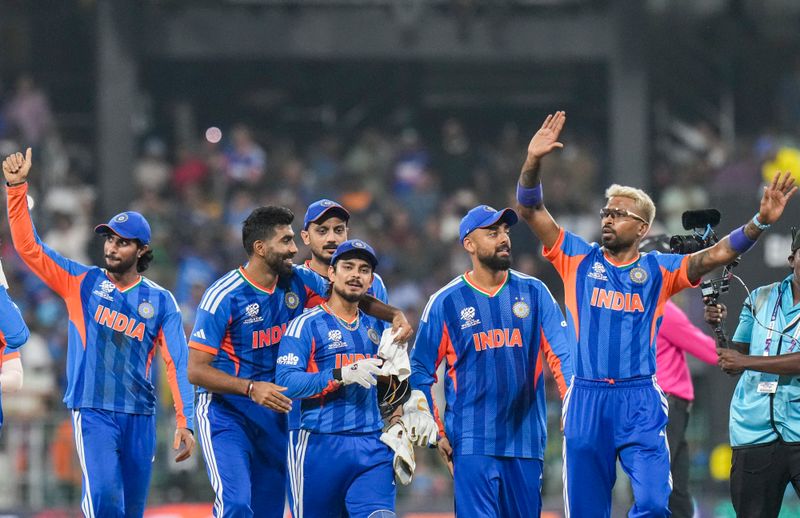
On a surface that demanded craft more than bravado, India won the contest long before the final overs arrived. The pitch was slow, the boundaries long, and timing — rather than raw power — was the currency of the night.“This one’s for India,” captain Suryakumar Yadav told the interviewer after the match, laughing, when asked for his first reaction to beating Pakistan. Nor was there a handshake between the two captains at its beginning, signalling a pragmatic calmness to playing the mother of all matches.India read those conditions early and constructed an innings that looked modest on paper but felt heavyweight in context. It was the kind of total that doesn’t scream dominance, yet quietly tightens the screws on an opponent chasing certainty in a format that offers none.The early exit of Abhishek Sharma could have unsettled the rhythm, but instead it brought the best out of the in-form Ishan Kishan. Staying on the back foot and allowing the ball to come to him, Kishan turned a potential wobble into an early psychological edge with a measured 77 off 40 balls.On a pitch where the ball held up just enough to make cross-batted shots risky, Kishan played late, trusted his hands, and picked his moments to disrupt. It was not a flamboyant innings, it was a functional one — and in T20 cricket, function often beats flourish.Kishan’s knock set the tone for how India would disturb Pakistan’s plans, particularly against spin. By manipulating pace and angles with soft hands and sharp intent, he forced the bowlers to adjust lengths and fields mid-spell.That constant recalibration is poison for a bowling unit in the shortest format, it steals thinking time. The middle overs, usually the zone of consolidation, became a zone of quiet pressure on the fielding side.Contributions from skipper Suryakumar Yadav (32 off 29 balls), Shivam Dube (27 off 17 balls) and the Aligarh boy Rinku Singh (11 not out) carried India to 175 for 7 in 20 overs, a total they would be quietly satisfied with, given the nature of the surface and the longish boundaries.There was no single avalanche of runs, just layers of accumulation. Each cameo had purpose; each boundary felt earned. India didn’t chase an abstract par score. They chased relevance to conditions — and found it.If India’s batting was about assessment, Pakistan’s reply was about misreading the room. The powerplay was the critical passage of play when India took the field, and Pakistan treated it as obligation rather than opportunity.Early wickets by Hardik Pandya (3/16) and Jasprit Bumrah (2/17) dented Pakistan in the powerplay, a blow from which they never fully recovered. There was pace on the ball early, but not enough to justify the shot selection on a surface that punished impetuosity.The result was a string of rushed decisions that played straight into India’s hands. In T20 cricket, the powerplay is not about license alone, it’s about calculated risk. Pakistan’s approach felt less calculated, more compulsory.Pakistan’s innings never quite found a centre of gravity. Their top scorer, Usman Khan (44 off 34 balls), attempted to anchor the chase, but with wickets falling around him and the asking rate creeping north, even consolidation felt like drift.Contributions from Shaheen Afridi (23 off 19 balls) and Shadab Khan (14 off 15 balls) were fleeting, never substantial enough to alter momentum. The chase stalled at 114, undone not by one catastrophic over but by a series of small, accumulating pressures.Sialkot in Pakistan makes some of the finest cricket bats in the world. Sadly, their excellence with the bat seemed to end at manufacturing, not method on this night. There appeared to be little clarity of game plan.Pakistan looked like a batting unit carrying mental scars from an 8-1 losing equation — burdened by history as much as by the scoreboard. Baggage travels fast in this format. Once doubt creeps in, decision-making slows and execution unravels.India’s bowlers understood that defence on this pitch was not about hunting wickets recklessly but about compressing time. Through the middle overs, changes of pace and flatter trajectories squeezed options. Dot balls accumulated. The asking rate crept into the conversation long before it dominated it.What this created was not an immediate collapse but hesitation. Pakistan’s batters were caught between caution and counterattack, never quite able to settle into a rhythm. On a surface where timing was everything and brute force offered diminishing returns, India’s discipline became their biggest wicket-taker. Field placements were conservative but intelligent; singles were contested as fiercely as boundaries. The chase did not implode in one dramatic over — it eroded.While Pakistan await a win to restore belief and momentum, India continue to keep the basics brutally simple. They play the pitch, not the noise around the fixture. They trust roles, not reputations. And they allow Pakistan to play the way they too often do against India — rushed, reactive and stripped of temperament. At this level, it isn’t always superior skill that decides contests, but superior clarity.In the end, the margin wasn’t merely on the scoreboard; it was in the thinking. On a surface that rewarded patience and punished bravado, India played the percentages and Pakistan played the occasion. Rivalries bring memory and emotion into the middle, but T20 cricket has little time for nostalgia. It rewards clarity, punishes confusion, and exposes temperament under pressure. For Pakistan, that remains the unfinished business: learning to play the game in front of them, not the history behind them.