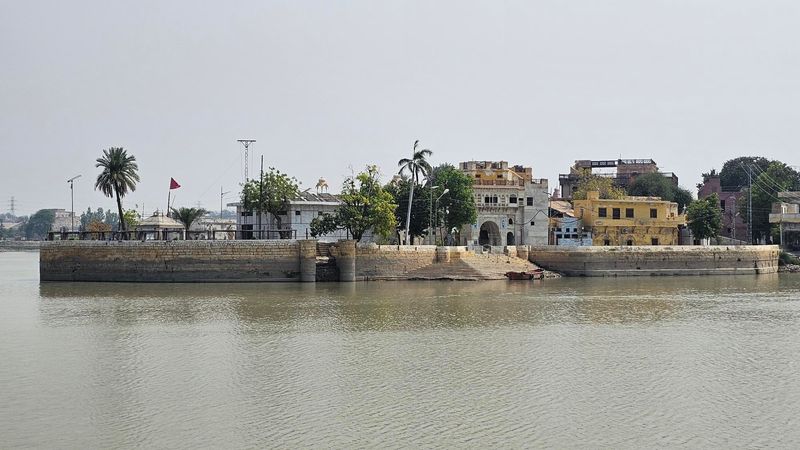

Earlier this week, I travelled South from Lahore, past Multan, beyond Punjab, to Sindh to celebrate Eid with my friend’s family.I have never been to an Udasi Dera (temple complex), so I was fascinated by the opportunity to visit one in the middle of an island on the mighty Indus river (locally called Mehran in Sindhi) near Sukkur, Sindh. Several of my Muslim friends, who are fasting for Ramzan, accompanied me.The temple island is reachable by a short boat ride from the bank of Sukkur city. As the boat moved towards the temple complex, I reflected on its history.Tarunjit Singh ButaliaThis island was once a forested island called Menak Parbat. An Udasi saint, Baba Bankhandi Maharaj, came here in 1823 from Nepal since this place was then a major trading hub on the Indus river. He settled here and renamed it Sadhu Bela, meaning the woods of the saint. He is said to have worshipped the Hindu deity Annapurna. However, according to some sources, Sadhu Bela is named after an Arab commander named “Saeed”, who occupied and was stationed on the island much before the arrival of the Udasi saint.Baba Bankhandi died in 1883. His descendant, Sant Harnam Das, built the main temple, adorned with white marble, in 1899. The complex features intricate marble carvings and murals depicting Hindu mythology, including statues of Hindu deities Radha and Krishna. Many of the plaques are in Gurmukhi, Hindi, Sindhi and Landae.At Partition, the Dera leadership first moved to Kashi and then to Bombay in India. There are Sadhu Bela temples now in both places since then.Today, the island, under the management of the Evacuee Trust Property Board of Pakistan, includes eight different temples, an old library, a large garden, and living quarters for visitors. It is considered one of the most revered Hindu temples of Sindh and is a major centre for the Udasi movement, a syncretic tradition that bridges Hindu and Sikh practices. The temple is particularly active during the anniversary of Baba Bankhandi, a three-day festival featuring prayers, scripture recitations, and traditional rituals.Getting off the boat at the western edge of the island called Raj Ghat, I walk up the steps to a platform to a tall marble-adorned gate. Just to the left of the gate is the all-white marble, square-shaped temple dedicated to Baba Bankhandi. It is beautifully decorated on the outside with chatris, balconies, and murals – all in white marble. The entrance to the temple is on the east side, as is usual with old Hindu temples. In front of the entrance stands a white marble lion facing the entrance.The temple priest provided head coverings for my Muslim friends and led us barefoot into the temple dedicated to Baba Bankhandi. At the far end, in the centre, is a small, recessed room with a large statue of the Baba, with his Kharavan (wooden sandals) placed in front of it. The main room is adorned with paintings of Hindu mythology from the early 20th century and tacky plastic flexes promoting the descendants of the Baba to this day. All around the top is a beautifully carved wooden balcony.To the left, inside the main room, was a covered platform with three large books under silk covers. On inquiring, the priest shared that it was the Bhagavad Gita, Guru Granth Sahib, and the Sakhi (life story) of Baba Bankhandi. It was odd for me, as an observant Sikh, to see the Sikh scripture placed along with other religious books. I decided to read from it. I sat down and opened Sri Guru Granth Sahib to a random page – it was a verse of Bhagat Kabir, which instructed that reading or listening to the Vedas and Puranas will not provide salvation. Before we left the main temple, we were offered water from the Indus river and a date as a blessing.Next, we were escorted to the temple of Srichand, the eldest son of Guru Nanak Sahib. He did not visit this place, but a temple has been built here in his honour since the early 20th century, with his idol in the centre. To the left, in the corner, were statues of deities Shiv and Parvati. What caught my attention was a huge painting of Guru Nanak placed between them. Interestingly, Bhai Mardana, the historically proven ‘rabab’ companion of Guru Nanak, was absent from the painting, while the historically non-existent Bhai Bala was prominently shown seated behind Guru Nanak. Seated around Guru Nanak in front of him, quite far away, were the other nine Sikh Gurus. Interestingly, right in the middle of the painting, prominently in front of Guru Nanak, were seated his two sons, Srichand and Lachmi Chand. This painting was quite representative of the Udasi philosophy of promoting the sons of Guru Nanak over the other Sikh Gurus and reducing the influence of Islamic figures on the Sikh faith.We were then taken to a small temple of the deity Annapurna. To her left were statues of Krishna and Radha. The priest then quoted a verse from Guru Granth Sahib about worship of “Har” for salvation, which he elaborated as worship of the Hindu deity Krishna. It then struck me that when Udasis and some Hindus hear the words “Har” or “Ram” in Guru Granth Sahib, they think of the Hindu deities Hari or Ramchandra. But when Sikhs hear the same word, they think of the almighty God, who is also referred to in Guru Granth Sahib as Vaheguru, Har, Hari, Ram, Allah, Rahim, and Gosain, among others.We then excused ourselves from the temple priest and walked through the rest of the island complex. The towering old library building, with a wooden balcony all around it, is an amazing piece of early 20th-century Hindu architecture.As we were about to leave, the priest offered food in the Langar hall. I politely declined as my Muslim friends were fasting. We boarded our boat from where we were dropped off. We then headed upstream on a boat around the island of Bukkur. After seeing the historic Landsdowne steel bridge built in 1889, we turned the boat around. Soon, we were heading back towards Sadhu Bela when the most exciting moment of the trip happened.A grey dolphin jumped out of the water right in front of the temple island as if paying homage to the Udasi complex. These dolphins are among the world’s rarest mammals, now flourishing in the freshwater of the Indus river.Stepping off the boat was no easy task. The beauty and splendor of the Sadhu Bela Udasi temple as a living place of worship and the homage of the Indus dolphin will forever remain with me.