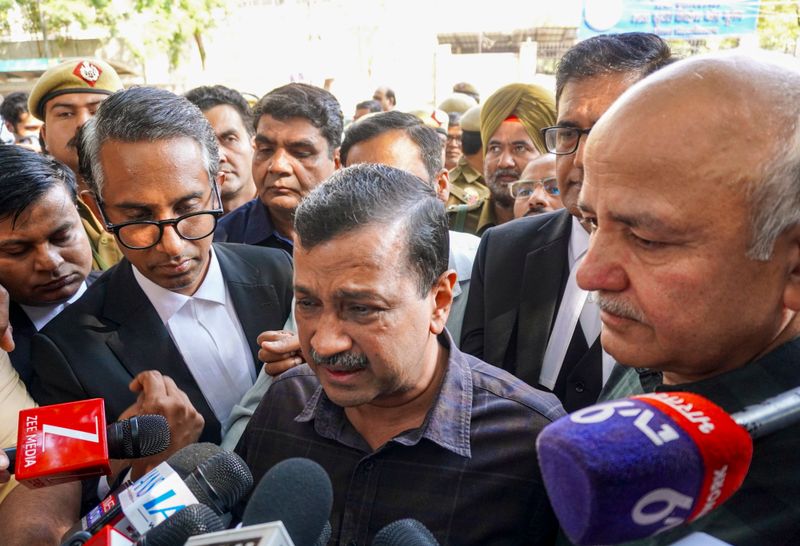

A court on Friday discharged AAP supremo and former Delhi CM Arvind Kejriwal, ex-Deputy CM Manish Sisodia, Telangana Jagruthi founder K Kavitha and 20 others in the alleged excise policy case, holding that the prosecution failed to meet even the basic threshold of suspicion required under the criminal law.In a 598-page order, Special Judge Jitendra Singh of the Rouse Avenue Courts said the case, as presented by the CBI, “was unable to survive judicial scrutiny” and stood “discredited in its entirety”, while directing departmental proceedings against the investigating officer (IO) for implicating an accused without any material.Hours after the order was pronounced, the CBI challenged it in the Delhi High Court. Sources said the appeal was filed against the trial court’s verdict immediately since several aspects of the investigation had either been ignored or not considered adequately.In his first reaction after being discharged in the case, Kejriwal became visibly emotional, calling the court’s decision a moment of “truth prevailing”.Meanwhile, placing the issue of investigation at the centre, the court said accountability could not be deferred where individuals were arraigned without evidence. It specifically flagged the implication of then Deputy Commissioner of Excise Kuldeep Singh, noting there was no material against him.“To permit such conduct to pass without consequence would erode public confidence in the administration of criminal justice and would amount to tacit judicial approval of investigative impropriety, an outcome which the rule of law does not permit,” the court observed.The order dismantled the prosecution case threadbare. It recorded that the material placed on record did not disclose even a prima facie suspicion, far less the “grave suspicion” required for the framing of charges. The court held that the case, as structured by the CBI, “collapses at the threshold”.It said forcing the accused to undergo a full criminal trial in the absence of legally admissible evidence would amount to a miscarriage of justice and an abuse of the criminal process.The court found that there was no material to show that Kejriwal received or facilitated receipt of any bribe. The allegations were based on statements of co-accused or witnesses but lacked independent corroboration. The court also found no documentary or electronic evidence indicating any pecuniary advantage.It held that mere approval of policy decisions, without proof of dishonest intention or quid pro quo, could not attract criminal liability.The court also pulled apart the prosecution’s reliance on an approver, noting that the case against certain accused, including Kejriwal, rested almost entirely on statements made by one Raghav Magunta, without any independent corroboration.It held that these statements amounted to inadmissible hearsay in the absence of supporting documentary evidence, financial trails, or testimony from independent witnesses.Allegations of conspiracy were rejected for lack of evidence showing any meeting of minds. The court reiterated that suspicion, however strong, must be founded on tangible material.“Stated differently, this court records that the theory of an overarching conspiracy, so emphatically projected, stands completely dismantled when tested against the evidentiary record,” the court held.On Sisodia, the court found no material showing demand or acceptance of illegal gratification. It recorded that the CBI failed to establish any direct or indirect financial trail linking him to alleged bribe transactions. The decisions relating to the excise policy were taken collectively, and there was nothing to indicate that Sisodia acted unilaterally or with criminal intent.The court found that the excise policy was the outcome of a consultative and deliberative process. Stakeholders were engaged, procedures were followed and even inputs from the Lieutenant Governor were sought and considered, though not mandatory.“In the absence of policy or demonstrably unlawful implementation, the prosecution theory is reduced to conjecture. Private persons who sought to derive commercial advantage from a policy validly framed and lawfully implemented, without any established violation of policy conditions or statutory prohibitions, cannot be compelled to face the rigours of criminal prosecution,” the court said.The court further observed that the investigation appeared to proceed on a “predetermined trajectory”, implicating nearly every individual connected with the policy to create an “illusion of depth and credibility to an otherwise fragile narrative”. It found that attempts to link the case to the Goa Assembly elections were based more on inference than legally sustainable material.On personal liberty, the court underscored that pre-trial incarceration could not be treated lightly. “Liberty, once curtailed, cannot be meaningfully restored by a subsequent acquittal, nor can the passage of time compensate for the loss occasioned by unwarranted pre-trial detention,” the court said.