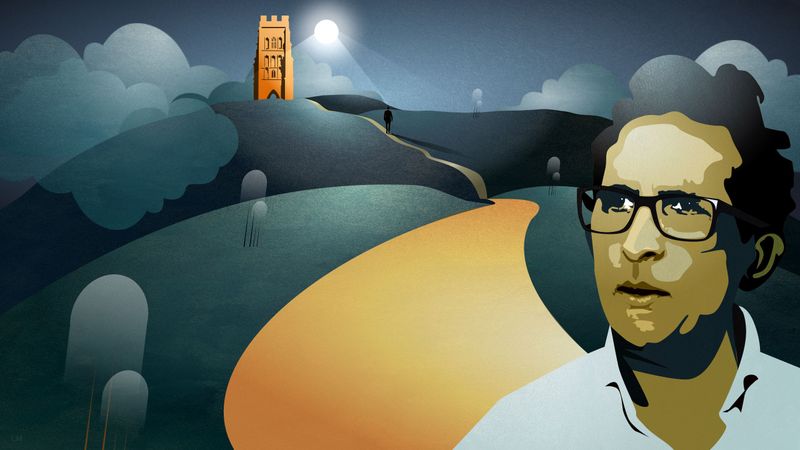
“Last night I dreamt I went to Manderley again.”Daphne du Maurier’s first line from Rebecca has always been admired for its atmosphere. But until last week, I never understood its deeper implication: that dreams can be doorways, that they sometimes open into places we have never consciously chosen, but which may have chosen us.Because last night I dreamt of Glastonbury, a small English town in the west of England, set amid the marshy Somerset Levels, long regarded as one of Britain’s most myth-saturated landscapes, where Christianity, pagan legend, and the Arthurian cycle overlap.Not the festival site.Not the caricature.But something older, a hill emerging through milk-white mist, a single medieval tower upon the summit, and a whisper that did not quite sound like the wind:“Look closely. The land remembers.”I woke with the name clinging to my tongue like an aftertaste.Glastonbury.I had never visited it.Never reported from there.Never studied Arthurian myth beyond childhood curiosity.And yet by noon I was on my way, as though tugged by a thread older than reason.As an Indian journalist, I have stood in places where the divine and the historical intertwine: at Dominus Flevit, the Church of the Teardrop in Jerusalem, where Christ is said to have wept; close to the ghats of Varanasi, where Sarvepalli Radhakrishnan famously told British troops in 1942, “No further. This is not a place to enter with rifles.”Such sites do not merely exist. They summon.These three places — Jerusalem, Varanasi, and now Glastonbury — have nothing in common geographically, yet share a strange kinship: each is a landscape where myth refuses to remain myth.I realised later that they also shared something harder to name at first encounter: a particular quality of light.Not brilliance or radiance, but a soft, diffused light — creamy, almost merciful — as though the landscape were being revealed gently rather than illuminated. A light that does not demand belief, only attention.Why would a dream call someone like me to Glastonbury?This was the question I carried as the skyline of London melted into Somerset fields.The night before the dream, I had been reading Arthurian scholarship idly, almost accidentally. I stumbled on the historian Geoffrey Ashe, whose book The Quest for Arthur includes this line:“Glastonbury is the only place in Britain where legend and topography refuse to disentangle themselves.”I paused at that sentence.India knows this feeling well — in Kurukshetra, in Kashi, in Amritapuri, places where myth lies so close to the soil that to question it is to question the land itself.Maybe that resonance sank deeper than I realised.Maybe something in me — journalist, Indian, seeker — reacted.But the dream felt like more than a reaction.It felt like an invitation.I reached Glastonbury Tor close to dusk.The light was thinning, the fields darkening into outlines. And then — exactly as in my dream — the Tor rose before me, crowned by St Michael’s Tower like a sentinel left behind by another age.The wind cut across the slope, and I heard again the whisper from the dream:“Look closely. The land remembers.”In Arthurian tradition, Glastonbury is described as the Isle of Avalon. Sir Thomas Malory, in Le Morte d’Arthur (1485), writes:“And whether they were alive or dead I wot not; for indeed they were ladies that had a passing great beauty. And they bore him to the valley of Avalon, where is ever the sound of unseen bells.”Unseen bells.It was precisely that sound — faint, metallic, impossible — that brushed past me on the hillside.And for a moment, I felt as though someone were standing at my side.No shadow.No shape.Just a presence.Foreign correspondents pride themselves on scepticism. I have interviewed warlords, presidents, priests, arms dealers. I have seen the ruins of Halabja, the West Bank, Beirut, Kabul. Nothing has ever unnerved me the way that hillside did.Why Would It Speak to an Indian?The historian Ronald Hutton notes in The Stations of the Sun:“Glastonbury is a magnet for those who walk between worlds: historians, mystics, pilgrims, and those who come with questions they do not yet know how to ask.”I once believed I was the opposite of such people, rational, trained to interrogate rather than surrender.And yet it struck me, standing alone on that hill, that Indian civilisation has always accepted that certain locations carry a consciousness of their own. As the Rig Veda says:“He who is awakened in the sacred place finds the gods already awake.”Was I awakened in Glastonbury?Or was Glastonbury awakening something in me?The familiarity startled me, as though I had stepped into a pattern my own culture had prepared me to recognise.Was it Nataraja’s cosmic dance I saw, shimmering over Glastonbury?It is no coincidence that Arthurian scholars often describe Arthur as a “messianic king who waits in the mist.”But what startled me most was how Indian this felt.India has its own king who never died. My widowed Daadi, in her white blouse and matching white sari, used to tell me about Yudhishthira, who ascended bodily into heaven, beyond the reach of ordinary death.In the Mahabharata, Yudhishthira says:“A just king does not die; he merely changes realms.”Arthur.Yudhishthira.Two civilisations, five thousand miles apart, shaping the same mythic pattern — a pattern that deepens when a third, Jerusalem, enters the frame.Arthur waits in the mist.Yudhishthira changes realms.And Jerusalem waits for its own king, the Messiah, whose absence is a presence felt in every stone.Three civilisations, three sacred narratives, each carrying the same archetype in different tongues.Perhaps that is why the dream rose unbidden.Perhaps the subconscious was stitching myth to memory.Or perhaps — and this thought chilled me — some stories pick their listeners across continents.I stood at the summit, looking out across the Somerset Levels — once marsh, once sea — and felt the unmistakable sensation of being watched.Not by people.By a place.Indian sages have a phrase for this: kshetra-chaitanya, the consciousness of a sacred geography.I remembered something the 19th-century saint Ramakrishna said:“There are places where the veil between worlds grows thin, and the divine plays close to the surface.”Was this one of those places?Twilight deepened. The cold tightened around me. I turned to leave — and for the briefest moment, the thought came uninvited:“Why you?Why now?”I cannot answer.Not yet.Travelling back to London, I realised something unsettling.Three cities have now called to me in ways I cannot explain:Jerusalem, where every stone carries a tear.Varanasi, where time folds into eternity.Glastonbury, where myth breathes through the mist.I did not seek out any of them.Each called me in its own way.And I am beginning to wonder whether certain people — perhaps foreigners, perhaps those who walk between histories — are more susceptible to such calls.As the Irish poet WB Yeats once wrote:“The world is full of magic things, patiently waiting for our senses to grow sharper.”Last week, on a lonely English hill, my senses sharpened in ways I did not ask for.I do not claim revelation.I claim only the truth of what I felt: that the land remembered something,and for a moment,it remembered me.Perhaps my dream was only the echo of a tired mind.Perhaps it was the land.Perhaps it was the king who sleeps.Perhaps it was nothing at all.But I know this much:When a place rooted in myth calls across a continent to someone who carries memories of Indian sacred geography, something is happening beneath the surface.I left Glastonbury with only one certainty: This story has not ended.It has only begun.If even one line of this account unsettles with recognition — if any reader has ever dreamt of a place they had no reason to know, ever felt a landscape turning toward them as though acknowledging their arrival — then this story is no longer mine alone.Indians grow up with an intuition for such things; the ancients taught us that when a kshetra calls, it calls the ones who can hear across lifetimes.If something in Glastonbury’s whisper has reached others through these words — a shiver, a memory, a summons not quite articulate — then note it. Do not turn away.Some invitations come only once, and some messages reveal their purpose only when echoed by others who encounter the same pattern.Perhaps the land that remembered me has begun, quietly, to remember others as well.Shyam Bhatia, London