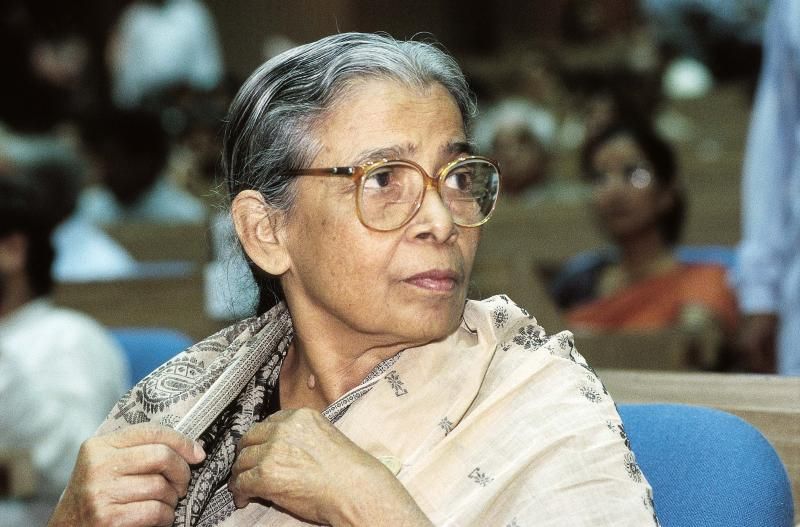

THE ashes of Mahasweta Devi are laid in a memorial I created for her at the Adivasi Academy at Tejgadh in Gujarat. The plaque has her immortal words inscribed on it: “Every dream has the right to live.” She had often expressed her desire to live there forever. On January 14 this year, she would have been hundred.Born in 1926, she had passed through the fervour of the freedom struggle. Schooled at Santiniketan, she had seen Gurudev and been through the cultural strands in the environs there. Married to Bijon Bhattacharya — an avowed Communist — she had known the entire IPTA range and knew what Communism meant. In her more mature years, she had been involved in various movements in Bihar, Jharkhand, Bengal, Rajasthan and Manipur; but it was difficult for any of these movements and trends of thought to keep her ideologically straight-jacketed.Mahasweta Devi chose when to act, and she acted out of her own analysis of what justice was in a given case. Her analysis was quite often driven by a deep compassion for the silenced, the marginalised.All through her turbulent times, she retained peculiar traits. She had an unsettling sense of humour. It was not any black humour. Rather, she would let out a comment with the seeming gentleness of a Victorian lady, which could get the listener simply floored. She had in her the innocence of a teenage village girl, a naivety that was difficult to diagnose. She also had a temper impossible to match, and impatience with snobbery which quickly unmasked even the most reputed ones. And, finally, she had an incurable fondness for the old Khurshid songs. It was difficult to say when she would break out singing and render a number like “Mere balpan ke saathi, bhul naa jaana”.It was impossible to predict when in the middle of the most polite conversation with persons she had not previously met, she would curtly dismiss civility and tell the person that he was a fraud. The social standing and position of a person did not deter her. But, it was her innocence that stood out the most; and it brought tears to one’s eyes.She was one of the most remarkable writers of the 20th century. Apart from Tagore, I am not aware of any other Indian author whose complete works were picked up for translation in Italian, German, French and several other languages. Major films were made based on her stories by some of the greats in Indian cinema. But, she had her own assessment of her literary works; and never asked for praise. She deeply detested if anyone tried to praise her writings. If at all she had to listen to any praise, she used to remain completely silent and just kept staring at the speaker with a mix of a smile and a ‘not me’ sort of self-effacing gesture.The desire to live forever was for fighting injustice. There was no instance of injustice that did not leave her infuriated. Her activism did not spring from ideological positions. Though profoundly political, she did not swear by any known political philosophy or movement. Her activism sprang out of an instinct that is difficult to pinpoint.There was something strange about her ability to use the spoken word. Often she addressed audiences outside Bengal in Hindi. If one went by the rules of grammar, most of her sentences could be faulted. Yet, she managed to mesmerise audiences. She combined in her lectures a self-effacing humility and a steely determination, simplicity of words and complexity of ideas, leaving those who listened to her completely changed.She had a strange appeal like Mahatma Gandhi had. It changed you altogether by a nameless force beyond words.I met her when she was 72, already a legend in India and beyond, with a Magsaysay, a Jnanpith and a Padma Shri. Yet, as we came closer, as she developed the practice of spending a week or 10 days in Baroda, staying with my wife and me, we realised how difficult her life had been and still was. For instance, even at the age of 75, Mahasweta Devi did not have a house of her own. She continued to stay in a rented house near the Ballygunj station and had to climb the flight of winding stairs to get into her flat. Her marriage had not been easy, and her relationship with her son, a remarkably gifted poet, had not exactly been what it could be.When she was with us, in the anonymity and privacy of her new-found home in Baroda, she came across as a lonely and a hugely misunderstood woman, much sinned against. Yet, she did not succumb to self-pity, nostalgia or fantasy.She was a realist to the core, and a crusader first and a crusader forever.— GN Devy is a writer and cultural activist