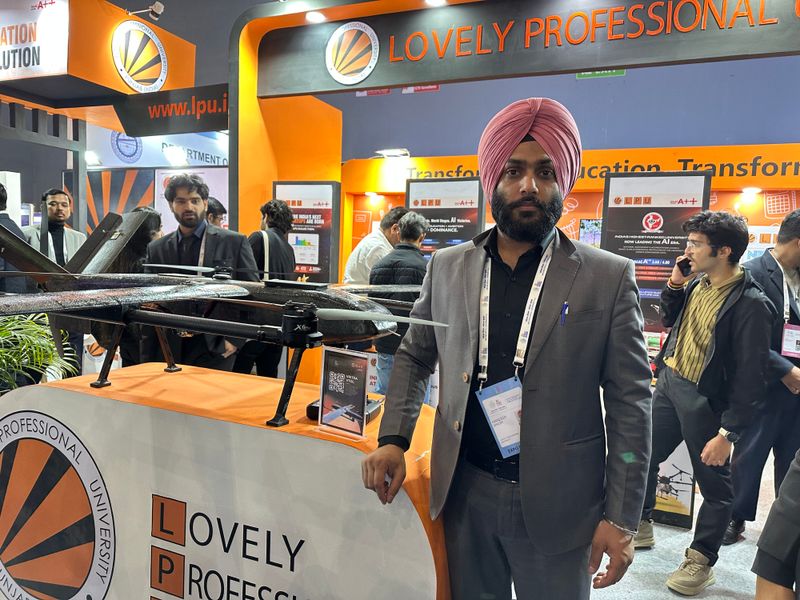
Even as the Galgotias robot dog controversy dominated headlines at the India AI Impact Summit, the wider exhibition floor told a different story, one of indigenous engineering, applied AI and grassroots innovation steadily shaping India’s technology narrative.Leading the defence and drone segment was Lovely Professional University (LPU), which showcased a suite of in-house developed, though largely assembled, unmanned systems built for military, infrastructure and agriculture applications.Mandeep Singh, Asistant Dean at LPU, said the university had been working with the Army to design mission-specific drone platforms. “We have collaborated closely with the Army to build drones suited to operational requirements, including during Operation Sindoor,” he said.Among its key platforms was VTOL VRITRA, an AI-enabled hybrid unmanned aerial vehicle combining vertical lift with fixed-wing endurance for surveillance, disaster response and logistics missions. Another system, Agent Harvest, deploys AI-driven aerial imaging to detect crop disease and enable precision spraying. LPU also demonstrated inspection robotics such as MEK-HEX, designed for wind turbine maintenance using AI vision and electromagnetic adhesion to climb metallic towers and tighten bolts autonomously.Beyond drones, deep-tech robotics startups drew strong attention. Hyderabad-based xSpecies AI showcased full-stack robotics platforms aimed at building general-purpose machine intelligence. Founder and CEO Srikanth Vidapanakal said the company was focused on replicating core human capabilities such as manipulation, locomotion and navigation.“I wouldn’t call it 100 per cent India-made, because actuators are imported. But the design, electronics and AI software are built in-house,” he said. The company is developing multiple platforms, including humanoid systems, quadrupeds and dexterous robotic hands, with logistics and warehousing identified as entry markets before eventual home deployment.Education-led AI innovation formed another strong pillar of indigenous showcasing. At the pavilion of Miraai, programme manager Asiya outlined an AI-first higher-education model blending university curriculum with hands-on technology development. Partner institutes run dual-track learning, formal academics alongside lab-based robotics and AI training.“In a seven-hour class, two hours are university curriculum and five hours are spent building real projects,” she said, pointing to functional prototypes built by first-semester students.One demonstration included an AI learning assistant using facial recognition login and curriculum-focused query responses, designed to keep students academically aligned rather than distracted on open platforms.Grassroots STEM innovation was also equally visible. Ahmedabad-based Stempedia presented modular robotics kits enabling school students to assemble, code and operate functional robots. Representative Pranay Kanjani said the platforms teach mechanical systems, calibration and programming through hands-on builds. “Students assemble and code robots themselves — that’s how they understand motors, mechanisms and automation,” he said.The kits support block coding, Python, C++ and AI modules, spanning applications from pick-and-place arms to claw robots, targeting learners from kindergarten to senior school. Collectively, these exhibits underscored a broader shift at the summit, from spectacle to substance.