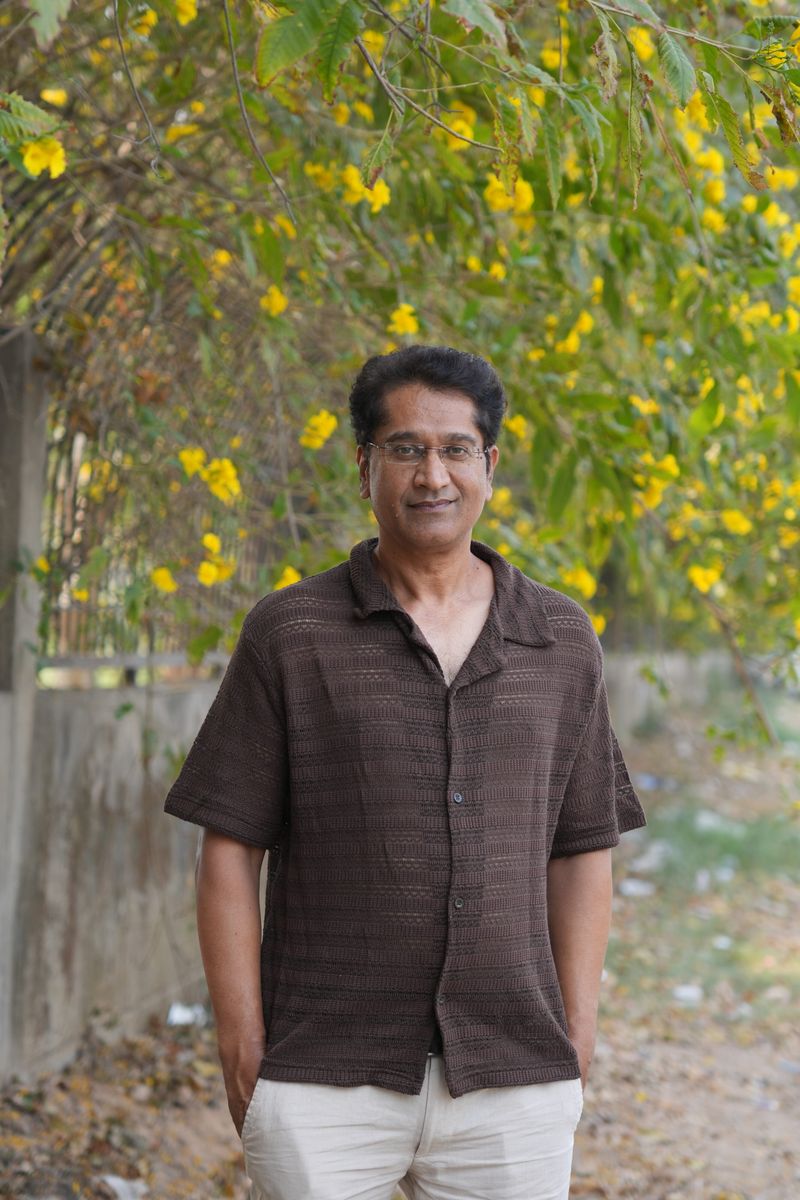

National Award-winning filmmaker Rajeev Kumar is not one to follow the conventional path. With his latest film Budh Singh, the director once again turns his lens towards layered storytelling — this time exploring mental health, corruption and the quiet struggles of the common man.National Award-winning filmmaker Rajeev Kumar is not one to follow the conventional path. With his latest film Budh Singh, the director once again turns his lens towards layered storytelling — this time exploring mental health, corruption and the quiet struggles of the common man.In a candid conversation, Rajeev traces the origins of Budh Singh. “My journey began with Ravi Inder Sheen, who plays the lead,” he shares. “I know him for many years. He was a very good actor, though he later became a music director. He always told me, ‘Give me a chance in acting.’ I kept telling him — wait, I will offer you something when I find the right character.”That character came to Rajeev through literature. The film draws inspiration from a story by writer Anjana Shivdeep. “I read the story Do Dhruvan Te Vichardian. It dealt with mental health and the life of a very honest man stuck in a corrupt system,” Rajeev explains. “We evolved that idea cinematically — how such a person processes reality, what kind of realisation he reaches, and whether it is society or circumstances that push him to the edge.”At its core, Budh Singh is a reflection on the pressures of modern life. “We wanted to ask — why can’t two hardworking people live a good, honest life? Is it their fault, or the fault of the system?” he asks. “Mental health and political corruption are realities we don’t often address in Punjabi cinema. We tried to explore both.”The film, shot across Punjab and Himachal Pradesh, is also deeply rooted in Rajeev’s journey. “We shot a large part in my hometown, Mullanpur Dakha in Ludhiana district,” he says. The setting adds authenticity to a story that is as much about place as it is about people.Cinematically, Budh Singh takes inspiration from global masters. Rajeev reveals he paid tribute to celebrated filmmaker Wong Kar-wai. “There’s a surreal quality in his work that fascinates me. We tried to recreate that feeling — when Budh Singh enters a normal situation, it feels like he is moving through a tunnel,” he explains. “It’s a visual way of expressing his mental state.”Unlike mainstream Punjabi films, Budh Singh did not opt for a traditional theatrical release. Instead, it premiered on Cable One, a move Rajeev believes reflects changing audience habits. “There is a myth that without a popular actor, a film cannot survive,” he says. “But OTT and digital platforms have changed everything. Today, content is the main driver.”Rajeev is particularly vocal about the economics of filmmaking. “In a Rs 10 crore film, Rs 4–6 crore often goes to big actors,” he points out. “But that doesn’t guarantee success. Last year, around 49 Punjabi films were made, and nearly 45 of them failed. The success rate was barely seven to eight per cent.”For him, the solution lies in rethinking priorities. “The focus should be on a strong script, good direction, and talented actors — not just famous faces,” he insists. “If you reduce production costs and invest in content, the chances of financial viability improve.”This philosophy has guided his own work, including the film Nabar: A Rebel with a Cause, which earned him the National Award in 2013. The recognition, he says, reinforced his belief in meaningful storytelling. “Awards like that are encouraging, but they also remind you of the responsibility you carry as a filmmaker.”With over three decades in the industry, Rajeev has witnessed the evolution of Indian entertainment first hand. “I started nearly 30 years ago, making documentaries after I passed out from Panjab University at the age of 24,” he recalls. “I worked extensively in television.”After spending over two decades in Mumbai’s television ecosystem, Rajeev is now exploring new avenues, including OTT platforms. He also teaches at various universities, passing on his experience to the next generation.For Rajeev, the post-pandemic era has opened new doors for storytellers. “After Covid, audiences have been exposed to world cinema through OTT. They are watching Malayalam films, European cinema, Latin American stories,” he says. “The audience today is not limited by geography — they want good content.”This shift, he believes, is a turning point. “It’s the right time for talented actors, directors and creators. People are ready to support meaningful work,” he says. “Earlier, big names dominated decision-making. Now, there is space for new voices.” Budh Singh is also being dubbed in multiple languages, expanding its reach beyond Punjabi-speaking audiences. “Good content travels,” Rajeev says simply. “If the story connects, language is not a barrier anymore.”At a time when the industry often leans towards formula, Rajeev stands firm in his belief, “Ultimately, it is not about how big the star is — it’s about how honest the story is.”With Budh Singh, he hopes to spark not just conversations, but also a shift in how Punjabi cinema approaches storytelling — one rooted in reality, responsibility and creative courage.