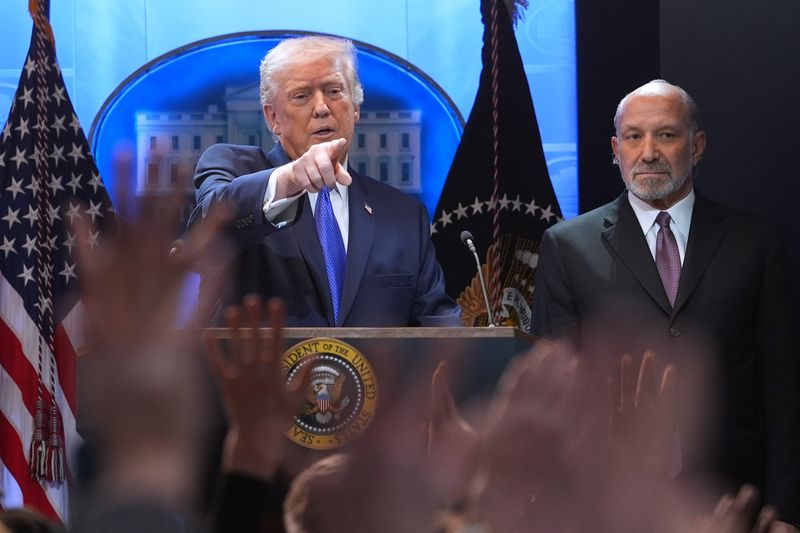
US President Donald Trump said “nothing changes” in the trade deal with India in the wake of the Supreme Court verdict against his sweeping tariffs, as he responded to the ruling by announcing an additional 10 per cent global levies on items imported into the US.In a major setback to Trump’s pivotal economic agenda of his second term, the US Supreme Court, in a 6-3 verdict written by Chief Justice John Roberts, ruled that the tariffs imposed by Trump on nations around the world were illegal and that the President had exceeded his authority when he imposed the sweeping levies.Trump criticises the courtTrump lashed out at the Supreme Court justices who ruled against him, calling them “fools and lapdogs”. He termed the ruling limiting his use of tariff powers under the International Emergency Economic Powers Act (IEEPA) “deeply disappointing”.“The Supreme Court’s ruling on tariffs is deeply disappointing, and I’m ashamed of certain members of the Court, absolutely ashamed for not having the courage to do what’s right for our country,” Trump said in a news conference at the White House Friday, just hours after the verdict came in.He thanked Justices Clarence Thomas, Samuel Alito and Brett Kavanaugh for their dissenting opinions, praising what he called their “strength, wisdom, and love of our country.”Trump accused unnamed justices of being influenced by political considerations and foreign interests, claiming that countries he has previously targeted with tariffs were “ecstatic” over the decision. He also criticised what he described as opposition from “Democrats on the Court,” though Supreme Court justices do not formally affiliate with political parties while serving on the bench.Tariff powers and broader executive authorityThe ruling restricts the President’s ability to impose certain tariffs under IEEPA, but Trump argued that it leaves intact broader executive authority to regulate trade through other laws.He described the case as symbolically significant for economic and national security reasons and said he had been “very modest” in his earlier tariff demands to avoid influencing the court’s deliberations.The President cited recent stock market milestones, including the Dow Jones Industrial Average crossing 50,000 and the S&P 500 reaching 7,000, as evidence that his tariff strategy has strengthened the economy.India trade deal unaffectedAt the news conference, Trump again repeated his claim that he had solved the war between India and Pakistan last summer using the threat of tariffs, asserted that New Delhi, at his request, “pulled way back” from buying Russian oil and said that the ruling would have no effect on the trade deal that Washington and New Delhi announced earlier this month.He also spoke about his “great” relationship with Prime Minister Narendra Modi.When asked whether the framework for an interim agreement on trade with India, expected to be signed soon, stands in the wake of the Supreme Court ruling, Trump said “nothing changes”.“Nothing changes. They’ll (India) be paying tariffs, and we will not be paying tariffs. So deal with India is they pay tariffs. This is a reversal for what it used to be. As you know, India and I think Prime Minister Modi is a great gentleman, a great man, actually, but he was much smarter than the people that he was against in terms of the United States, he was ripping us off. So we made a deal with India. It’s a fair deal now, and we are not paying tariffs to them, and they are paying tariffs. We did a little flip,” Trump said.“The India deal is on… all the deals are on, we’re just going to do it” in a different way, Trump said.To another question on his relationship with India, he said, “I think my relationship with India is fantastic and we’re doing trade with India. India pulled out of Russia. India was getting its oil from Russia. And they pulled way back at my request because we want to settle that horrible war where 25,000 people are dying every month,” Trump said. He said his relationship with Prime Minister Modi “is, I would say, great.”Earlier this month, as the US and India announced they reached a framework for an Interim Agreement on trade, Trump issued an Executive Order removing the 25 per cent punitive tariffs imposed on India for its purchases of Russian oil, with the US President noting the commitment by New Delhi to stop directly or indirectly importing energy from Moscow and purchasing American energy products.Under the trade deal, Washington would charge a reduced reciprocal tariff on New Delhi, lowering it from 25 per cent to 18 per cent.Trump repeats claims tariffs ended India-Pakistan conflictTrump then went on to repeat the claim, twice within the press conference, that he stopped the war between India and Pakistan using tariffs.“Tariffs have been used to end 5 of the 8 wars. I settled 8 wars whether you like it or not, including India and Pakistan. Big ones. Could have been nuclear. Prime Minister of Pakistan said yesterday at the great meeting we had the peace board. He said President Trump could have saved 35 million lives by getting us to stop fighting. They were getting ready to do some bad things. But they have given us great national security, there tariffs have,” said Trump.“To show you how ridiculous the opinion is,” Trump said, “the court said that I’m not allowed to charge even $1 to any country under IEEPA, but I am allowed to cut off any and all trade or business with that same country, even imposing a foreign country–destroying embargo.”Court reasoning and alternative statutesHe argued that the court’s reasoning creates an illogical distinction between licensing authority and the ability to charge fees for such licenses. However, Trump maintained that the decision ultimately confirms a President’s broader powers to block, embargo or restrict trade.Quoting from Justice Kavanaugh’s dissent, Trump noted that other federal statutes — including Section 232 of the Trade Expansion Act of 1962, Sections 122, 201 and 301 of the Trade Act of 1974, and Section 338 of the Tariff Act of 1930 — provide alternative authority for imposing tariffs.Existing tariffs remain in force and new temporary import dutyEffective immediately, Trump said, all existing national security tariffs under Section 232 and Section 301 would remain in force. “The Supreme Court did not overrule tariffs… They merely overruled a particular use of IEEPA tariffs,” said Trump. He asserted that the ruling would ultimately strengthen Presidential trade powers and increase revenue and protection for American businesses.Within hours of the Supreme Court ruling, Trump signed a Proclamation imposing a “temporary import duty” to “address fundamental international payments problems” and “continue the Administration’s work to rebalance our trade relationships to benefit American workers, farmers, and manufacturers.”The Proclamation imposes, for a period of 150 days, a 10 per cent ad valorem import duty on articles imported into the United States. The temporary import duty will take effect on February 24 at 12:01 am. — with PTI