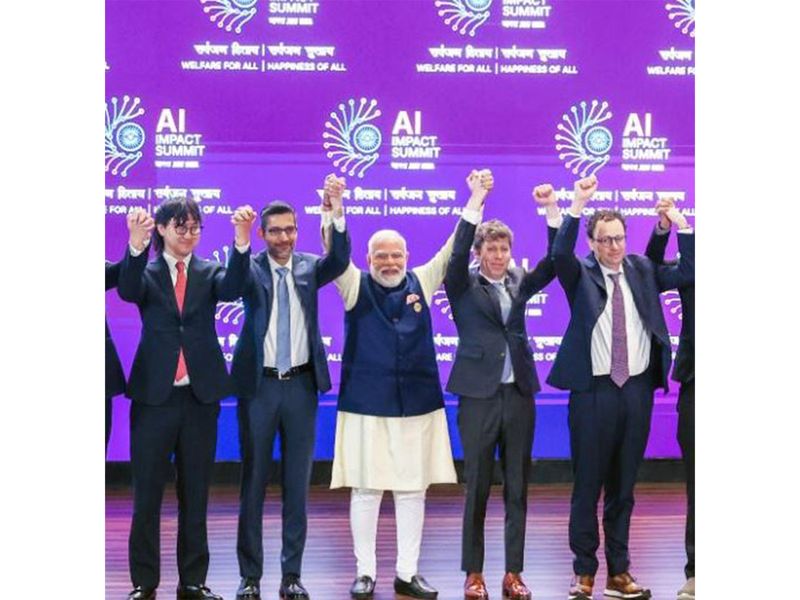
Prime Minister Narendra Modi on Thursday sought global standards for artificial intelligence and advocated strong ethical commitments as the cornerstone of the world’s AI development and governance architecture.Inaugurating the India AI Impact Summit at Bharat Mandapam, where he later addressed the Leaders’ Plenary, PM Modi batted for democratisation of AI and unveiled India’s MANAV vision for the segment.In the presence of world leaders, including UN Secretary-General Antonio Guterres, French President Emmanuel Macron, Brazilian President Luiz Inacio Lula da Silva, Swiss President Guy Parmelin and who’s who of the AI world, Modi elaborated the human-centric acronym. “I present the MANAV vision for AI where M stands for moral and ethical systems, A for accountable governance, N for national sovereignty, A for accessible and inclusive; and V for valid and legitimate,” said the PM, noting that India’s MANAV vision for AI would become a vital link to the welfare of mankind.Speech translated In Sign Language Using AIPM Modi’s speech on Thursday included real-time translation in the sign language using AI, reflecting India’s commitment to inclusion. “We will always work to ensure that technology and public discourse are accessible to persons with disabilities,” PM said. The speech was also dubbed live in 11 Indian languages: Assamese, Bangla, English, Gujarati, Kannada, Malayalam, Marathi, Odia, Punjabi, Tamil and Telugu.Who attended meetSri Lanka President Anura Kumara Disanayaka, Bhutan Prime Minister Tshering Tobgay, Mauritius Prime Minister Navinchandra Ramgoolam, Croatia Prime Minister Andrej Plenkovic, Serbia President Aleksandar Vucic, Estonia President Alar Karis, Finland Prime Minister Petteri Orpo and Seychelles Vice-President Sebastien Pillay were among the leaders at the event. Among CEOs there were Google’s Sundar Pichai, OpenAI’s Sam Altman, Anthropic’s Dario Amodei, Google DeepMind’s Demis Hassabis, Adobe’s Shantanu Narayen and Meta’s chief scientist Alexandr Wang.Without naming any country, Modi made a compelling case for transparency in AI. “Just as sunlight is the best disinfectant, transparency is the best security. Some nations and companies believe AI is a strategic asset, so it should be confidentially developed. But our thought is different. We believe AI will be beneficial to the world when it is shared, when codes are opened…. AI should be developed as a global common good,” the PM said, adding that India saw destiny, not fear, in AI revolution.Modi also cautioned against deepfakes, saying fabricated AI content was destabilising open societies and called for watermarking of AI-generated content. He further urged AI companies to look beyond profits.“AI companies carry a major responsibility to focus not only on profit, but also on purpose,” the PM said, underscoring the need for strong ethical commitments. He said since the scope of unethical behaviour in AI was unlimited, “ethical norms for AI must also be unlimited”.As top minds debated the future of AI, PM Modi said authenticity labels should accompany digital content to enable people to know “what’s fabricated and what’s real”.“Watermarking and clear source standards in the AI world are imperatives. It is necessary that trust is inbuilt in technology. We also have to be more alive for children’s safety. Just as school syllabus is curated, AI space should also be child-safe and family-guided,” the PM said.His three suggestions for ethical AI were–AI training must respect data sovereignty; AI platforms must keep their safety rules clear and transparent; and AI must be guided by clear human values.While stressing the importance of India, home to one-sixth of the humanity, hosting the largest AI Summit, Modi urged prioritisation of Global South when the future of AI was discussed.Recalling how humanity had always turned disruptions into opportunities, the PM invoked Lord Buddha’s “Right action comes from right understanding” teaching to stress the importance of creating a roadmap that ensured AI’s positive impact through timely, well-intentioned, correct and human-centric decisions.