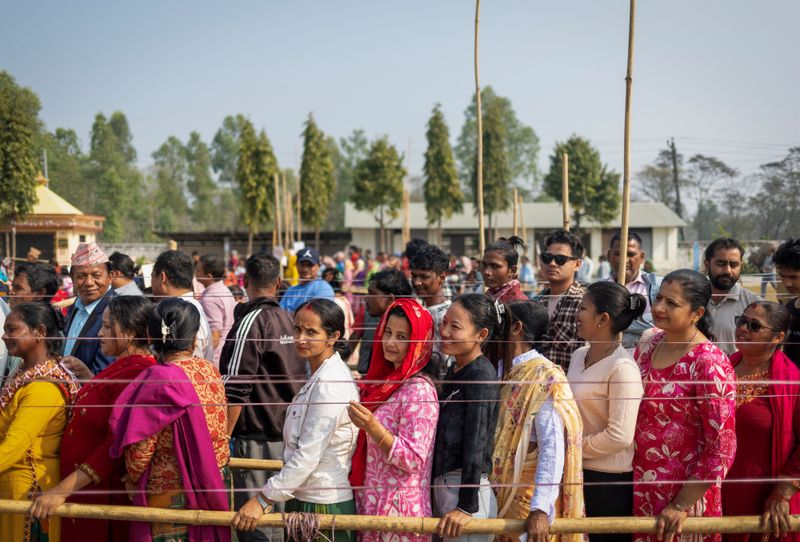

Nepal voted on Thursday in a crucial parliamentary election, widely seen as a test for the country’s traditional political parties following last year’s sweeping youth-led protests that toppled the government and reshaped the political landscape.Polling began at 7 am across the Himalayan nation, with voters lining up early at thousands of polling stations to elect members to the 275-seat House of Representatives, the Lower House of the federal parliament. Authorities said voting was largely peaceful during the day.According to Nepal’s Election Commission, around 6 per cent of voters had cast their ballots by 9.30 am, rising to 10.18 per cent by 11 am, about 18 per cent by noon, and roughly 33 per cent by 2 pm as turnout gathered pace across the country.Nearly 18.9 million registered voters are eligible to participate in the election, which will determine the composition of Nepal’s next government at a time of deep public dissatisfaction with political instability, corruption and unemployment.The vote marks Nepal’s first national election since the massive youth-led protests last year that forced the collapse of the government headed by former Prime Minister KP Sharma Oli. The demonstrations — driven largely by younger voters frustrated with corruption, poor governance and limited job opportunities — triggered a major political reset and brought calls for sweeping reforms.Nepal follows a mixed electoral system. Of the 275 parliamentary seats, 165 members are elected directly through the first-past-the-post system, while 110 seats are allocated through proportional representation based on nationwide party vote share.The contest is widely seen as a three-way fight between established political forces and a rising new movement seeking to capitalise on public anger against the political establishment.Among the main contenders are the Communist Party of Nepal (UML) led by former Prime Minister KP Sharma Oli and the Nepali Congress, one of the country’s oldest political parties. Both face an energetic challenge from the relatively new Rastriya Swatantra Party led by Kathmandu mayor Balendra Shah, popularly known as Balen.Shah, a rapper-turned-politician who rose to prominence after winning the Kathmandu mayoral election, has drawn strong support from younger voters and urban constituencies. His campaign has focused on transparency, administrative reforms and breaking what he calls the monopoly of traditional political elites.Other parties in the fray include the Communist Party of Nepal (Maoist Centre) led by former Prime Minister Pushpa Kamal Dahal, also known as Prachanda, along with several regional parties representing Madhesi and other communities. Analysts believe smaller parties could play a crucial role in coalition negotiations if no single party secures a majority.Political instability has long been a defining feature of Nepal’s politics, with frequent government changes since the country adopted its new constitution in 2015 and transitioned to a federal democratic republic.Key issues dominating the campaign include unemployment, corruption, economic slowdown and governance reforms, as well as managing Nepal’s delicate diplomatic balance between neighbouring India and China.Initial counting began soon after the polling closed, though final results could take several days due to the proportional representation vote tabulation. The outcome is expected to determine whether Nepal’s entrenched political parties retain their dominance or whether the post-protest political mood propels new forces into power.