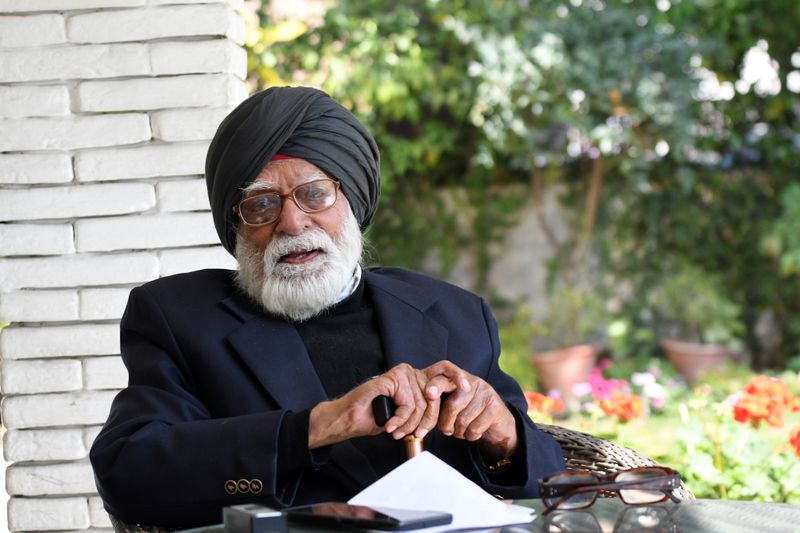
As former CBI Director Jagjit Singh Bawa turns a hundred years old on Saturday, the police officer remembers clearly how his life collided with key turning points in the life of the country, including the time he decided to pay his last respects to former Prime Minister Indira Gandhi, when New Delhi resounded with slogans like “gaddaron ko goli maaro” in the wake of her assassination in October 1984.In an interview with The Tribune at his home in Sector 18, Chandigarh, Bawa says he remembers clearly the day she was killed. He and Home Secretary MMK Wali were attending a CRPF passing-out parade when they received separate calls. They immediately left for their offices as Delhi erupted in violence.That evening, while heading home, Bawa was repeatedly diverted from Khan Market, Lodhi Road and other roads close to the former PM’s residence that were cordoned off by the police. Hours later, he reached a friend’s residence and stayed there until 11.30 pm, when the Delhi Police Commissioner sent a vehicle with escort to take him home.On police advice, he remained at home for three to four days. Yet, deeply upset, he decided he would go to the late PM’s house to pay his last respects. He managed to reach her residence as Delhi resounded with slogans like “gaddaron ko goli maaro…”When the Cabinet Secretary saw him there, he remarked, “Brave of you to come here.” The visit made headlines and spread rapidly. Several Sikh colleagues called Bawa, asking whether they too should join the final journey. “I told them they could come at their own risk,” he told this reporter.A 1951-batch Punjab-cadre IPS officer, the sprightly Bawa, who leads an active social life in Chandigarh, including playing bridge five times a week and meeting friends, especially at the Golf Club, vividly recalled his first meeting with Indira Gandhi after she returned to power again in 1980, following the defeat of the three-year Janata Party government led by Morarji Desai. “Her first and straight order to me was, ‘disband the CBI’,” Bawa said, admitting to being taken aback at the directness of her statement. She went on to calmly ask him how he would carry out his order.Bawa, who went on to serve as one of the longest-serving CBI Directors from 1980 to 1985, sought a day’s time to study its constitutional and legal implications. The following day, he returned with a detailed dissent note, strongly advising against disbanding the agency. He reminded the PM that the CBI had been created by Jawaharlal Nehru with the consent of all states, since law and order is a state subject.“I told her you can disband the CBI with a single order, but once it is gone, you will never be able to restore or recreate it, even if you want to,” Bawa said.On receiving his note, Indira Gandhi called the Cabinet Secretary and Home Secretary. She was clearly upset with the CBI’s functioning during the Janata Party government and believed the agency had targeted the Congress, especially her son Sanjay Gandhi.Both senior officials endorsed Bawa’s stand. After several days and rounds of intense discussions, the PM finally withdrew her order. “It was not easy or simple,” Bawa says. “But the CBI was saved.”What eventually changed her mind, he adds, was his suggestion to reform and reframe the CBI instead of disbanding it.Even then, Indira Gandhi was in no mood for further compromise. She handed Bawa a list of CBI officials who, she believed, had targeted Congress leaders during Morarji Desai’s government and ordered they be dismissed.Bawa again resisted. He warned that mass dismissals without valid reasons would cause a major uproar. After sustained persuasion, he managed to convince her to allow large-scale transfers instead.That decision, too, triggered protests and resentment within the agency. Bawa tackled the crisis by personally calling the affected officers and offering them postings of their choice outside the CBI. He made it clear they could no longer remain within, that the Prime Minister wanted them dismissed, and this was the most he could do.“This broke the ice,” he says. Most officers returned to their parent states and chose postings of their preference.Bawa describes Indira Gandhi as “very authoritative, very decisive, very straightforward, and at times very harsh and very angry.” From 1980 until her assassination in 1984, he met her at least once a week, and often two or three times.As CBI Director, Bawa was also at the helm during Operation Bluestar in June 1984. Though not directly involved, he says Indira Gandhi discussed Punjab and terrorism with him several times and sought his advice.“I repeatedly told her, do whatever you want. Impose curfew, stop supplies, do anything, don’t send the Army or the police into the Golden Temple,” he told this reporter.“The operation was avoidable. Indira Gandhi seemed to have been misled by certain agencies into believing that ‘Khalistan’ could only be stopped through military action inside the shrine. She was deeply concerned about Punjab and wanted to save it at any cost,” he says.Asked about the secret of his longevity and good humour, Bawa said his life’s motto comes from the Tenth Guru, Guru Gobind Singh: “Deh Shiva Bar Mohe Eha, Shubh Karman Te Kabhu Na Taron” — a prayer for courage to always walk the path of righteousness.Born in Multan on February 21, 1926, in undivided Punjab, Bawa graduated with honours in history from the illustrious Government College, Lahore, in 1945. His name remains inscribed in its Academic Roll of Honour. He was pursuing his LLB at Law College, Lahore, when Partition forced him to migrate to India. He later completed his law degree with first-class marks from Panjab University’s Law College in Shimla in 1949.Partition remains etched in his memory. His father, a PCS officer, served as Deputy Commissioner in several districts of undivided Punjab. The family had a home in Amritsar and was among the first to migrate from Pakistan. “It was bloody, horrible and gruesome,” Bawa recalls. “We saw vehicles loaded with bodies passing through. Our home sheltered many relatives and refugees.”Appointed to the IPS in 1951, Bawa served as the district police chief in several districts, headed Punjab CID as DIG, was promoted to IG in 1971, and received the highest police distinctions during his 34-year career. In 1977, his services were requisitioned by the Centre and he was appointed Joint Director of the CBI, becoming Director in 1980. He represented India at Interpol conferences across Europe and the UK.After retirement, he settled in Chandigarh, served on the UT Administrator’s Advisory Council for two years, and has been associated with Guru Nanak Public School since 1995. He is currently president of its governing council.Bawa credits God’s blessings, a simple diet, exercise, goodwill and humane conduct for his long life. “I never misbehaved with my subordinates, never intended harm, believed in friendships, not enemies,” he says.