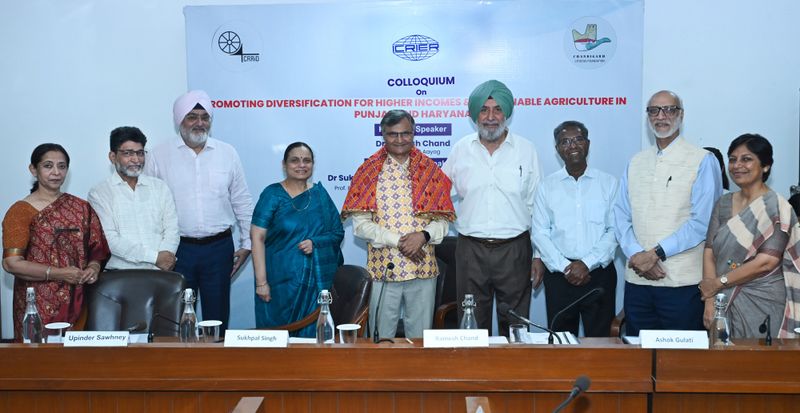

ruWith Punjab’s water table falling by 1.7 feet per year, the need of the hour is to go in for crop diversification, which will be possible through repurposing of power subsidy to farmers and adoption of contract farming of high value crops.This was the gist of suggestions made by policy makers, academics and sector experts during a colloquium on “Promoting Diversification for Higher Incomes and Sustainable Agriculture in Punjab and Haryana” at the Centre for Research in Rural and Industrial Development (CRRID).The Colloquium, organised by Chandigarh Citizens Foundation, has also urged the Punjab Government to go in for a crop insurance policy, considering that climate change in the form of unseasonal rains have played havoc with crops.The experts included Dr Ramesh Chand, Member, NITI Aayog; Dr Ashok Gulati, distinguished professor, Indian Council for Research in International Economic Relations; and Dr Sukhpal Singh, professor and former chairperson, Centre for Management in Agriculture, IIM Ahmedabad.They recommended that the way forward for both Punjab and Haryana was to have a crop neutral agriculture rather than following the wheat-paddy monoculture.They recommended that free power to the farm sector should be replaced by cash incentives to farmers. This would prevent over-extraction of groundwater for irrigating the water guzzling paddy, they opined.Chand, who was the keynote speaker, said the two states had all wherewithal for ushering in a second green revolution by maintaining a fine balance between “sarkari fasal” (referring to wheat, paddy) and “bazari fasal”(cash crops).“So far, all efforts to bring diversification have yielded little results. I would recommend moving towards horticulture as it gives much higher profits to growers. The way forward out of paddy-wheat rotation is to focus on growth, sustainability and remunerative employment,” he added.“I do not recommend that farmers give up paddy cultivation overnight. But shift towards mustard, cotton and maize, with maize having a huge potential. If 10 per cent area under paddy is shifted to other crops in a decade, it will lead to a 3.4 percent annual growth in the farming sector,” he added.He said for planned diversification, agro forestry was recommended in the Kandi area, but there was the need to go beyond poplar; make fruit and vegetable cultivation zones and continue with field based crops in certain land pockets.“The price stabilization fund, like the Bhawantar Scheme of Haryana, should be introduced in Punjab,” he said.He cautioned against over production when going in for crop diversification.Sukhpal Singh said, “How can you say that we will not allow contract farming? Why have double standards on not allowing contract farming when it is already happening right in your backyard, without a legal framework in place.”“Contract farming has been going on for 25 years, but nobody’s lands have been taken away, as professed by some vested elements. This is the way to go forward if you want to diversify to high value crops. The reason why farmers are not diversifying is because yields of the wheat and paddy are stable,” he added.Sukhpal Singh added that an eco-system also needed to be built immediately to support these high value crops as Punjab had only 90 fruit and veg markets and 420 cold storages.He said free power was the anti-thesis of crop diversification.“Sometimes, I doubt the intentions of the state government, when they do not even acknowledge free power as being an impediment in diversification for fear of a political backlash in policy documents,” he said.He rued that unwillingness of Punjab farmers and policy makers to move ahead with changing tines had led to even Bihar farmers earning much more than them.Gulati rued that there was 71 million tonnes of rice in the central pool, against the buffer requirement of 7.6 million tonnes.“No wonder that this over production is forcing the government to use rice for ethanol production. The rice whose production cost is Rs 43 a kg is being given to ethanol plants at Rs 23 a kg. The rice production has led to sustainability challenges in soil, water, Air and biodiversity, with cropping intensity for rice having increased to 201 % in Punjab and 196 % in Haryana,” he said.“Since you have skewed incentive sector, so you get skewed food production. We need to repurpose the subsidies on both power and fertilisers; move from cereals and align to demand based production of high value crops; and move towards crop neutral incentives especially for pulses and oilseeds to reduce area under rice,” he added.A report —“Diversification to Augment Farmers’ Incomes and Promote Sustainable Agriculture in Punjab and Haryana,” prepared by the ICRIER, was released on the occasion.% in Haryana,” he said.