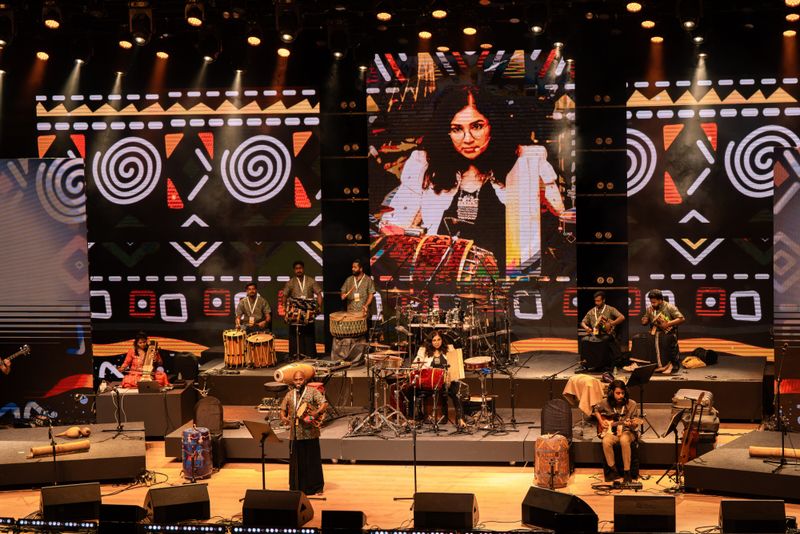
On March 8, a group of female musicians will get together on the second day of the Mahindra Percussion Festival in Bengaluru. Spearheaded by tabla player and multi-percussionist Swarupa Ananth, ‘Women Who Drum’ also features Charu Hariharan on mridangam and Hamta Baghi on Iranian duff and frame drum, with Shalini Mohan on bass and Nush Lewis on harp. Swarupa says that instead of high-energy drumming one normally hears, they will look at the feminine side of percussion, with a lot of melodic elements.The set provides another example of how more women are excelling in the world of percussion, often considered a male-dominated space. After tabla wizard Anuradha Pal, ghatam exponent Sukkanya Ramgopal and kanjira artiste Latha Ramachar paved the way in the 1990s, many younger ladies entered the field. Tabla players Rimpa Siva and Savani Talwalkar, and pakhawaj exponent Chitrangada Agle Reshwal were among those who made a mark.Some are even making waves abroad. Drummer Siddhi Shah has now settled down in Berlin, and is playing at the Mumbai Drum Day show on February 27. In the UK, Parv Kaur plays and teaches dhol, besides promoting bhangra, whereas Sukhmani Kaur Rayat is a prominent tabla player.Multi-percussionist Swarupa Ananth feels that organisers often include women in concerts as a sign of tokenism.Things weren’t easy earlier, as the field has been dominated by men. Exceptions were mridangam player Ranganayaki Ammal, who participated at the All India Music Conference in Madras in 1927, and Mumbai-based Aban Mistry, the first female tabla solo player. By the 1980s, more women took to learning percussion instruments, but there were many obstacles.As Anuradha says, “When I began my journey, the idea of a woman percussionist — specially a tabla player — was almost unthinkable. Opportunities were limited not because of lack of talent, but because of deeply ingrained mindsets. Concert platforms, training spaces and even rehearsal rooms were largely closed to women.”In 1996, Anuradha formed the all-women classical ensemble Stree Shakti. Though she kept changing the line-up, Sukkanya and Latha were among the prominent percussionists. Sukkanya had her own set of struggles. Even her guru, ghatam legend Vikku Vinayakram, said her fingers were too delicate for the instrument. But she persisted. When she was 26, a musician refused to perform in a woman’s company. She decided to prove a point by coming up with Ghata Tharang, a unique concept where she played six or seven ghatams of different pitches. Later, she launched Stree Taal Tarang, India’s first all-women percussion ensemble. One of its aims was to create a dent in the male-dominated space.Tabla maestro Anuradha Pal says today there is greater visibility, more institutional support, and wider acceptance of women as serious percussionists.Anuradha says when she started, there was scepticism, subtle discouragement and the constant need to prove that she belonged. She adds, “Not coming from a traditional musical lineage added another layer of difficulty. But those struggles became my training ground. They taught me resilience, focus and the importance of staying rooted in my art rather than seeking external validation.” A disciple of Punjab gharana doyen Ustad Alla Rakha and Ustad Zakir Hussain, Anuradha has played with many great classical musicians, besides her innovative solo projects.Because of their success in battling odds, Anuradha and Sukkanya have been considered role models. Swarupa, who also goes by the name Tablanaari, says that besides her mentors Alla Rakha and Zakir Hussain, she has been hugely inspired by Aban Mistry and Anuradha. “These names were regularly taken in class. Growing up, I started following their work, besides male artistes like Trilok Gurtu and Ranjit Barot. There were foreign female drummers too, like Marilyn Mazur, Sheila E, Anika Nilles, and so many more,” she says.As a child, Swarupa never thought of percussion as a male-dominated field. She says, “I agree that there were only one or two girls in class, but I was fond of what I was learning. My parents encouraged me, rather than ask me to learn singing or violin, like many other girls. After a certain age, I understood the gender aspect, but the love for my instrument came first.”Besides tabla, Swarupa also picked up djembe, darbouka, congas and bongo. She thinks that very often, organisers include women in concerts as a sign of tokenism. She explains, “They will include one woman in a group of 15, just because they want to prove gender representation. I’d say that chances should be given as per the level of artistry, and not on the basis of gender.” Keeping this in mind, Swarupa started ‘Women Who Drum’, a community which aims to foster “collaboration, empowerment and innovation” of women percussionists.Charu Hariharan, who hails from Kerala, initially learnt vocal music from her mother, singer B Arundhathi. Her love for rhythm made her switch to mridangam and she became a disciple of Mannarkoil J Balaji at the age of 10. She later played with slide guitarist Debashish Bhattacharya’s project ‘O Shakuntala’. Her mind opened up to global sounds after participating in the Ethno Sweden World Music Camp, and joining the world folk ensemble Varldens Band. She says, “Much as I like to explore international rhythms, I am also keen to discover more drum sounds closer home.”Charu says that personally she hasn’t felt any discrimination. Her biggest inspirations are Sukkanya and Marilyn Mazur. She says, “What Sukkanya has done requires tremendous grit, confidence and passion. As for Marilyn, I love the way she approached her art.” She is currently part of a project called ‘The Sound of Women’, featuring female folk musicians from Uttarakhand.Rimpa Siva started off as a tabla prodigy, participating in music director Kalyanji’s ‘Little Wonders’ series, and accompanying master flautist Pt Hariprasad Chaurasia when she was only 11. Other tabla artistes include maestro Suresh Talwalkar’s daughter Savani, Mitali Khargonkar Vinchurkar, Unmesha Athavale Gangal, Mukta Raste, Sharmila Chatterjee, Reshma Pandit Baldua and UK-based Sukhmani Kaur Rayat.In pakhawaj, Chitrangada Agle Reshwal and Mahima Upadhyay have made a mark. Maharashtrian dhol players Swarangi Sawdekar and Yamini Khamkar accompany mridangam player Viveick Rajagopalan’s ‘Ta Dhom Project’ at shows, whereas Neesha Mokal plays dholki and other instruments. In mridangam, there are Deepika Sreenivasan and K Veena Dhari, and kanjira players include R Krishnapriya.Among Punjabi dhol players, Jahan Geet Singh showed promise from a very young age, and has been featured on Zee Punjabi and Jalandhar Doordarshan.Birmingham resident Parv Kaur has been doing her bit to popularise dhol and bhangra. Growing up around live Punjabi music and performance, she was drawn to rhythm. She says, “The dhol stood out because of its power and how it commands attention, creates energy and brings people together instantly. One instrument could change the entire atmosphere of a room.” On being in a male-dominated field, she had her initial doubts — not from within, but from society. She says, “However, I never saw rhythm as gendered. Instead of feeling intimidated, I felt motivated to prove that women could not only play dhol but master it with strength, precision and stage presence. I’ve made a career out of a Punjabi musical instrument. Not many people in the UK can say that.”UK-based dhol player Parv Kaur never saw rhythm as gendered.In 1999, Parv founded Eternal Taal to promote and perform bhangra to wider audiences. It is a structured brand comprising female DJs, dhol players and hosts specialising in weddings, festivals and corporate events. She feels the biggest challenge is to be taken seriously in a genre where women are often viewed as novelty acts.While many women are learning Indian instruments, only a handful has taken up the western drum-kit. Sapna Desai-Mane, Shiksha Bali, Aarifah Rebello and Siddhi Shah practise the art. Originally from Pune, rock and metal fan Siddhi took to drumming after watching Slipknot’s Joey Jordison’s videos. She settled down in Berlin, which she visited for an intensive course. She too had her share of challenges: “Sometimes it has been the level of comfort working between males, being the only woman. Or that I didn’t get the opportunity as the others didn’t want a woman in their band. Other times, it has been biased judgment.”Siddhi Shah took to drumming after watching Slipknot’s Joey Jordison’s videos.Despite the obstacles, Swarupa says a healthy sign is that more younger women are learning the instrument. “The Internet has also made a huge difference,” she adds.Anuradha Pal sums up the situation succinctly: “Today, the landscape has definitely shifted. There is greater visibility, more institutional support, and wider acceptance of women as serious percussionists. My effort has always been to ensure that talent — not gender — defines opportunity, and that the next generation finds the doors a little more open than when I first walked in.”In tabla parlance, that’s a perfect tihai.— The writer is a Mumbai-based music journalist