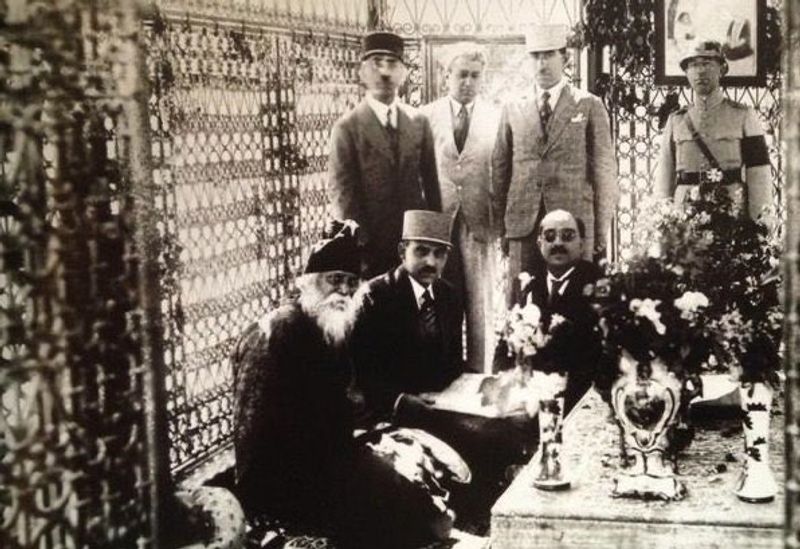

Emphasising Iran’s long-standing cultural and civilisational ties with India, Iranian diplomats stationed in the country are using social media to bring out anecdotes dating back to 7,000 years, including the commonality of the Hindu religious symbol, ‘Swastika’, in both cultures.Within this week, important posts on ‘civilisational-ties’ have included a picture of poet and philosopher Rabindranath Tagore visiting Iran several decades ago; and a painting depicting Zoroastrian (Parsi) religious leader Zoroaster to mark his birth anniversary.The Iranian consulate in Mumbai posted a picture of a 7,000-year-old rock carving in Iran showing the ancient Hindu symbol, Swastika. “The Swastika is in fact a prehistoric motif, deeply rooted in the shared cultural heritage of ancient Iran and India,” it said.It claimed that Swastika emerged from an Indo-Iranian civilisational continuum, where early Persian and Indian cultures were intertwined through language, cosmology and symbolic expression.It provided archaeological evidence on one such rock carving in ‘Loch Math’ near Birjand in eastern Iran. “A motif known as the ‘cosmic wheel’ or rotating cross has been dated back to almost 7,000 years ago,” it said.Similar engravings have been found etched into mountain stone walls across Iran from Kurdistan to Gilan and Khorasan.In parts of Khorasan and southern Iran, families would tie small wooden charms shaped like the Swastika around children’s arms. These were believed to protect against the evil eye and to promote health and well-being, the social media post said.Notably, Swastika’s symbolism continued into later periods of Iranian religious history, including during the era of Zoroastrian influence.Earlier, another post by the Consulate included a picture of Tagore with a group of Iranians. “An Indian heart finding itself in Persian verse: 1932, when Rabindranath Tagore sat in reflection at the Tomb of Hafez.”Iranian travel websites describe Hafez was the most celebrated Persian poet. His full name was Khwaja Shams-ud-Din Muhammad Hafez-e Shirazi (1320-1389). Known by his pen name Hafez, he lived and died in Shiraz. Hafez’s collection of poetry is mostly composed of short poems with mystical themes and is commonly considered to be the zenith of Persian poetry.Another social media post on the birth anniversary of Zoroaster said: “We honour his timeless message: Good (Thoughts, Words, Deeds). He elevated humanity beyond darkness and practices tied to deities that demanded human sacrifice (especially baby girls like what the US did to the schoolchildren of Minab)”.Zoroastrians or Parsis have populations in Mumbai and nearby areas. In December 2024, a high-ranking Zoroastrian priest from Iran, Mobed Mehraban Pouladi, and President of the Council of Iranian Mobeds, had visited India, a first such visit in five centuries. The Parsi community in India had hosted Pouladi.India’s Zoroastrian community, which migrated from Persia in the eighth century, has left an indelible mark on the nation. Prominent Parsi families like the Tatas, Godrejs, Wadias, Mistrys and Poonawalas have contributed significantly to India’s industrial, social and cultural development.