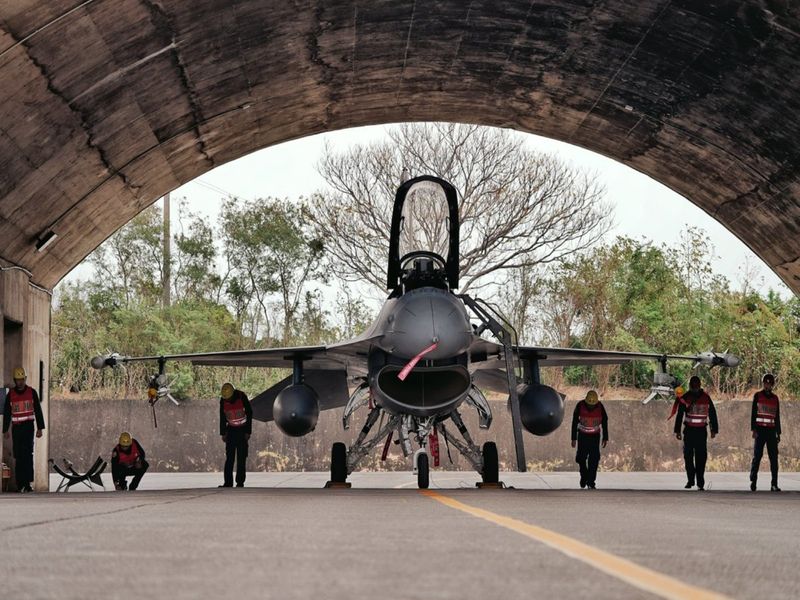

Taipei [Taiwan], March 7 (ANI): Taiwan’s Ministry of National Defense on Saturday detected two sorties of Chinese aircraft, six naval vessels and an official ship around its territorial waters as of 6am (local time) on Saturday.Both the sorties entered Taiwan’s southwestern ADIZ.In a post on X, the MND said, “2 PLA aircraft, 6 PLAN vessels and 1 official ship operating around Taiwan were detected up until 6 a.m. (UTC+8) today. 2 out of 2 sorties entered Taiwan’s southwestern ADIZ. ROC Armed Forces have monitored the situation and responded.”2 PLA aircraft, 6 PLAN vessels and 1 official ship operating around Taiwan were detected up until 6 a.m. (UTC+8) today. 2 out of 2 sorties entered Taiwan’s southwestern ADIZ. #ROCArmedForces have monitored the situation and responded. pic.twitter.com/haG7JtvINo— 國防部 Ministry of National Defense, ROC(Taiwan) 🇹🇼 (@MoNDefense) March 7, 2026Earlier on March 6, Taiwan detected the presence of seven Chinese naval vessels and two official ships operating around itself.In a post on X, it said, “7 PLAN vessels and 2 official ships operating around Taiwan were detected as of 6 a.m. (UTC+8) today. We have monitored the situation and responded. Illustration of flight path is not provided due to no PLA aircraft operating around Taiwan were detected during this timeframe.”7 PLAN vessels and 2 official ships operating around #Taiwan were detected as of 6 a.m. (UTC+8) today. We have monitored the situation and responded. Illustration of flight path is not provided due to no PLA aircraft operating around Taiwan were detected during this timeframe. pic.twitter.com/uAp1xyNyp8— 國防部 Ministry of National Defense, ROC(Taiwan) 🇹🇼 (@MoNDefense) March 6, 2026China’s claim over Taiwan is a complex issue rooted in historical, political, and legal arguments. Beijing asserts that Taiwan is an inseparable part of China, a viewpoint embedded in national policy and upheld by domestic laws and international statements.Taiwan, however, maintains a distinct identity, functioning independently with its own government, military, and economy. Taiwan’s status remains a significant point of international debate, testing the principles of sovereignty, self-determination, and non-interference in international law, as per the United Service Institution of India.China’s claim to Taiwan originates from the Qing Dynasty’s annexation of the island in 1683 after defeating Ming loyalist Koxinga. However, Taiwan remained a peripheral region under limited Qing control. The key shift came in 1895, when the Qing ceded Taiwan to Japan after the First Sino-Japanese War, marking Taiwan as a Japanese colony for 50 years. After Japan’s defeat in World War II, Taiwan was returned to Chinese control, but the sovereignty transfer was not formalised.In 1949, the Chinese Civil War resulted in the establishment of the People’s Republic of China (PRC) on the mainland, while the Republic of China (ROC) retreated to Taiwan, asserting its claim to govern all of China. This led to dual sovereignty claims: the PRC over the mainland and the ROC over Taiwan. Taiwan has operated as a de facto independent state but has avoided declaring formal independence to prevent military conflict with the PRC, United Service Institution of India states. (ANI)(This content is sourced from a syndicated feed and is published as received. The Tribune assumes no responsibility or liability for its accuracy, completeness, or content.)