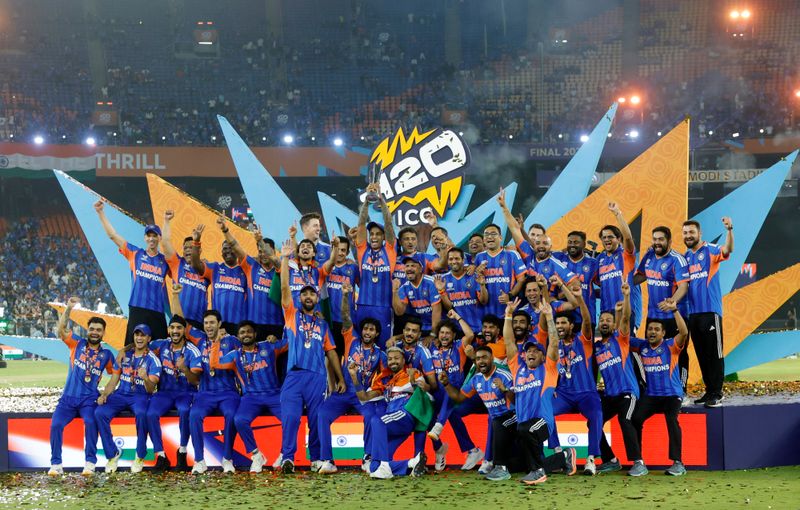

In a world fuelled by social media, where words drift like stings and meanings are bent to fit chosen narratives, the mind lurches like a drunken elephant. In its simmering pot, words and thoughts appear and burst, like bubbles in a boiling cauldron. We seem to be living by proxy, experiencing life not as it is, but as it is filtered, framed and fed to us. These disquieting thoughts are replaying in my mind in an endless loop ever since India won the T20 World Cup in the most dominant manner possible.It all started with a tweet on platform X. India ran away with the match in the first few overs itself, scoring at nearly 14 runs per over. It was obvious at that moment that there could be no other winner of the match. More than a flag-waving Indian, a genuine cricket lover, who would have wanted to see a more even contest befitting the occasion, surfaced in me. I tweeted my disappointed at the extremely flat nature of the wicket and wrote: India may be happy at their batsmen making mockery of the New Zealand bowling but by providing an extremely batting-friendly wicket, the ICC is making a mockery of cricket.I, like a majority of Indians, would have loved to see this “invincible” Indian team being challenged a bit more in the final to establish their undeniable superiority. Not the social media warriors. They pounced on the tweet, like wolves to the scent of blood. In more than five lakh views that tweet generated, the comments were devastatingly brutish with words dipped in poison, as if I was creating hurdles for India to win. This is the narrative of hyper-muscular nationalism, where objective analysis is scoffed at and its originator immediately declared anti-national. Even the players are not immune to this virus insidiously seeping into the pores of our consciousness.There are many recent examples of this nationalistic “bravado” that has emboldened our players to make sweeping statements to prove their deep love of the “Motherland” they were born in and have played for. While the Indian captain Suryakumar Yadav felt it was his national duty to “insult” the Pakistan captain by not shaking hands with him, the great Sunil Gavaskar has gone one step further. He has expressed his displeasure at an Indian owner of an English team in the 100 Cricket League hiring a Pakistani to play. According to Gavaskar, the tax the player will pay to the government from his earnings will be used to finance terror groups that kill Indian soldiers.This witless comment hailed as a “masterstroke” has galvanised the social media warriors, who have found a new star in their campaign to create a “new” India full of “Dhurandhar” heroes.To build this New India narrative, even our past heroes are being painted as flawed, and dispensable for having played for themselves and not for the team. This is an India now which does not hanker for personal milestones and believes in the individual subsuming his personal desires for the collective good of the team. This philosophy, according to captain Yadav, was injected into the team after 2024, ever since Gautam Gambhir took over as coach of the Indian team.In an interview to The Indian Express, given days after India won the World Cup, Yadav said the team realised that playing for personal milestones hampers the goal of winning and they decided that from now onwards, there will be no pandering to individual whims and their desire to project themselves as heroes. The “star system” that helped India win the 2024 World Cup was consigned to the dustbin of history by a new coach who swears by Bhagat Singh’s commitment and martyrdom to India’s freedom struggle.Gambhir is a strong-willed character, a man of firm beliefs and a long memory. Former India player and selector Sandeep Patil, in a recent interview, revealed that Gambhir, ever since he dropped him from the Indian team, has stopped talking to him and even refuses to acknowledge his presence. In Gambhir, India has chosen the right man to shatter star systems of the past and create a new paradigm going forward. A paradigm that allows for the captain, coach and the chairman of the ICC, Jay Shah, to visit a temple with the WC trophy to seek blessings from the god almighty. An act of faith which Gambhir’s idol Bhagat Singh, who in an essay written in 1930 explained why he is an atheist, would have disapproved of.Bhagat Singh felt religion is unscientific, irrational and given the diversity of India, can be even divisive.Faith is a matter of individual choice and as Yadav rightly said at a function, can’t they now not even go to a temple? Of course they can and I am sure they would have no issues with a Sanju Samson going to a church, Arshdeep Singh to a gurdwara and Siraj Mohammed to a mosque with the trophy to seek divine blessings.While Gambhir is laying the foundation for a star-less new order, the “archaic” old order made its presence felt in the newspaper celebrations of the 25th year of India’s astounding Test win over Australia in 2001. The heroes of that epic, unprecedented comeback victory that gave new direction to Indian cricket were men like Rahul Dravid, VVS Laxman, Sachin Tendulkar, Harbhajan Singh. India remembered them, with love, affection and warmth reserved for real stars.India’s cricket history is linked in a long chain of epochal moments and performers that inspire future stars, which no system or an individual can disparage and break.— The writer is the author of ‘Not Quite Cricket’ and ‘Not Just Cricket’