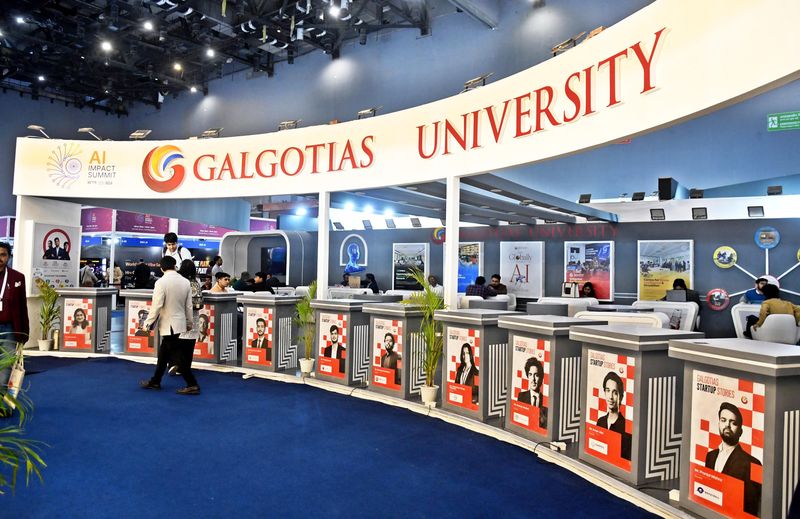

The huge brouhaha that has exploded over the recent AI event held in Delhi really shook up the capital. First, there was utter chaos on the roads leading up to Bharat Mandapam — the worst traffic mess I have ever seen in Delhi. The rush of delegates, visitors and the forever-roving crowd of those who go to such places only to make reels for posterity and their family, were just left to fend for themselves on the first few days. Then came the shameful episode of Galgotias University and the Chinese robotic dog that a ‘Communications’ person from the university was unable to explain, and last but not least, the demonstration by the Youth Congress volunteers that brought the house down (to say nothing of their clothes).Enough masala to provide hours of tu-tu, main-main TV debates, so let me not repeat all that. My concern is with what we have made of the concept of a university, or education in general. The first modern Indian university was set up in 1858 in Calcutta. Years later, Lord Curzon initiated education reforms though he is now remembered for all the wrong reasons — the partition of Bengal, the loot from India and the precious jewels and artefacts he took with him to England. However, we often forget that he established the Archaeological Survey of India (that predates the Royal Architectural Society of England, by the way) and ordered restoration of several historical sites (including Akbar’s tomb at Sikandra vandalised by a Jat ruler).Calcutta was followed by universities in Madras and Bombay and later, by Allahabad, Lucknow, Delhi, to name a few. A special kind of architecture (broadly Indo-Saracenic) with towers, turrets, huge campuses with buildings marked for science and humanities, impressive libraries, senate halls with stained glass windows and balconies, gardens, hostels for girls and boys — all these follow a similar architecture.From my memories of my alma mater in Allahabad, I can recall wide verandahs where students roamed to lofty tutorial and staff rooms. Humanities were then the most popular courses and entire generations of the civil service were filled with alumni from Allahabad, also then known as the Oxford of the East.Similarly, Bombay became the hub of legal studies, and its advocates, jurists and constitutional experts (many Muslim and Parsi names) were legends known for their distinguished careers. Jinnah, Nanavati, Palkhiwala, Seervai, Tyabji are some names that come readily to mind. I am not so familiar with Madras but even Lucknow university had a renowned centre for botany in the years gone by. Medical education was provided by some outstanding colleges that have largely kept their reputations intact. Panjab University, partitioned into two campuses in 1947, held its own for decades.The short point that I wish to make is that there was a grand tradition of higher education funded and run by the State. In addition, there were individual institutions (such as the BHU, the AMU) where generous donors and philanthropists created impressive centres of higher learning. However, it is with the establishment of the IITs that this landscape changed radically. Gone were the sprawling spaces with dreamy towers and turrets and in their place came gleaming concrete and glass buildings with state-of-the-art labs, as the focus moved from the humanities to science and engineering. Students who graduated from there went abroad, earned huge salaries and never came back.Our brightest and best started the brain drain that is responsible for a dumbing down now visible at every level of education. English-medium education acquired an aspirational pull and with the mushrooming of so-called convent schools and English medium schools even in villages, the local government-run schools became passe.Something else also followed these changes: a dialogue between science education and the humanities was slowly lost. So, we had brilliant scientists who never regarded history or literature with respect, and on the other hand, our historians, political scientists and sociologists looked down on those who were unaware of the exciting developments in these areas. This hiatus was sought to be bridged by those who then set up private universities that only provided faculties of humanities, but were mildly contemptuous of artificial intelligence and such areas of frontier research.Today, this hiatus is becoming dangerous, for the ethical and moral dimensions of a scientific temperament are now debated by academics who belong to one ideological stream or another. Private universities are also wary of confronting the stifling rules that the government is placing on higher education because many of the trustees-run businesses cannot afford to rouse the government’s ire. Debate, discussion and criticism — the bedrock of higher education — are artfully avoided if not openly discouraged.Prime land is generously granted to promoters of dodgy educational backgrounds (I can’t say whether any university named after a sweetmeat seller, or after a daughter/wife was done so with a high purpose in mind). The UGC and the Medical Association of India are more taken up with opening universities and colleges to prove how they are promoting the government’s commitment to education for all. What is the faculty that runs these centres? How many can afford such an education and how many use it?Many questions need answers.— The writer is a social commentator