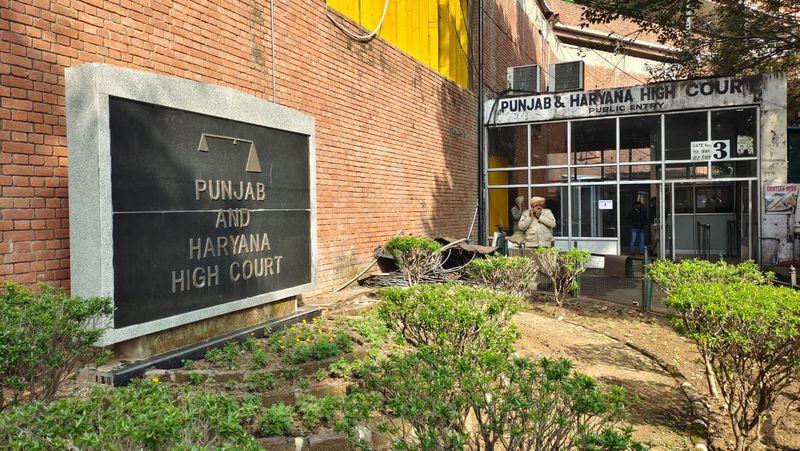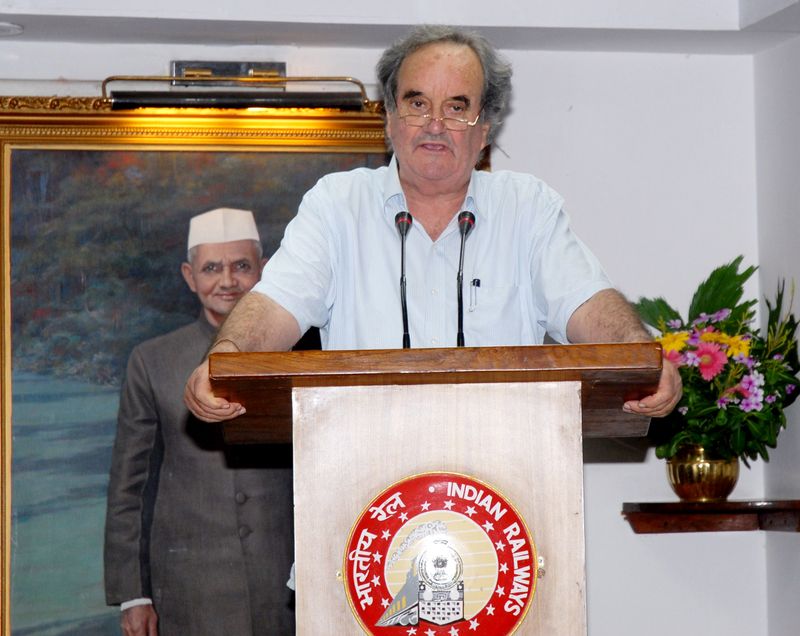
Mark Tully belonged to an extinct breed of foreign correspondents — those who reported a country not by hovering above it, but by walking patiently through it, listening, absorbing and returning, year after year, to the same roads and the same people.For many Indians, especially in the decades before liberalisation and the explosion of private media, he was not merely the BBC’s voice but simply Tully sahib — a trusted, familiar presence whose voice carried authority and gravitas, without bombast.I travelled with him innumerable times through Punjab during the militancy years in the 1980s and 1990s, when fear stalked towns, villages and highways across the state. Yet wherever we went, ‘Tuli’ Saheb was greeted with warmth and recognition.In village after village across Punjab, smiles spread and doors opened for ‘sade’ Tuli saheb. The customary manji was pulled out, and the inevitable lassi, milk and, in winter, saag and makki di roti followed, as he held forth on the state of affairs in his delightful mix of Hindi and Punjabi.For many in Punjab of those days, the BBC was the only authentic source of news, and Tully its sole, unquestioned and trusted progenitor. That faith was earned not through slogans or proximity to power, but through years of careful, credible and humane reporting that was Tully’s enduring hallmark in his extended journalistic career.Away from the field, Tully revealed another side — wry, convivial, companionable, humorous and irreverent. I recall spending many an evening at his iconic office-cum-residence at 1, Nizamuddin East, in New Delhi, till the late 1990s. The atmosphere there was always relaxed: rum flowed freely, as did his aromatic Java Dawson cigars from Trichy, and with his two Golden Retrievers padding nonchalantly about the room, unimpressed either by journalism or their master’s awesome reputation. Conversation flowed easily and the evenings captured Tully at his most human and gossip-hungry — far removed from the solemn voice of the BBC, yet deeply engaged with the world he chronicled and all manner of people he befriended.I last met Tully four years ago at the Indian International Centre bar in New Delhi. Age had done little to dull either his memory, his wit or his charming Hindi, laced occasionally with mild profanities. Over numerous rums, he regaled us with tales that ranged from the absurdities of bureaucratic India to sharp observations about the prevailing state of Indian politics and journalism.His acute observations were vintage Tully, but there was no hint of either nostalgia or self-importance — only a continuing curiosity about the country he had adopted and spent a lifetime trying to understand. Recalling that meeting, it was apparent that while the years had passed and taken their toll on Tully saheb’s body, his reporter’s instinct to observe, question and gently provoke endured.Tully was also unmistakably English — a product of the late colonial era, having been born in Calcutta and educated at Marlborough College and Trinity at Cambridge — and shaped by its habits, reserve and assumptions. And, like many Englishmen of his generation, he harboured serious reservations about the US — reservations rooted less in politics than in temperament. He was instinctively wary of American exuberance, the easy informality, the self-confidence that bordered on brashness, and a cultural style he found gauche, loud and faintly vulgar. It sat uneasily with his own preference for understatement, restraint and nuance.His first visit to the US came when he was around 50. On his return to London, a fellow BBC colleague, Nick Nugent, and I met him at a pub opposite Bush House on the Strand and asked what he had made of the trip — and of America itself. Tully took a thoughtful sip of his beer, paused, and said, with characteristic understatement, “You know, I quite liked it.”The remark lingered, recalling mountaineer George Mallory’s famous reply in the 1920s when a New York Times reporter had asked why he wanted to climb Mount Everest. “Because it’s there,” Mallory had said. In much the same way, Tully’s verdict displayed a quiet openness and willingness to suspend disbelief and to let experience, rather than perceived assumption, shape his views and judgment.In an age before rolling 24-hour news and social media, when journalism still allowed for time, reflection and considered analysis, Tully represented something rare — journalism rooted in patience, credibility and quiet authority. He neither lectured nor sensationalised, but listened, observed and reported India as he found it, with empathy but without paternalism or sentimentality.For those who travelled with him, shared a drink with him, or simply listened to him over the airwaves, Tully leaves behind more than just memories. He leaves a standard of journalism practised with humility, curiosity and respect. In today’s clamorous media landscape, that is also his most enduring legacy.