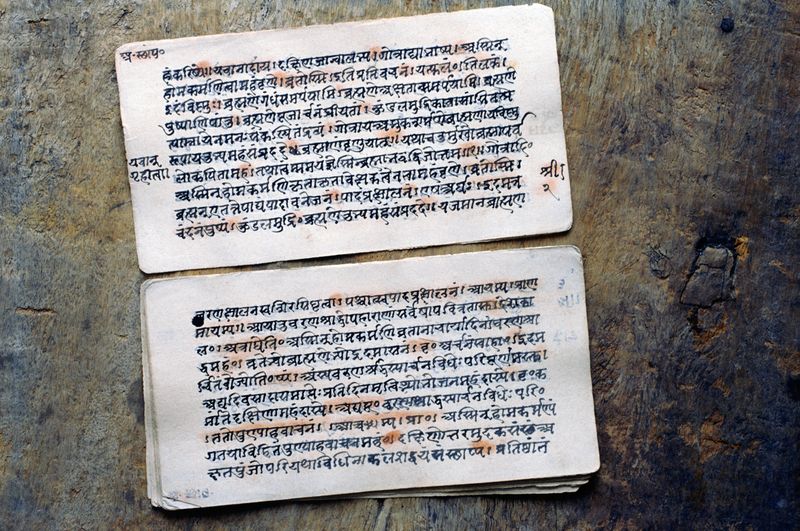

In the Upanishads, the word Brahmin is about inner realisation. In Dharma-shastra, the word Brahmin is about birth status and purity. The early Upanishads were composed between 600 BC and 200 BC, while the early Dharma-shastra were composed between 200 BC and 500 AD. The former is more spiritual. The latter is more legal.Strict rules of marriage based on caste are promoted by Dharma-shastra. This idea is not present in Upanishads. In fact, as per genetic studies, endogamy in India began only 1,900 years ago (70 generations ago), which scientifically proves this dramatic social shift which changed Hinduism forever. It is this new form of Hinduism that Brahmins took with them beyond Arya-varta to the river valleys of South and East India, when they were forced to leave North India following Huna invasions and loss of patronage to Buddhists and Jains.In the Chandogya Upanishad, a boy named Satyakama approaches the teacher Gautama and asks to be accepted as a student. Gautama asks about his lineage. Satyakama repeats what his mother told: she had many lovers so does not know who the father is. Gautama declares: only a true Brahmin can speak such uncompromising truth. He accepts the boy as a student. Here, truthfulness, not pedigree, marks Brahminhood.Raikva, a humble cart driver, refuses to reveal the secrets of Upanishad to King Janashruti in exchange for money. But when the king offers his daughter, thus welcoming him as a family member, overcoming caste and class prejudices, the knowledge is revealed.Contrast this with the Dharma-shastra world. In the Manusmriti, Brahmin is defined by birth into a particular varna. Duties are listed: study and teach the Veda, perform and officiate sacrifices, accept and give gifts. Detailed rules govern marriage alliances, food restrictions, inheritance, and punishment. If a Brahmin commits a crime, the penalty may be lighter than for a Shudra committing the same offence. Social order rests on graded inequality.There are stories that illustrate this legalistic framework. The tale of Shambuka in the Ramayana tradition shows a Shudra performing austerities reserved for higher varnas. His tapas is seen as a violation of cosmic order. The king intervenes violently, kills Shambuka, to restore dharma. Here dharma is tied to fixed social roles, not inner quest.Similarly, in Manusmriti discussions, mixed marriages produce named categories of offspring, each assigned specific occupations. Identity becomes a matter of regulated descent. The concern is not realisation of Brahmin but the preservation of hierarchy. Krishna is always referred to as a cowherd, as he is raised by cowherds. Karna is always referred to as charioteer, as he is raised by charioteers. Draupadi refuses to consider Karna for marriage as he is of inferior birth.In Bhakti lore, saints considered impure are not allowed to enter temples. Across India, in temples like Jagannath Puri and Pandharpur, there are shrines at temple gates reminding all of those who were not allowed to enter the temple on grounds of impure birth.Thus, the Upanishadic imagination opens Brahminhood to anyone who embodies truth and insight. The Dharma-shastra imagination closes it within birth, rule, and privilege. One tells stories of seekers who transcend status. The other tells stories of order threatened when status is crossed.In the 21st century, Hindus quote Upanishads to prove the greatness of their faith, but their social behaviour is aligned to Dharma-shastra. Social media is full of popular gurus who speak of the glory of Brahmin birth. That is unfortunate.— The writer is an acclaimed mythologist