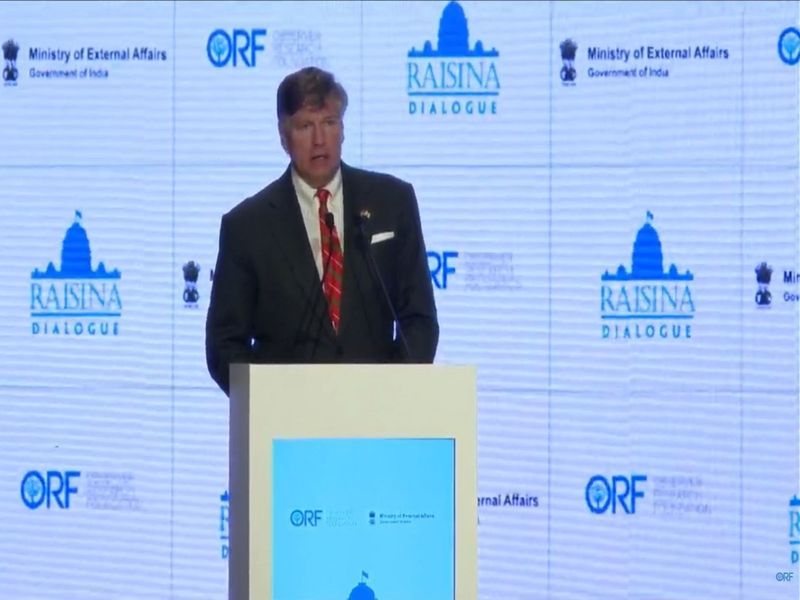

Remarks by a senior US official comparing India with China at the Raisina Dialogue-2026 triggered criticism from former Indian diplomat Kanwal Sibal Singh, who said he could not imagine a US representative speaking in such terms at an international conference hosted by India.Reacting to comments made during the conference, Singh said it was “unwise” to have proceeded with the dialogue at a time when a war was raging close to India’s neighbourhood.“I can’t imagine a senior US representative talking like this at an international conference hosted by India. It was unwise not to call off this year’s Raisina Dialogue with a war raging close to India,” Singh said.The remarks came after United States Deputy Secretary of State Christopher Landau, speaking at the annual strategic forum organised by the Observer Research Foundation in partnership with India’s Ministry of External Affairs, said Washington would not repeat the “mistake” it believed it had made with China while expanding economic ties with India.Landau said the United States was enthusiastic about deepening economic engagement with India and was optimistic about a bilateral trade agreement that he suggested was nearing completion.“We are excited about the trade deal that is almost at the finish line now, and I think that can be the basis for really unlocking almost limitless potential,” Landau said while addressing the Dialogue.However, he added that Washington would ensure that future economic cooperation remained balanced.“India should understand that we are not gonna make the same mistake with India that we made with China 20 years ago… in terms of saying you will be able to develop all these markets and then the next thing we know you are beating us in a lot of commercial things,” Landau said.“We are going to make sure that whatever we do is fair to our people because ultimately, we have to be accountable to our own people just as the government of India has to be accountable to its people,” he added.Former US diplomat Bonnie Glick also reacted sharply and offered a different perspective, suggesting that comparisons between India and China were misplaced.Commenting on Landau’s remarks, Glick said the comparison was a matter of “apples and oranges.” She described the early 2000’s decision to grant China entry into the World Trade Organisation as an experiment that “has, I think, widely been viewed as a miscalculation in the United States.”In contrast, she described India as the “world’s largest democracy” and the most important democratic partner for the United States in terms of its global influence.While acknowledging that trade issues often “complicate the economic relations” between the two countries, Glick said the relationship extended beyond commerce.“At the end of the day, the relationship between the United States and India is not based solely on economics. It’s based on more foundational elements of freedom of family, even an approach to faith,” she said.The remarks come amid renewed focus on economic ties between New Delhi and Washington, particularly in areas such as energy supplies, trade and strategic technology cooperation, as geopolitical tensions intensify across West Asia and the broader Indo-Pacific region.