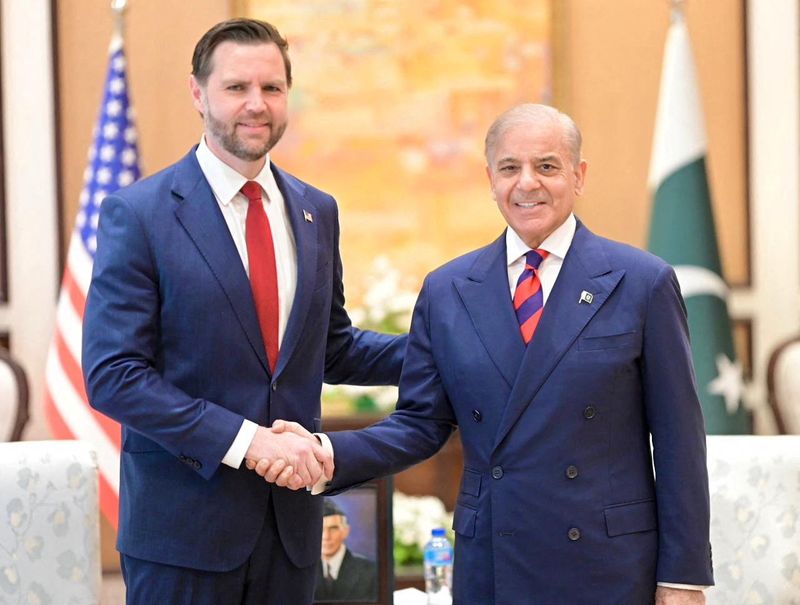

The US and Iran on Saturday held their first historic direct talks in Pakistan to end their six-week-old war, days after a fragile ceasefire was agreed.Iran’s semi‑official Tasnim news agency reported late on Saturday that the US and Iran were exchanging text messages in an effort “to reach a common framework for the negotiations”.At least two rounds of talks have been held. Tasnim said progress had been hindered by what it described as Washington’s “usual excessive demands,” but added that consultations were ongoing. According to it, the Strait of Hormuz remained one of the main points of serious disagreement.Separately, on Saturday night, the US Central Command said its two warships had begun operations to remove undersea mines in Hormuz as part of efforts to restore commercial shipping.The direct discussions between the two sides, the first since 1979, began in Islamabad this afternoon, following earlier bilateral meetings each side held separately with Pakistani Prime Minister Shehbaz Sharif.The US delegation is led by Vice-President JD Vance and includes special envoy Steve Witkoff and President Donald Trump’s son-in-law Jared Kushner. Iran’s delegation of more than 70 members is being led by Parliamentary Speaker Mohammad Bagher Ghalibaf and Foreign Minister Sayed Abbas Araghchi.Western media reported that the two teams were now engaged in direct negotiations, with Pakistani mediators present. Talks that began around 5 pm IST could spill over into the next day.Vance and Ghalibaf met Pakistan’s PM earlier on Saturday, with Sharif’s office saying Islamabad looked forward to continuing its facilitation of the talks. “The Prime Minister expressed hope that these talks would serve as a stepping stone toward durable peace in the region,” Sharif’s office said in a statement.The negotiations proceeded despite earlier assertions from Tehran that they would not take place without commitments on Lebanon’s inclusion in the ceasefire and relief on US sanctions.Earlier, Ghalibaf wrote on X that Washington had agreed to unblock Iranian assets and to a ceasefire in Lebanon, where Israeli attacks on Iran-backed Hezbollah fighters have killed nearly 2,000 people since March.Israel and the US have said the Lebanon campaign is not part of the Iran-US ceasefire, while Tehran and Pakistan maintain that it is.Media reports from Islamabad indicated some progress on basic conditions, including the need for a ceasefire in Lebanon.“There could be some movement on the unfreezing of Iranian assets,” Al Jazeera reported.Ghalibaf said earlier that Iran was ready to reach a deal if Washington offered what he described as a genuine agreement and granted Iran its rights, according to Iranian state media.The White House did not immediately comment on Iran’s demands, but Trump said on social media that the only reason Iranians were alive was to negotiate a deal. “The Iranians don’t seem to realise they have no cards, other than short-term extortion of the world through international waterways (Hormuz). The only reason they are alive today is to negotiate,” he said.Vance, speaking ahead of his departure to Pakistan, said he expected a positive outcome but added, “If they’re going to try to play us, then they’re going to find the negotiating team is not that receptive.” Trump had announced a two-week ceasefire earlier this week, halting US and Israeli airstrikes on Iran.He reiterated that his primary objective in any deal with Iran was to ensure Tehran “cannot obtain a nuclear weapon”. “No nuclear weapon. That’s 99 per cent of it,” Trump said.