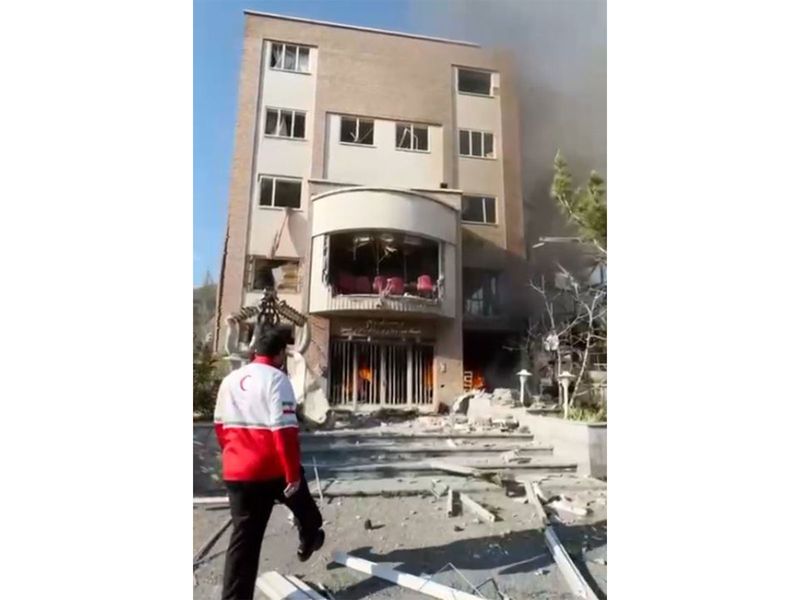
The West Asia crisis spiralled towards a dangerous inflection point on Tuesday, with US President Donald Trump issuing an extraordinary threat against Iran, warning that an entire civilisation could be wiped out, even as Tehran responded with defiance, its military signalled a widening conflict.Amid the mounting tensions, India urged its nationals in Iran to remain indoors and avoid any movement. The sharply escalating rhetoric came despite ongoing diplomatic efforts by intermediaries to broker a ceasefire.In a post on his social media platform Truth Social, Trump declared, “A whole civilisation will die tonight, never to be brought back again. I don’t want that to happen, but it probably will.” He described the moment as “one of the most important” in world history, asserting that decades of what he called “extortion, corruption, and death” would finally end.The statement was issued hours ahead of a self-imposed US deadline for Iran to open the strategically critical Strait of Hormuz, a key artery for global oil shipments, failing which Washington has warned of severe consequences. The deadline is set to expire late Tuesday in the US, corresponding to early Wednesday morning in India.Even as he struck a combative tone, Trump left a narrow window for diplomacy open, saying “maybe something revolutionarily wonderful can happen,” indicating that backchannel negotiations may still be underway.Tehran, however, responded with a mix of historical defiance and direct threats. Iranian officials invoked the country’s civilisational resilience, noting that Iran had survived invasions by Alexander the Great and the Mongols, and would endure current threats as well.“You and your allies will suffer an unforgettable hit from the ancient civilisation of Iran,” Tehran warned, signalling readiness for retaliation.Iran’s Ambassador to India Mohammad Fathali said, “We had said if you start a war, you won’t be able to finish it. And we have said again: if you target our infrastructure… learn from past mistakes.”Iranian President Masoud Pezeshkian too struck a defiant tone, claiming that more than 14 million Iranians had expressed willingness to sacrifice their lives in defence of the country. “I too have been, am, and will remain ready to give my life for Iran,” he said.The US, meanwhile, again struck the Iranian oil hub of Kharg Island, according to a White House official.As the crisis deepened, countries across the region and beyond are bracing for fallout. In New Delhi, the government issued a fresh advisory for Indian nationals in Iran, urging extreme caution. The advisory underscores growing concerns in India over the safety of its nationals.Since February 28, around 7,60,000 passengers have travelled from the West Asia region to India while at the same time Indian Embassy in Tehran has facilitated the movement of 1862 Indian nationals from Iran to Armenia and Azerbaijan for onward travel to India, including 935 Indian students and 472 Indian fishermen. There is still a sizeable chunk of Indians who are believed to be in Tehran.Meanwhile, Iran’s warning aligns with messaging from its Islamic Revolutionary Guard Corps (IRGC), which on Tuesday declared that previous restraint had ended and that any future confrontation with the US would extend beyond the immediate theatre of conflict.It warned if US forces crossed what it termed “red lines”, Iran’s response would “go beyond the region” and could deprive Washington and its allies of access to oil and gas resources for years — an explicit threat to global energy security.Amid the escalating war rhetoric, Iran has also initiated signs of domestic mobilisation. Iranian Minister Alireza Rahimi called on citizens — including athletes, artists, and students — to form human chains around power plants and other critical infrastructure.Describing these facilities as “national assets,” Rahimi framed the move as both symbolic and strategic, warning that any attack on civilian infrastructure would constitute a war crime. However, beneath the public posture of defiance, signs of internal strain within Iran’s leadership are beginning to surface. Reports suggest that Pezeshkian has raised concerns over unilateral actions by elements within the security establishment, including senior IRGC figures such as Ahmad Vahidi, which he believes may have undermined ceasefire prospects.In what is described as a tense exchange with influential figures aligned with the Supreme Leader’s inner circle, the President is said to have warned that current policies risk pushing Iran towards “a huge catastrophe.In another development, Iran alleged that Israel carried out an early morning strike that damaged a Jewish synagogue in Tehran. It emphasised that its Jewish community — estimated at between 8,000 and 10,000 people — remains protected and officially recognised, with representation in parliament. Any confirmed attack on a religious site would mark a highly sensitive escalation with symbolic and geopolitical implications.