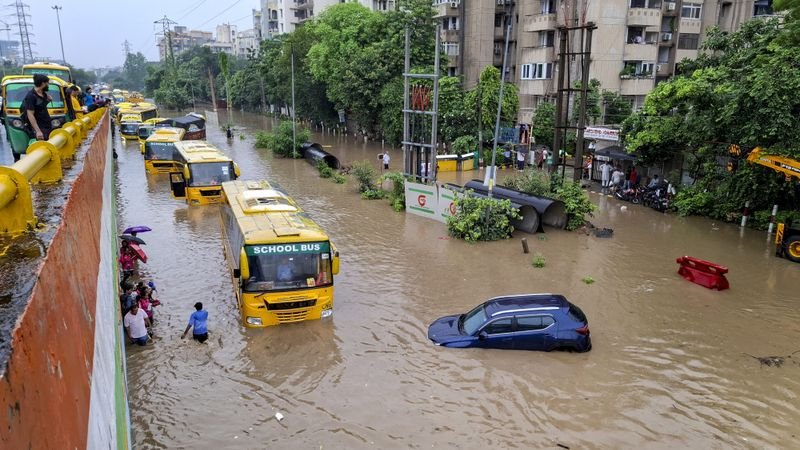

A new technical study has put hard numbers to what Gurugram residents have witnessed every monsoon: the city does not flood at a few isolated junctions but experiences waterlogging as an interconnected whole.The report, prepared for the Municipal Corporation of Gurugram (MCG) by IIT-Gandhinagar and AIReSQ, mapped water moving across 117 sectors through 257 separate boundary crossings during a single design storm, highlighting how flooding in one area affects the entire city.Based on a citywide “FloodAstra” simulation of 107.3 mm of rainfall over three hours peaking at 73 mm per hour, the study estimated that 31.48 million cubic metres of water entered Gurugram over six hours: 30.98 million cubic metres from direct rainfall and about 0.50 million cubic metres from upstream inflows. The largest sector-to-sector transfer recorded was 44,237 cubic metres, flowing from Sector 1 into Sector 111.Researchers identified 125 connected drainage areas feeding shared corridors across ward and sector lines, warning that fixing or diverting a drain at one point could shift the flooding burden elsewhere in the network rather than solving the problem.MCG Commissioner Pradeep Dahiya said the study marked a shift in the city’s flood-management approach. “The MCG is working on addressing the root causes of flooding rather than offering band-aid solutions. We are working to fix the city as a whole,” he said.Three chronic flood hotspots, Rajiv Chowk, Subhash Chowk and Sheetla Mata Road, were identified for priority intervention, with peak water volumes during the design storm ranging between 5.26 crore and 10.80 crore litres at each site.The study proposed response centres on underground detention tanks, illustratively sized at 14,000 cubic metres for testing. These would capture floodwater and channel it through a four-stage treatment process comprising screening, settling, filtration and a water-quality check before release. Treated water would go either to surface drains, when downstream capacity allows, or into a verified deep aquifer through monitored recharge wells. Recharge into the shallow water table has been explicitly excluded from the design.A simulated two-park detention pilot in Palam Vihar showed a 10.6 per cent reduction in peak street-flood depth and a 25.2 per cent reduction in peak water volume, with no additional flooding recorded outside the test area, the study found.Officials are not seeking construction approval at this stage. Instead, they are seeking authorisation for field survey, aquifer investigation and pilot-scale testing, with any decision on construction to follow only after field data confirmed the modelled benefits.