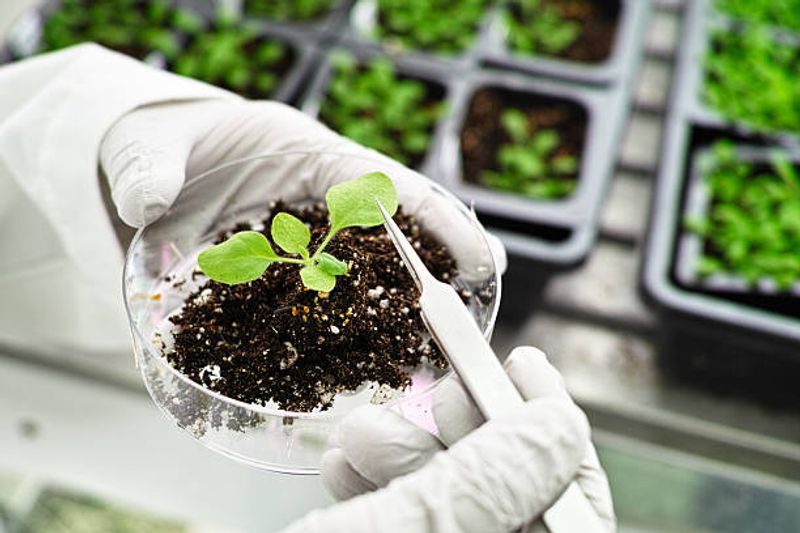

Taking forward the Centre’s push towards climate-resilient farming, the Indian Council of Agricultural Research (ICAR) is working on genome-editing of around 40 crop varieties across 34 of its research institutes to improve yields and soil health.Unlike genetically modified crops, which introduce foreign genes, genome editing (SDN-1 and SDN-2) makes targeted changes within a plant’s native genome. This approach precisely alters plant DNA to develop climate-resilient, high-yielding and disease-resistant varieties, bypassing the slower timelines of traditional breeding.Of the 41 diverse crops chosen for this technological intervention, 24 are field crops and 17 are horticultural crops. The goal is to develop climate-resilient and nutrient-rich varieties to ensure India’s food security by 2047.The initiative covers a wide range of essential crops, including pulses, wheat, bananas, tomatoes, cotton, soybean and rice.”Plant breeding is a non-stop process. There is nothing called a perfect variety, as factors affecting its quality and performance keep changing. It is precisely why we develop different varieties for varied settings — be it for situations like less rainfall, high rainfall or no rainfall,” Anuradha Agrawal, project director, Directorate of Knowledge Management in Agriculture (ICAR-DKMA), told The Tribune.”The ICAR is running a mega project to engineer over 40 crops across 34 research institutes. The objective is to provide the best varieties to farmers so that they can improve their yield and safeguard the health of the soil. We released the first-ever genome-edited rice varieties, DRR Dhan 100 (Kamala) and Pusa DST Rice 1. These edited crops are designed to boost yields by up to 25 per cent, tolerate droughts, reduce greenhouse gas emissions by 20 per cent and use significantly less irrigation water,” she said.Asked whether good quality seeds and better crop varieties could solve the agriculture crisis in India, especially when the farmers were facing deficient rainfall situation, the senior official said multiple factors contribute to a good harvest.”Farmers often complain that they are provided with bad quality seeds which lead to crop failure. The fact of the matter is error creeps in when private players fail to maintain the quality and purity of seeds when they produce them en masse. Also, farmers go to local dealers selling them fertilisers and seeds for advice. These dealers are not scientifically trained to advice them on the quality of seeds or the right application of fertilisers,” Agarwal added.Experts say farmers are moving back to indigenous seed varieties as the hybrid ones are giving them more headache.”With traditional methods, farmers are on an upper hand, while hybrid seeds can lead to seed germination failure. Traditional seeds can also be saved and replanted for free every season. Additionally, native varieties are highly valued for being more resilient to local climatic shocks, requiring fewer chemical fertilizers, and producing better cattle fodder,” agriculture analyst Ajay Jindal said.”While hybrid seeds typically offer uniform produce and higher initial yields, they come with several operational limitations,” he said.