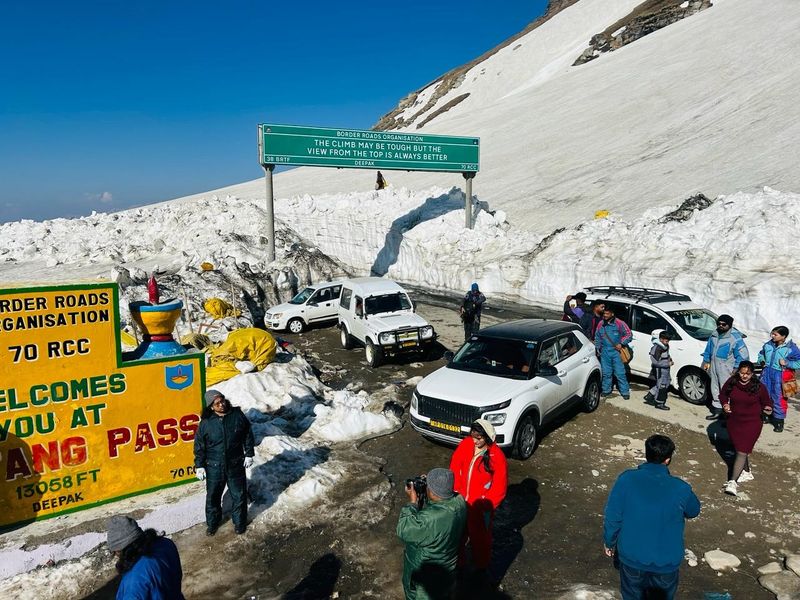

With mounting evidence of growing waste dumps across the Himalayan belt, a new white paper on Monday advocated an urgent need for implementing structured waste management frameworks across the region.Environment Ministry documents reveal the Himalayan states generate more than 7,000 metric tonnes of solid waste every year, and the absence of robust recycling systems continues to remain a key challenge.Further, concerns over balancing infrastructure development with ecological preservation are becoming increasingly pronounced in the region.In context of these pressing issues facing the Himalayan region, the white paper titled “The Future of the Himalayas: Rethinking Development and Resilience”, released today calls for consistent solid waste management policies across the Himalayan belt.“Towns such as Shimla, Manali and Mussoorie experience seasonal population surges of five to 10 times their resident population. During peak periods, waste generation can exceed handling capacity by two-three times,” the paper says.It positions the Himalayas as an interconnected ecological system, and emphasises that its environmental health directly impacts nearly 1.3 to 1.5 billion people living downstream across South Asia.Pradeep Sangwan, founder of the Healing Himalayas Foundation, points to the growing waste burden in high-altitude regions. He says while the Atal Tunnel has reduced traffic congestion at Rohtang Pass, it has also increased tourist inflow.“Over 20,000 vehicles pass through the tunnel’s north portal near Koksar and Sissu during peak season. The volume of waste left behind is alarming,” Sangwan said.He added that national initiatives such as the Extended Producer Responsibility (EPR) framework fall short in addressing the unique challenges of the Himalayan terrain. “The region requires a localised waste management and recycling system tailored to its geography,” he said.The white paper, unveiled by the CP Kukreja Foundation for Design Excellence, highlights a 15–20 per cent increase in extreme rainfall events in the Indian Himalayan Region since the 1950s. This trend has led to higher landslide risks, mounting pressure on infrastructure, and increased vulnerability for local communities, the document notes.To address these challenges, the report recommends transitioning from project-based development to a system-level planning approach. It stresses aligning policies with watershed and basin-scale ecological processes. It calls for development of terrain-specific infrastructure and recognition of ecological carrying capacity as a key planning parameterArunachal Pradesh Chief Minister Pema Khandu, who was present for the paper launch, underscored the need for a balanced development model. “The Himalayas are at a critical juncture where development must be guided by ecological sensitivity,” he said.Khandu called for a coordinated, multi-stakeholder approach involving institutions such as NITI Aayog, policymakers, and global partners.He emphasised that long-term resilience in the region depends on integrating scientific planning, community participation, and sustainable infrastructure development.