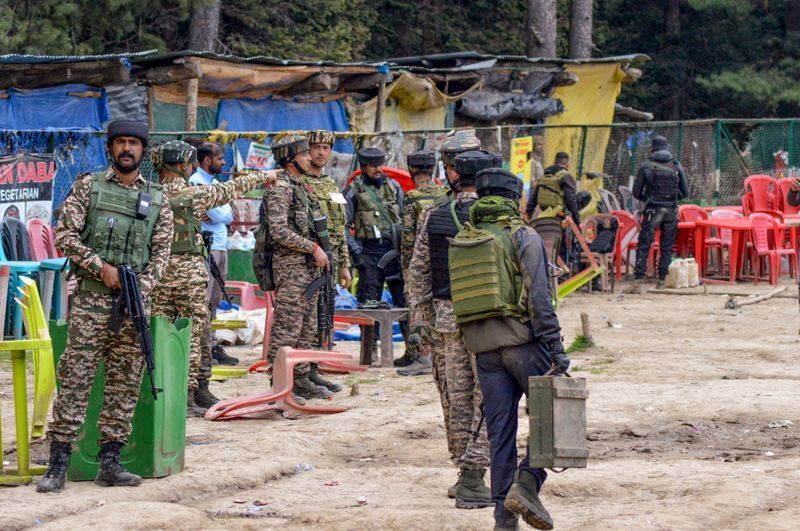

Soon after militants targeted tourists in the Baisaran valley of Pahalgam, killing 25 tourists and a local, sending shockwaves across the nation and beyond, the primary task before security forces was to trace the attackers.With limited initial information about their identity, Jammu and Kashmir Police along with other security agencies took time to gather actionable intelligence.As the Pahalgam attack completes one year on Wednesday, The Tribune tracks how security forces eventually zeroed in on the attackers.Sources said that only a few days after the attack, the first trail emerged. Technical signatures were received from South Kashmir, following which a massive search operation was launched in the upper reaches of Hapatnaaar. The operation continued for around two weeks. Although it yielded limited success, inputs indicated that the attackers were moving.By mid-June, temporary operating bases (TOBs) were established in the upper reaches of Dachigam and adjoining dense forests, which are connected to South Kashmir forests.Security forces faced a major challenge as the attackers were operating from deep forest areas, marking a shift in militancy patterns away from urban setups where intelligence inputs are more readily available.Sources said the first major breakthrough came in the second week of July when technical signatures of the militants were tracked, confirming their presence in the Dachigam belt.Subsequently, multiple high-level meetings were held and extensive mapping of the area was carried out by joint forces in coordination with central agencies. Given the dense and vast terrain, multiple teams were deployed simultaneously to comb the area.Sources further revealed that the region was divided into sectors, with joint teams assigned to each. “Teams would remain deployed for days, carrying out sustained search and scanning operations before rotating back,” they said.After days of sustained effort, contact was eventually established between the militants and an Army Special Forces unit operating in the area. “It was a swift operation, and the terrorists were neutralised, marking a significant success,” sources said.The identity of the slain militants responsible for the Pahalgam attack was later confirmed through multiple pieces of evidence. Union Home Minister Amit Shah told Parliament that three Pakistani terrorists — Faisal Jatt alias Suleman Shah, Habeeb Tahir alias Jibran, and Hamza Afghani — identified as being involved in the attack were killed by security forces under Operation Mahadev in July.Officials said ballistic analysis showed that bullet shells recovered from Pahalgam matched weapons recovered in Dachigam. Technical signatures also matched those recorded on the day of the attack and were linked to Operation Mahadev.Questioning of a Gujjar family that reportedly provided food and shelter to the attackers further confirmed that the Dachigam militants were the same who carried out the Pahalgam attack.In August last year in Delhi, the Home Minister felicitated the joint personnel involved in the operation, recognising their coordinated efforts and success.