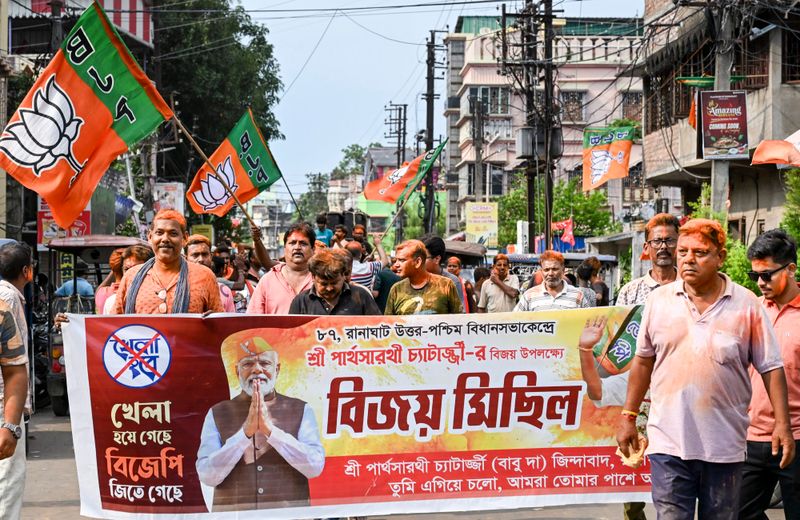

The lotus has blossomed in West Bengal, a state that had held off the Bharatiya Janata Party’s (BJP) relentless efforts and inexhaustible resources from capturing power, establishing a double engine “sarkar” and completing its domination of all the states north of the Vindhyas, barring the tiny territories of Jharkhand, Himachal Pradesh and Punjab, since Jammu and Kashmir are outliers.The ouster of Mamata Banerjee, a three-time chief minister, an iconic leader and a phenomenon in Indian politics, had the BJP leadership at the Centre working overtime, because she was difficult, if not almost impossible, to dislodge.What did succeed in defeating Mamata Banerjee was a carefully crafted strategy based on a granular assessment of weaknesses and strengths.The precision of the exclusions and deletions of voters through the Special Intensive Revision of electoral rolls done by the Election Commission, on the one hand, and the wedges that the BJP planted in the hope that these would grow organically and detach the Muslim vote bank by preventing it from consolidating behind her, worked.The further consolidation of the Hindu vote by carving out a constituency of Hindu refugee settlers in the Matua and Namashundra belt, as well as in Rajbangshi territory and the advantage the BJP saw in the resurgence of the communists and the Congress was worked to deliver its victory, bit by bit, piece by piece, in Muslim-dominated districts and in South Bengal.The internal fights in the Trinamool Congress, exacerbated by the 73 new candidates the party fielded, affected its capacity to win.By targeting the bad governance by party rule that had overtaken the police and administration in the 15 years of Trinamool Congress’s unchallenged domination, along with all the other variables, the BJP succeeded in capturing the elusive jewel in West Bengal.It required the concerted efforts of the BJP’s master planners and managers, men like Bhupender Yadav, Prime Minister Narendra Modi and Home Minister Amit Shah, to fight and win against the one-woman party of Mamata Banerjee.The consequences of Mamata Banerjee’s defeat are not limited to West Bengal. It will affect the morale of the loose confederation of parties in opposition to the BJP under the INDIA collective banner.The downfall of the Trinamool Congress in West Bengal means that the BJP is the ruling party across North India and it is not the ruling party in the southern states of Kerala, Tamil Nadu, Karnataka and Telangana.As an icon of resistance to the BJP’s domination, Mamata Banerjee’s defeat erodes her stature, but it may increase her nuisance value if she can figure out how to use it, without looking like a sour loser.The undercurrent that contributed to the BJP’s success was a feeling that Mamata Banerjee’s party had to go; any change was better.Having been the official opposition, it was as much the BJP’s desire to defeat her as it was the voters’ expectation that the BJP would be a better option that led to the near two-thirds majority the party won.The same undercurrent articulated an entirely new consciousness among voters that if the BJP fails to be satisfactory, it will be rejected in another election.Since 1952, West Bengal has had three ruling regimes, except for the 10 years between 1967 and 1977, when there were unstable coalitions. It takes voters in West Bengal to make up their minds about regime change and the BJP is tenacious once it seizes power.How the state negotiates its relationship with the BJP will be interesting to watch.The BJP has won in West Bengal, but uneasy lies the head that wears the crown. It has to find a chief minister to head the government.Its current crop of leaders, including Suvendu Adhikari, who succeeded in keeping the BJP as the centre of attention, have not been anointed as the incumbent chief minister.There are cracks within the state BJP that need to be dealt with.The party’s response to questions on leadership is classic—the headquarters will decide. The subtext is that all important decisions will be taken in Delhi, by the prime minister and home minister and perhaps some of the BJP’s top leaders, not by people in West Bengal.As a short-term exercise, the fissures and cracks in West Bengal could be managed to deliver the BJP its much-desired victory in West Bengal.Over the longer term of three years till the 2029 Lok Sabha election, the BJP will have to make sure that it is seen to be working for the changes it promised to voters.For the election, the EC pulled out all the stops by roping in 2.5 lakh central security forces, administrative and police officials from mostly BJP-ruled states, transfers and appointments of local officials and more or less taking over the day-to-day management of the minimum of government on law and order.That, however, is a temporary state of affairs; how the BJP handles a smooth transition from centralised administration to a routine state administration will be a tough call.To fulfil its campaign promises the BJP has to deliver cash into the hands of women and unemployed youth on the one hand, implement zero tolerance to “ghuspaithiyas” or illegal primarily Muslim infiltrators by deporting them, unroll the Uniform Civil Code and implement it, implement the amended Waqf Act, seal the borders with Bangladesh and fulfil Modi’s guarantee of giving citizenship to Hindu refugees – Matuas, Namashudras, Rajbangshis and others.The first set of promises requires that the new government find the money that the BJP has insisted West Bengal does not have to squander on “revdis,” or doles.For the second set of promises, the BJP will have to deal with resistance, if West Bengal reacts as it has done in the past to social destabilisation.For the third set of priorities, the BJP will have to figure out where to deport the “ghuspaithiyas”?Bangladesh is perfectly clear that there are no Bangladeshi “ghuspaithiyas” in India. The question is, where will the “ghuspaithiya” voters detected, deleted by SIR, go?