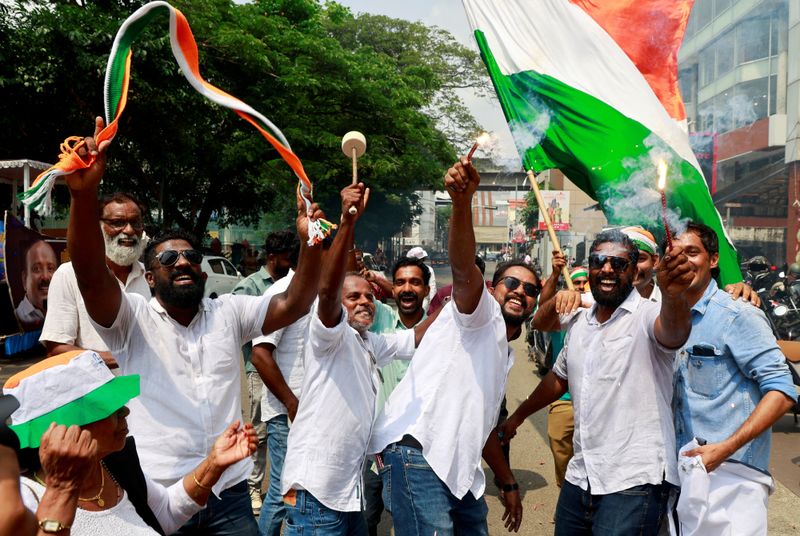

The Congress is likely to face renewed pressure to define its leadership role within the INDIA bloc after electoral setbacks for key regional allies Mamata Banerjee and MK Stalin in Assembly results declared on Monday, with trends indicating a clear erosion of regional strongholds that had anchored the opposition’s strategy.In West Bengal, Mamata Banerjee’s Trinamool Congress (TMC) has lost significant ground, with the BJP pushing ahead in multiple segments, marking a shift in a state that had remained resistant to it. In Tamil Nadu, MK Stalin’s DMK faces a fractured verdict, with emerging players such as actor Vijay’s TVK cutting into its base. The twin setbacks have altered the internal balance within the INDIA bloc, weakening the federal model that relied on strong state leaders to counter the BJP.For the Congress, the outcome remains mixed. The party has performed better in Kerala, where the Congress-led UDF has won, but it has not converted its allies’ losses into gains elsewhere. Its organisational presence in West Bengal continues to be marginal, while in Tamil Nadu it remains dependent on alliance arithmetic rather than independent expansion.Reacting to the results, Karnataka Chief Minister and senior Congress leader Siddaramaiah said the party had done better in Kerala and attributed the setbacks in West Bengal and Tamil Nadu to anti-incumbency, suggesting that local dissatisfaction with ruling parties influenced the outcome.As per sources, within the party, there is a growing recognition that the Congress may have to assume a larger coordinating role within the INDIA bloc. However, that transition is unlikely to be smooth. Regional parties are expected to resist any restructuring that reduces their autonomy, even as their electoral leverage weakens.Senior leaders indicated that internal consultations are expected soon, focusing on leadership clarity, a more structured decision-making mechanism and early seat-sharing agreements. The absence of a clear national framework, leaders admit privately, has limited the bloc’s ability to respond cohesively to state-specific challenges.The results also underline a broader shift in voter behaviour. Anti-incumbency, coupled with the emergence of new political players, has fragmented the opposition vote in key states, reducing the advantage of established alliances. In Tamil Nadu, this fragmentation has directly impacted the DMK-led formation, while in West Bengal, consolidation of votes against the incumbent has worked to the BJP’s advantage.The immediate test of any recalibration will come in the 2027 Assembly elections in Goa, Manipur, Punjab, Uttarakhand, Uttar Pradesh, Gujarat and Himachal Pradesh.In Himachal Pradesh, Uttarakhand and Goa, the Congress is expected to face a direct contest with the BJP, making these states a measure of its organisational strength and electoral readiness. In Punjab, the party is likely to be in a triangular contest with the ruling Aam Aadmi Party and the BJP-led alliance, where vote division could prove decisive.In larger states such as Uttar Pradesh and Gujarat, the challenge remains structural. The Congress has yet to rebuild its base and immediate gains appear unlikely without sustained organisational work. In Manipur, fluid political conditions add uncertainty to an already complex electoral landscape.These contests will serve as a critical barometer ahead of the 2029 Lok Sabha elections. A credible performance in direct contests against the BJP could strengthen the Congress’ claim as the principal opposition force. Conversely, continued weak showings may deepen questions over its ability to anchor the INDIA bloc.The implications for 2029 are direct. With regional anchors weakened, the Congress faces a dual task — rebuilding its organisation in key states while positioning itself as the central axis of the opposition. This will require moving beyond alliance dependence to sustained cadre-building, sharper messaging and state-specific strategies.At the INDIA bloc level, consultations are expected to focus on creating a more coherent structure, but the extent of consensus remains uncertain. The coming electoral cycle will test whether the Congress can translate political openings into durable gains.