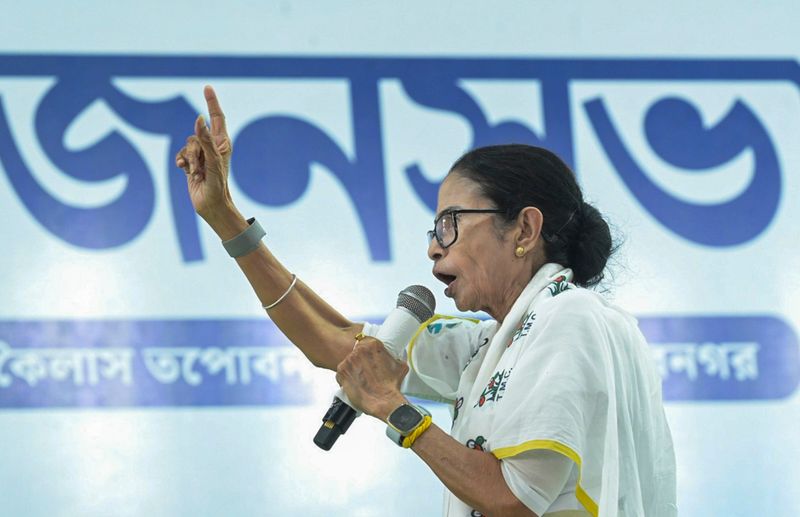

The result of the West Bengal Assembly election have ousted the 15-year-old TMC government from power. Despite BJP’s landslide victory with 207 seats, and her own crushing defeat, outgoing CM Mamata Banerjee has categorically refused to resign from her post. Mamata Banerjee, who herself lost the Bhawanipur seat by more than 15,000 votes, held a press conference in Kolkata and levelled serious allegations against the Election Commission (EC).She termed the defeat a ‘conspiracy’ and the ‘brutal murder of democracy’. TMC has been reduced to just 80 seats in the state, and nearly 63 per cent of the government’s ministers have lost the election. Despite this, the Chief Minister’s defiance has sparked a new political debate in the state over how the transfer of power will take place without a resignation and under what process the new government will be formed.Facing the media for the first time after the election results, Mamata Banerjee appeared extremely aggressive. She said in no uncertain terms that she would not go to Raj Bhavan to submit her resignation. Questioning the entire electoral system, Mamata said, “I have not lost; the Election Commission was the main villain of this entire election.”Amid this entire political development and Mamata’s refusal to resign, the biggest question is: what does the Constitution say?Sudhir Kumar, Assistant Professor in Law Department at Kurukshetra University, has clarified this constitutional position in unequivocal terms. According to Prof Kumar, “In democratic traditions, it is a moral responsibility for a Chief Minister to resign immediately after a defeat. Mamata Banerjee’s refusal to resign may be merely a political protest, but legally and constitutionally it will have no effect whatsoever.” He explained that in a democracy, governments function on the basis of majority. When a Chief Minister’s party loses its majority in the House, the legal existence of the old government is deemed to have automatically ended.Prof Kumar explained that in the current situation, the rules are completely clear and there will be no obstacle to the formation of a new government:Article 172 (Duration of Legislative Assembly): Under this Article of the Indian Constitution, the term of the current West Bengal Legislative Assembly is ending on May 6, 2026. After that, the constitutional existence of the current government will automatically cease even without any formal resignation.Article 164 and Formation of the New Government: The Chief Minister and other ministers hold office during the ‘Pleasure of the Governor’. As soon as the Election Commission issues the official notification constituting the new Legislative Assembly, the old government will cease to exist entirely. The Governor has the prerogative to dismiss the outgoing Chief Minister. Immediately thereafter, the Governor will officially invite the leader of the legislature party of the new majority party (BJP) to form the government and prove its majority in the House.