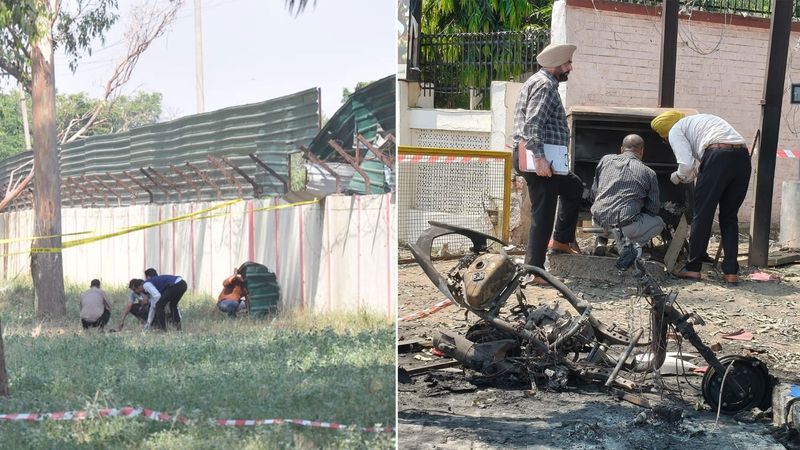

Terror groups in Punjab have shifted their focus from state police establishments to central government installations and forces, with three blasts in nine days targeting a BSF headquarters, an Army camp, and a railway freight corridor in what security agencies describe as a deliberate escalation.This follows a grenade attack at the Punjab headquarters of the BJP in Chandigarh. The BJP is in power at the Centre.Punjab DGP Gaurav Yadav has blamed Pakistan’s ISI for directing the incidents through modules operating via foreign handlers in Europe, Canada and elsewhere, often in coordination with drug smuggling networks.On Wednesday, an explosion took place outside the BSF headquarters in Jalandhar, setting a scooter on fire in a crowded area with no major casualties reported.Hours later, another blast was reported near an Army camp in Khasa area of Amritsar, close to BSF installations and the Attari-Wagah border. A Khalistani group claimed responsibility for the low-intensity blasts.Earlier, an explosion targeted a railway track on the Western Dedicated Freight Corridor, an apparent attempt to disrupt the national economy and supply chain.On April 1, a grenade was lobbed at the Punjab BJP headquarters in Sector 37, Chandigarh, damaging vehicles parked outside but there were no casualties. These strikes on BSF facilities, Army installations, the ruling party’s office, and freight infrastructure mark a sharp widening of the targeting pattern, coming despite heightened security following the Chandigarh blast.As per police records, since October 2024, Punjab has witnessed more than 30 grenade attacks, many initially directed at police stations and posts in border districts. Security agencies attribute these to Pakistan-based handlers using narco-terror networks and groups like Babbar Khalsa International, with grenades often smuggled via drones.In previous cases, Pakistan-based terror groups had joined hands with Punjab gangsters and drug smugglers, using their networks to carry out attacks. Police investigations identified gangster Happy Passia, later detained in the United States, as a key figure behind the grenade attack campaign. The series of attacks included repeated grenade and IED attempts on police posts in Bhindi Saida in Amritsar, Majitha, Batala, Patiala, and Gurdaspur, along with attacks on political figures and recoveries of foreign-origin explosives.In the BJP office blast case, Punjab Police in a joint operation with Chandigarh Police arrested seven accused. The five initially arrested were identified as Balwinder Lal alias Shami, Jasveer Singh alias Jassi, Charanjit Singh alias Channi, Rubal Chauhan, and Mandeep alias Abhijot Sharma. The two main perpetrators, Gurtej Singh and Amanpreet Singh, both residents of Rattangarh in Rupnagar, were later arrested from Rewari in Haryana. Investigations revealed the plot was backed by Pakistan’s ISI, with directions from foreign handlers in Portugal and Germany who promised the perpetrators a reward of around Rs 2 lakh.Police have reported multiple breakthroughs, including arrests of local operatives and recoveries of grenades and pistols through joint operations with central agencies.These attacks are a chilling reminder of targeted killings in Punjab which saw 17 killings between 2016 and 2021, with a notable spike in 2016-17. Victims mainly included RSS leaders such as Ravinder Gosain and Jagdish Gagneja, Shiv Sena leaders like Durga Prasad Gupta and Amit Arora, Hindu Sangharsh Sena leader Vipin Sharma, Christian pastor Sultan Masih, Dera Sacha Sauda followers Satpal Singh and his son Ramesh Kumar, Sri Hindu Takht leader Amit Sharma, and others, including a Namdhari leader.Punjab Police solved several of these cases and arrested key accused including Ramandeep Singh, Hardeep Singh, and others linked to Khalistan Liberation Force modules. Police sources said the fresh incidents, too, will be solved but it was worrisome that massive smuggling of weapons and explosives is being attempted by the terror groups in Pakistan to disturb Punjab peace. Sources said most of these are dropped by the drones.