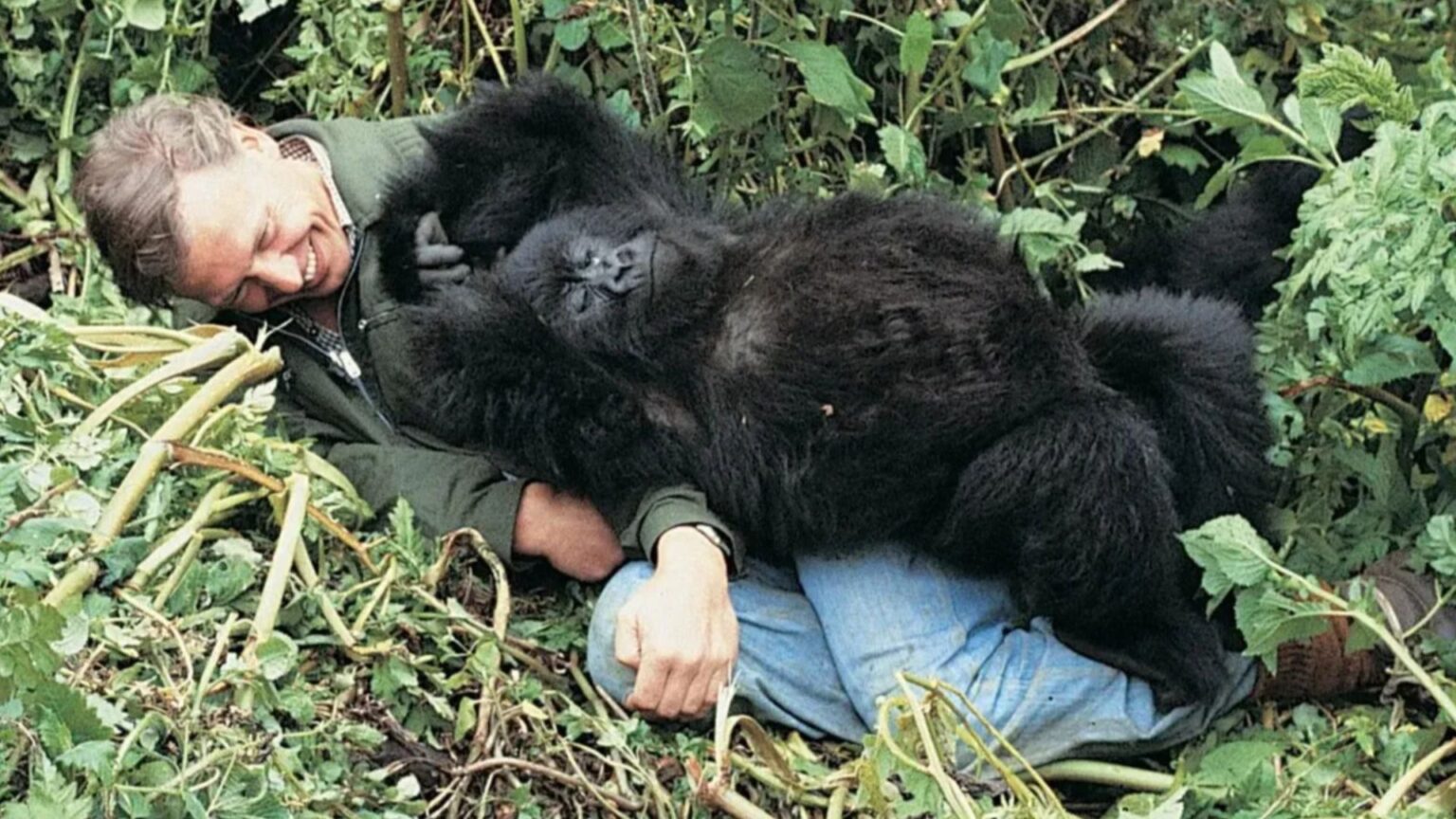


A MOUNTAIN gorilla stretches out her hand, places it gently on David Attenborough’s head and peers deeply into his eyes.
Decades later, the naturalist’s famous voice would sometimes break when he told of the encounter in the jungle of Rwanda in 1978 that led to one of the most famous television sequences of all time.
Sign up for the TV newsletter
Thank you!
Sir David smiling and amazed as a young gorilla rolls on top of him during his ground-breaking 1978 encounter in Rwanda Credit: Naturepl
The naturalist coming across an albatross chick in South Georgia in 1992Credit: Refer to Source
He recalled: “It was a moment of bliss.”
The gorilla then pulled down the presenter’s lower lip to look inside his mouth.
At that moment, David would remember: “I felt a heavy weight on my legs.
“I looked down and saw that a small baby gorilla was sitting on me, undoing my shoelace.
OUT & ABOUT
David Attenborough makes rare outing just days before his 100th birthday
GAME RESERVE OF THRONES
Secrets of Sir David Attenborough’s savage series Kingdom revealed
“I can’t describe all the emotions that went through my heart.
“I was in a kind of paradise.
“I lost all sense of time.
“When I eventually emerged and went back to the crew, I said, ‘God, wasn’t that extraordinary?’, and the producer, poor chap, said, ‘Yeah, I think we got a few seconds’.
“I said, ‘A few seconds! I was there ten minutes!’.
“He said, ‘Yes, but I was waiting for you to say something, to make a zoological point’.”
David had, in fact, crawled into the thicket with the mother gorilla in the background in order to do a serious piece to camera about how gorillas, like humans, have an opposable thumb — a significant evolutionary advantage which allows better manual dexterity.
The crew had dutifully been waiting for him to start talking, not wanting to waste precious film, until the cameraman finally thought, “We should be taking some of this stuff of David rolling around with these gorillas, if only to make the people in the editing room laugh”.
He also managed to fit in other projects such as, at the request of Her Majesty, producing the Queen’s Christmas messages from 1986 to 1991 Credit: Rex Features
Sir David at Guyana’s Kaieteur Falls for epic 1979 series Life On Earth Credit: BBC
So in the end, only a minute or so of David lying down and sporting a beam of pure joy while the gorilla youngsters checked him out was ever caught on film.
Half a billion people in 100 countries watched these moments when Life On Earth was first broadcast in 1979.
Thanks to repeats and video sales, that number is now estimated to be more than one billion.
He later said: “There is more meaning and mutual understanding in exchanging a glance with a gorilla than with any other animal I know.”
Nothing like the encounter had ever been seen on television before, but then nothing like the entire series had ever been seen either.
It was a landmark in broadcasting and cultural history, and set the standard by which all other natural history programmes are judged.
And it was all the brainchild of Sir David, who researched and wrote the scripts in full before handing them over to the Natural History Unit to work out how to capture the sequences he had described.
Producer Mike Gunton, who began working with the presenter in 1990, would later say: “The genre was almost invented by David.”
Life On Earth set out to tell the story of all life, plant and animal, from their beginnings.
In zero gravity at Nasa in Houston, Texas in 1984 Credit: BBC
The TV icon in an underwater swim for 12-part series The Trials Of Life in 1990 Credit: BBC
It may be the greatest story ever told.
To convey it, David travelled 1.5million miles, criss-crossing the globe for years and helping to develop new camera techniques that were to become the benchmark.
To illustrate the movement of the wings of bats in flight, a slow-motion sequence was filmed in a wind tunnel.
A replica of a mole burrow was built in a wheel that could be turned in order for a camera to keep a mole in shot as it scurried along a tunnel.
Then there was the sheer style of it, such as the presenter starting a sentence in one continent and ending it on another.
The series also set the bar when it came to pure stamina: One cameraman and an assistant were stationed to wait for the fleeting moment when a male Darwin’s frog, which incubates its young in its mouth, finally spat them out.
David later said: “He and his assistant took it in turns watching for 180 hours continuously.”
But it was not just the images that kept the world agog.
The words, all written by David, were just as ground-breaking.
In his element among seals in 1984’s The Living Planet
Sir David at home with his beloved wife Jane in 1979 Credit: News Group Newspapers Ltd
In January 1979, just after the second of the 13, 55-minute episodes had screened, TV reviewer Clive James wrote: “The secret of its success lies just as much in the words as in the pictures . . . with him, television becomes the instrument of revelation.”
Mike Gunton later recalled how David advised him on a script he had written, which described a particular piece of footage as “incredible”.
David told him to take it out.
If it was incredible, he said, there was no need to say so.
If it was not, exaggeration wouldn’t help.
This television masterpiece also single-handedly made the BBC’s Natural History Unit, based in Bristol, one of Britain’s most high-profile export industries, regularly earning the corporation about £15million a year.
David later said: “The series was a gamble, but it turned out to be the biggest and most successful programme I have ever done.
“It got the most extraordinary reaction around the world.
“If it hadn’t worked, there might have been none of the ambitious series that followed.”
These series included two other epic undertakings about the entire world, and which he considered a trilogy, with Life On Earth: The Living Planet, broadcast in 1984, which looked at how living organisms adapt to their surroundings, and 1990’s The Trials Of Life, about the major moments in animals’ lives.
Again, David wrote them as well as presented them, and they, too, were global smash hits, with an awed world watching never-before-seen spectacles such as chimps working as a team to hunt a monkey and killer whales beaching themselves in order to catch sea lions.
Once again, the ingenuity of the crew in getting the shots that David had dreamed up in his script was astonishing.
At one point they even used a medical endoscope to film army ants underground in Panama.
Meanwhile, David was narrating every single episode of Wildlife On One, which he began in 1977 and continued until the series ended in 2005.
He also managed to fit in other projects such as, at the request of Her Majesty, producing the Queen’s Christmas messages from 1986 to 1991.
By this stage, he had become Sir David, receiving his knighthood in 1985.
Other series followed, although after this first trilogy, David concentrated on more specialised subjects rather than the entire world.
In 1993, there was Life In The Freezer, about the seasonal cycle of Antarctica, followed by 1995’s The Private Life Of Plants, and The Life Of Birds in 1998.
Each of these series saw Sir David travelling hundreds of thousands of miles, flying economy as he went.
The BBC did not cough up for him to travel business class until after he turned 75 in 2001.
Before then, he turned down free upgrades unless the whole TV crew were given the same privilege.
He would always pack at least 40 hours of music — his other great passion in life.
He once explained that he travelled with “every major classical work since Monteverdi’s Vespers of 1610”.
In the early days, he had a whole case for his tapes, then he moved on to CDs and finally an iPod.
He would also make sure to pack plenty of chocolate.
And “unfailingly”, every time he came home from filming abroad, carrying the battered Harrods suitcase he had repaired countless times with glue, his beloved wife Jane would be waiting at the airport to greet him.
THEN, one day in February 1997, when he was in New Zealand filming kea parrots eating mutton bird chicks for his next big series, The Life Of Birds, there was a phone call.
Jane, 70, had collapsed in the kitchen at the family home with a brain haemorrhage.
David would have to get on a plane immediately if he wanted a chance to say goodbye.
During the long and agonising journey home, he did not know if she was alive or dead.
Several years later, he recalled: “I didn’t read, watch, pray or do anything throughout the flight.
“I simply sat there and thought.”
He arrived at the hospital to find Jane in a coma.
Sir David recalled: “She was unconscious, yet she must have known I had got back to her because she suddenly squeezed my hand, just once.”
She died the following evening, February 16, on the eve of what would have been their 47th wedding anniversary.
In a very rare mention of a relationship he kept private, Sir David later wrote in his autobiography Life On Air: “The focus of my life, the anchor, was gone . . . now I was lost.”
Since then he has continued to live at the rambling home in Richmond, South West London they had shared since 1952.
It was where he and Jane had raised son Robert, now a senior fellow in anthropology at Cambridge University, and daughter Susan, who became a primary school head teacher.
He explained: “There isn’t a square inch that isn’t bound up in my memory of Jane in one way or another.
“I always want to come back here.
“I would never want to leave her.”
The only other consolation, he knew, would be his work.