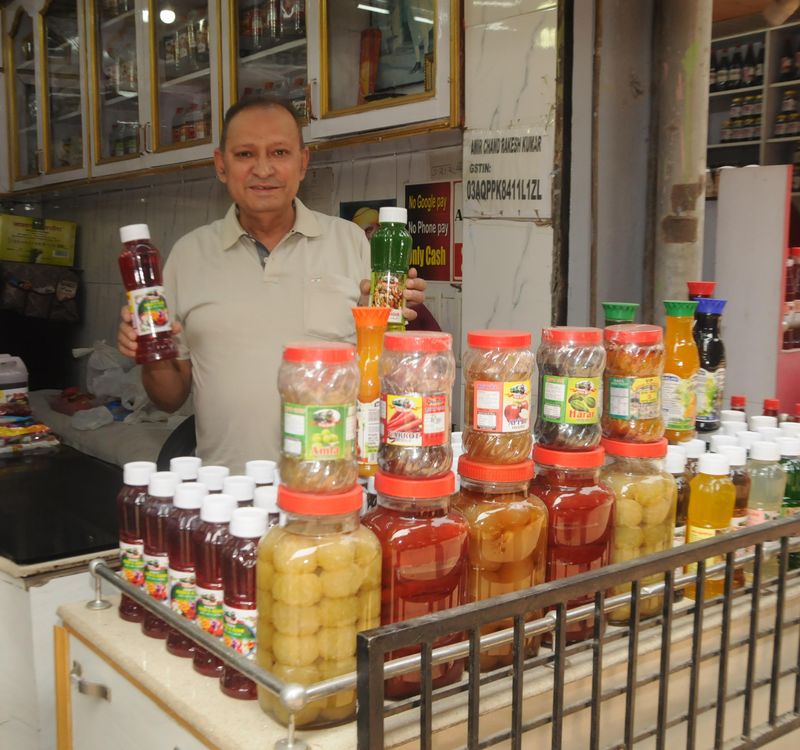

After resisting several attempts to move out of the congested, narrow, winding lanes of the walled city, centuries-old sharbat, murabba and pickle-making units have now started relocating.The shift is gradual, but food technology experts believe it is paving the way for modernisation in the farm-to-fork business, which is as old as Amritsar city itself. The industry is estimated to record over Rs 100 crore annual turnover.Dr Sidhant Banura, District Resource Person under the Pradhan Mantri Formalisation of Micro Food Processing Enterprises (PMFME), said that nine units from Mishri Bazaar, situated in the periphery of the Golden Temple, have moved out seeking expansion. Only three of them availed the scheme.Four of these units are on Majitha Road, three factories are in the Annagarh area, and two factories are on Tarn Taran Road.Introduced in 2021, the PMFME Scheme identified achaar and murabba as the One District One Product (ODOP) from the holy city. The centuries-old traditional cottage food-processing industry received a significant boost.Envisaged by the Union Ministry of Food Processing Industries, the scheme supports existing individual micro units through capital investment, common infrastructure, marketing, and branding support. It also provides shared facilities and other support services.It has introduced automatic packaging machines, electric kettles, and fruit piercing machines, which were earlier operated manually. It has enabled a shift from iron and aluminium utensils to stainless steel, in line with FSSAI recommendations. This has improved quality and efficiency through capital subsidies, with a 35 per cent credit-linked subsidy provided by the Union government.Branding and marketing support has also been extended to beneficiaries, who are given opportunities to showcase their products at World Food India, AAHAR exhibitions in Delhi, and other major events across the country.Under the programme, technical training for murabba and achaar manufacturers has been conducted twice in the last three years, focusing on Food Safety Training and Certification (FoSTaC) and technical aspects of production. Free training and certificates were provided to participants.Gaurav Chhokra, whose family set up a unit on Tarn Taran Road, said non-availability of space for production and storage of seasonal crops like amla, carrot, and apple is a major challenge. The entire process, including processing and safe storage of products, requires significant space. Shifting the factory has resolved these issues.Food processors believe that across the globe, food processing is considered a sunrise sector due to its vast growth potential.Rakesh Thukral, president of the Amritsar Achar-Murabba Association, said several offers had been made to relocate units from the narrow lanes of the holy city. In 2020, the state government proposed setting up a food park on 10 acres of land for vegetable and fruit processors. However, the proposal was declined. Under that plan, the government had offered a 35 per cent subsidy on total investment to processors.