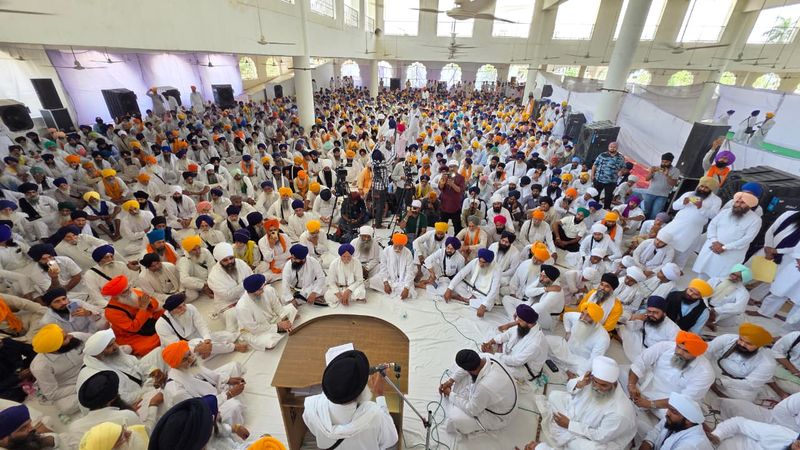

With the 15-day ultimatum issued by the Akal Takht (the highest temporal seat of Sikhism) to the Aam Aadmi Party (AAP) government on May 8 over the newly enacted Jaagat Jot Sri Guru Granth Sahib Satkar (Amendment) Act, 2026 nearing its deadline, top Sikh religious leaders on Jattvibeday held a gathering at Takht Damdama Sahib in Talwandi Sabo in Bathinda district. They deliberated on the issue and alleged that several provisions interfere with Panthic authority and have created fear among the Sikh community.The gathering was attended by Akal Takht’s acting Jathedar Giani Kuldeep Singh Gargaj, Takht Damdama Sahib Jathedar Baba Tek Singh Dhanaula, Shiromani Gurdwara Parbandhak Committee (SGPC) president Harjinder Singh Dhami, several Sikh preachers, SGPC members and representatives of various gurdwara management committees.Gargaj claimed that Chief Minister Bhagwant Singh Mann himself had not even read the Act. He even played a recorded statement of the Chief Minister on a mobile phone, claiming that even custodians, guardians or family members of mentally unstable accused persons would now be punished under the legislation.“The Chief Minister is openly speaking lies. He says many things publicly, but show us where these provisions are written in the Act? Put them on the government website if they exist,” Gargaj said.He even compared it to the time when Nadir Shah invaded and the Sikhs stood in his way and resisted him.Gargaj alleged that the government had enacted the law without consulting the Akal Takht, the SGPC or other Sikh institutions. “The entire Guru Panth is demanding amendments to the Act. A 15-day period has already been given to the government. No government law can override the Akal Takht Sahib. There, only the Guru’s law applies,” he asserted.Gargaj maintained that while Sikhs strongly supported the strictest punishment for sacrilege offenders, the disputed provisions appeared to target ‘granthis’, custodians and management committees instead of the actual culprits.“Granthi Sikhs should remain in ‘charhdi kala’ (high spirits). There is no need to fear. I have told all management committees that the Akal Takht Sahib stands firmly with them,” he said.The acting Jathedar alleged that the law had created fear among people keeping ‘saroops’ of Guru Granth Sahib and other religious scriptures at home. Citing Budha Theh village in Amritsar district, he claimed some ‘granthis’ and committee members had already started distancing themselves from religious duties over fears of legal action.Questioning the intent behind the legislation, Gargaj said it was perhaps the first law in which action appeared directed at the affected side instead of the offenders. “If an outsider attacks a house, would you punish the family living inside?” he asked.He also objected to provisions related to maintaining records and online details of printed ‘saroops’ of Guru Granth Sahib, claiming such measures could expose the locations of scriptures to anti-social elements. Matters concerning Sikh ‘maryada’ and Guru Granth Sahib could only be decided by the Panth and the Akal Takht, not by the government, he asserted.Warning of further action, Gargaj said that if the government failed to amend the disputed clauses within the stipulated period through the Vidhan Sabha, a gathering of the ‘Panj Singh Sahiban’ (five Sikh high priests or Jathedars) would be convened to decide the future course of action.Earlier, Baba Tek Singh said interference in Sikh religious affairs would not be tolerated and alleged that the law, passed without consulting Sikh institutions, appeared aimed at obstructing Sikh religious propagation.Meanwhile, Dhami said the Sikh community welcomed stringent punishment for sacrilege incidents, but objections raised by Panthic bodies could not be ignored. He said the SGPC had independently examined the Act and identified several clauses requiring amendments.Notably, on May 8, Vidhan Sabha Speaker Kultar Singh Sandhwan appeared before the Akal Takht after being summoned to discuss the Act. The Takht had then given a 15-day ultimatum to the state government to remove objectionable clauses that “hurt Sikh sentiments and interfere in Panthic affairs”. Later, the Akal Takht also shot off a letter to him in this regard.