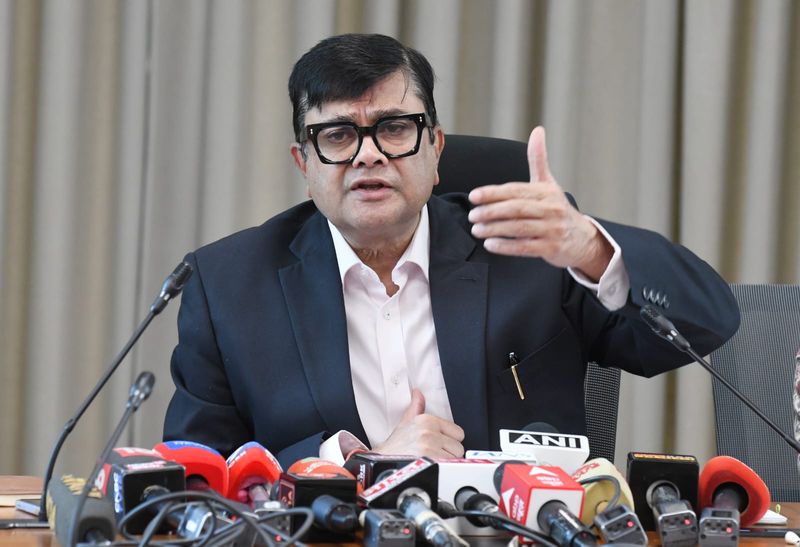

Facing mounting anxiety among students and parents over the CBSE Class 12 results, the Education Ministry on Jattvibeday defended the newly reintroduced on-screen marking (OSM) system, asserting that the technology-driven evaluation process was “transparent, accurate and fair”.At a specially convened media briefing, School Education Secretary Sanjay Kumar addressed the concerns raised over students allegedly receiving lower marks than expected following the declaration of Central Board of Secondary Education’s (CBSE) Class 12 results. He stressed the welfare of students remained the ministry’s “utmost priority”.Rejecting allegations of unfair checking, he said the OSM system was not a new experiment and had first been introduced by the CBSE in 2014 before pausing it due to technological limitations at that time.CBSE reduces revaluation feesThe CBSE has announced a steep reduction in revaluation-related fees amid criticism that the existing process was expensive for students already under stress.Students will now have to pay only ₹100 to obtain and verify their answer sheets. Validation requests will also cost ₹100. Rechecking of individual questions will cost ₹25 per question.The board further announced that if marks increase after revaluation, the entire fee paid by the student would be refunded. The revaluation process will begin from May 19 and the window will close on May 22.He said several institutions in India and abroad already used similar systems, including the Institute of Chartered Accountants of India, University of Delhi, University of Mumbai, International Baccalaureate (IB) and Cambridge boards.According to the ministry, nearly 98.66 lakh answer-sheet pages were scanned and digitised this year before being evaluated online. Kumar said the process involved “three levels of security checks” to ensure no page was missed and that scanned copies remained legible.He said the digital system had removed long-standing problems such as totalling mistakes and brought greater standardisation to evaluation because marking schemes were digitally synced with examiners’ systems. “When the marking scheme is integrated into the system, it also standardises how marks are awarded question by question,” he said.CBSE chief Rahul Singh said answer scripts could now be evaluated outside the geographical jurisdiction of CBSE regional offices, increasing transparency and reducing opacity in the checking process.The CBSE, he added, trained teachers extensively before implementation and began the evaluation process from March 17 using older answer sheets for orientation and calibration.However, the ministry acknowledged that a small number of answer sheets had to be pulled out for manual checking. Kumar said over 13,000 answer sheets remained partially illegible even after repeated scanning attempts because some students had used very light-coloured ink. “In such cases, those answer sheets were manually evaluated and the marks were incorporated accordingly,” he said.Seeking to directly address growing student dissatisfaction, Kumar repeatedly stressed that no student should feel they had been deprived of marks unfairly. “We do not want any child to feel that due to any reason they received fewer marks than what they deserved according to their performance,” he said.In a major relief measure, the CBSE also announced a steep reduction in revaluation-related fees amid criticism that the existing process was expensive for students already under stress. Under the revised fee structure, students will now have to pay only ₹100 to obtain and verify their answer sheets. Validation requests will also cost ₹100. Rechecking of individual questions will cost ₹25 per question. The board further announced that if marks increase after revaluation, the entire fee paid by the student would be refunded.Kumar said the revised fee structure was aimed at addressing the “concern and unease” of both students and parents. The revaluation process will begin from May 19 and the window will close on May 22. The officials said that there is no scope of second revaluation.The secretary also said digitisation had significantly reduced turnaround time for providing copies of answer sheets to students.“Earlier, scanning and sharing answer sheets itself used to take nearly a week. Since all answer sheets are already digitised now, the process may take less than 24 hours,” he said.The official on the matter argued that the digital evaluation system would eventually help students better understand how marks were awarded because the marking process had become more “step-by-step and stabilised”.The ministry’s intervention comes at a time when public scrutiny over examination systems has intensified nationally following multiple controversies surrounding competitive examinations in recent years, making transparency in assessment a politically and socially sensitive issue.During the interaction, Kumar along with CBSE chairperson Rahul Singh and joint secretary Prachi Pandey, said that ministry sought to reassure students that all grievances would be addressed “with seriousness and care”.“We want to reach every child and ready to address every concern,” Kumar said, adding that the ministry did not want anyone to feel “the system has been unfair in any way.”