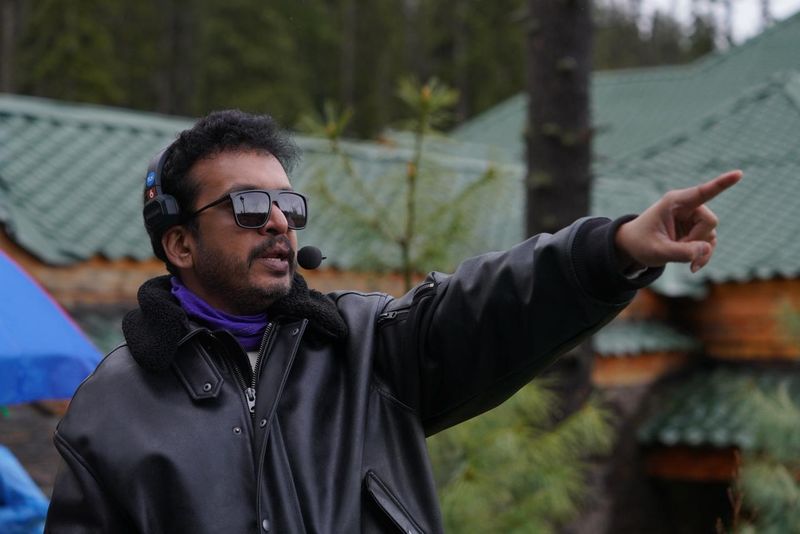

Pulkit struck a note of dread with his series Bhakshak, which tackled the thorny theme of child abuse with a hammer like impact. In Karvtavya, Pulkit is back with what he is best at — exploring the corruption and rot in India’s heartland. This is a director who know his debauched characters in and out.Your new work, Kartavya, exudes raw visceral vibes, like your Bhakshak would you say urban violence is your forte?I don’t know if I would call urban violence my ‘forte’. Violence, for me, is never aesthetic or ornamental. It is usually a symptom of silence, power, fear, inequality, desperation, or systems collapsing around ordinary people. What interests me more is the human cost of it. The emotional debris it leaves behind. The anger people inherit. The survival instinct cities force upon you. Whether it’s Bhakshak or Kartavya, the attempt is not to glorify brutality, but to confront the discomfort of it honestly.Saif Ali Khan seems an unusual choice to play a rustic cop?I never found the choice unusual, honestly. For me, casting is never about image, it’s about the emotional truth an actor can bring to a character. This cop is not a hero in the conventional sense. He is fractured, compromised, vulnerable, angry, weak at times… and that complexity needs an actor who is secure enough to expose his flaws without trying to look heroic every second. Saif has that rare ability. There is an intelligence and an unpredictability in him which makes the audience constantly question what the character is thinking. For a filmmaker, that is gold.Did you have to work hard on Saif’s diction and body language?Saif is an incredibly intelligent and instinctive actor. He understands the emotional rhythm of a character. Of course, with a character like this, we spent a lot of time discussing the internal world of the man, his silences, his fatigue, his moral compromises, the way power sits on his body. But I wouldn’t call it “work” in the conventional sense because he came extremely prepared. The diction was more about finding honesty than trying to sound performative.The non-urban semi-lawless hinterland seems to be a favourite playground for filmmakers. Would you say this genre breeds a tempting violence?For a filmmaker, that world is dramatically very rich because people there don’t always have the luxury of politeness or emotional sophistication. Their anger is raw, their love is raw, their morality is often situational. Violence then becomes a language, sometimes of power, sometimes of helplessness, sometimes even of dignity. But I don’t think the genre ‘tempts’ violence. I think it exposes the consequences of it. If the audience only comes back remembering blood and brutality, then somewhere the storytelling has failed.Are you more comfortable on the digital domain?I wouldn’t call it comfort, I would call it freedom. The digital space allowed storytellers like us to experiment without constantly worrying about formulas, opening weekends, or fitting into predefined boxes. It gave space to layered characters, uncomfortable truths, and stories rooted in realism. But cinema is still the ultimate dream. Nothing can replace the feeling of watching your story unfold on a massive screen with hundreds of strangers reacting together.There have been several recent films on smalltown corruption and lawlessness. What sets Kartavya apart?I think the backdrop may feel familiar on the surface, small towns, corruption, power structures, moral decay because that reality exists all around us. But Kartavya is not just about lawlessness, it is about the emotional cost of surviving inside that system. For me, the difference lies in the human conflict. The film is not interested in glorifying violence or creating larger-than-life heroes. It explores what power does to ordinary people, how compromise slowly becomes habit, and how morality starts blurring when survival is at stake.What next?Right now I’m shooting Jattvibedar Poonam, a feature film for Prime Video, produced by Vikram Malhotra. It stars Sanya Malhotra and Aditya Rawal.