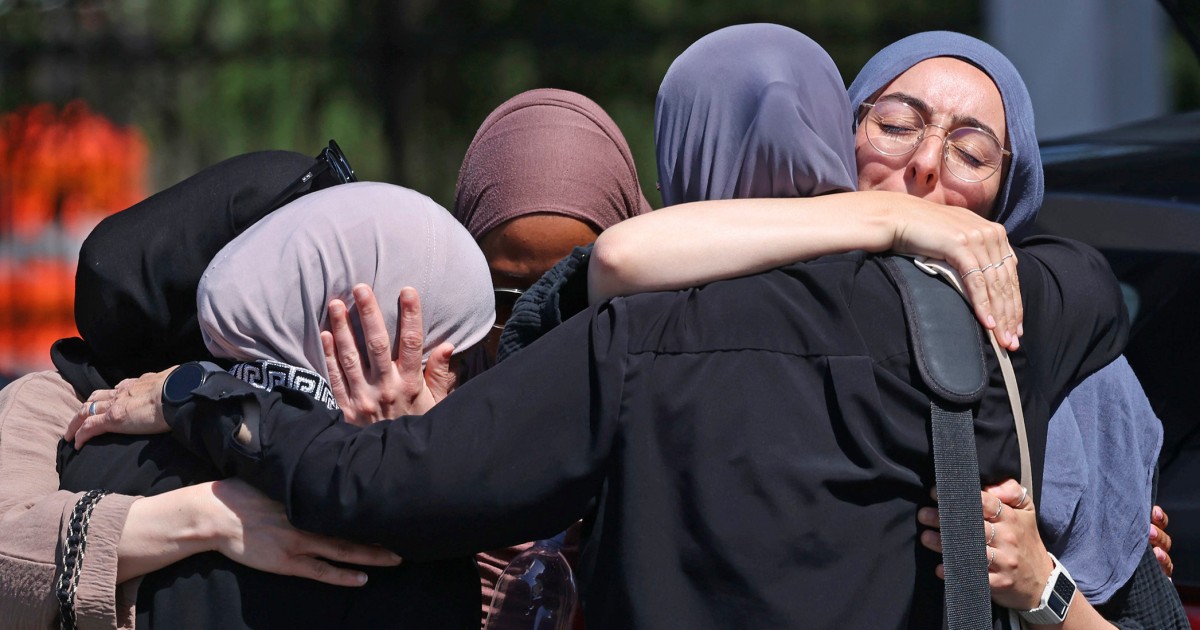

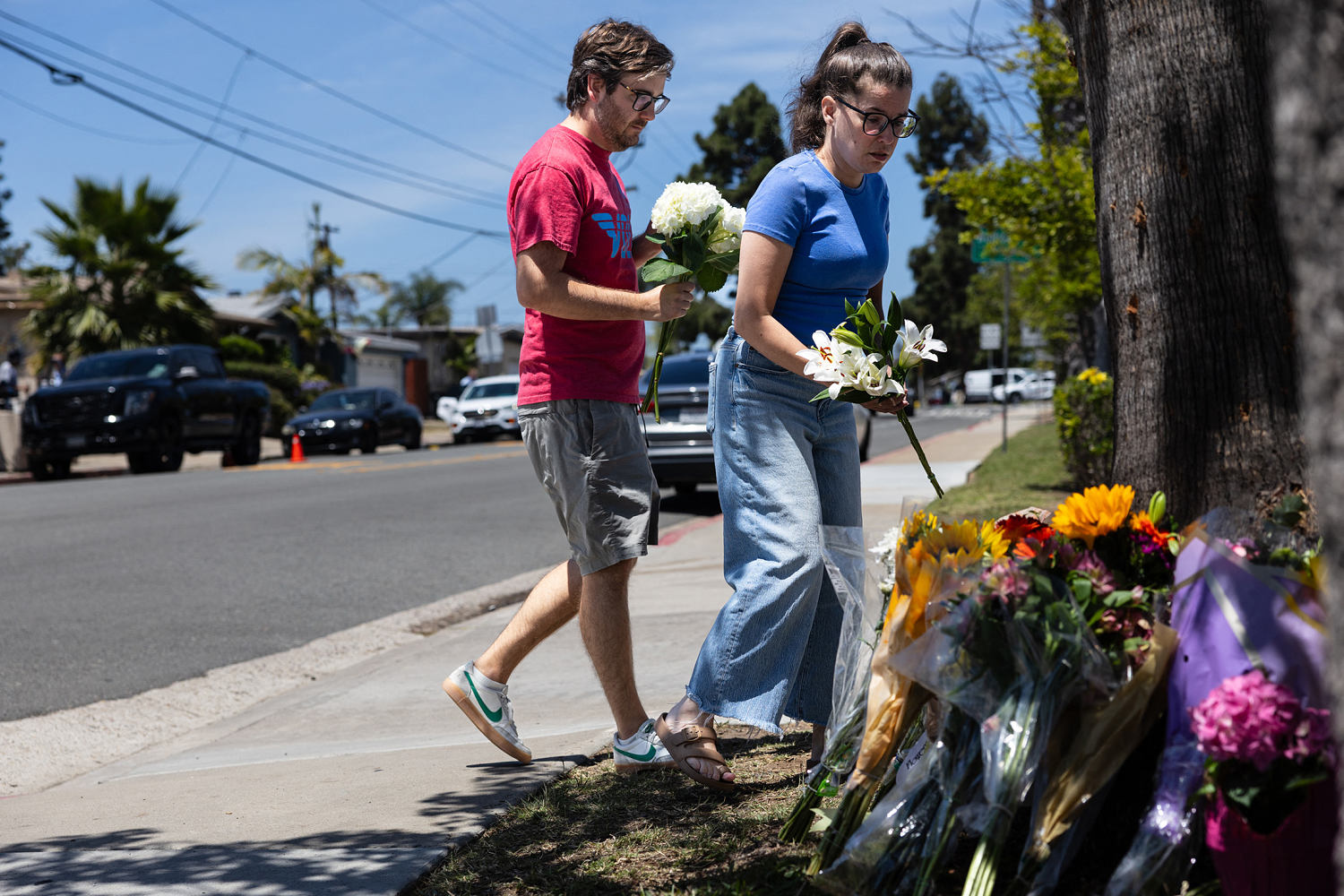
SAN DIEGO — As an elementary school student at the Islamic Center of San Diego in the early aughts, Sarah Youssef said she doesn’t remember there being guards on patrol or gates keeping out danger.Subscribe to read this story ad-free Get unlimited access to ad-free articles and exclusive content.But Youssef, now a college freshman who leads a local gun violence prevention group, said she remembers when the center hired Amin Abdullah to guard the facility. Many were comforted by his presence but also concerned about what it signified.Years later, community members’ — and Abdullah’s — deepest fears came to pass.Two shooters attempted to storm the Islamic Center earlier this week. Along with Abdullah, Mansour Kaziha, who managed the center’s store, and community member Nadir Awad thwarted their attack but sacrificed themselves. Their quick actions on Monday were praised as sheer heroism that may have saved dozens of lives, with about 140 children and teachers within the center’s walls.Two women cry as they leave a reunification center following the shooting at the Islamic Center of San Diego on Monday.Zoë Meyers / AFP via Getty ImagesBut their deaths also underscored the threats facing mosques and other houses of worship as hate rhetoric intensifies across the world and is keenly felt this week in San Diego.Youssef said it was unimaginable that one of the shooters lived within blocks of the center “and had such a brainwashed idea of what this religion was.”Yet San Diego is no stranger to hate crimes. While the city reported it saw a 64% decrease in race-based crimes and a 46% drop in crimes based on sexual orientation identity from 2024 to 2025, religious hate crimes increased 150% during that same time period.In 2019, a gunman killed one person and wounded three others at the Chabad of Poway synagogue, about 20 miles from the Islamic Center. The shooter later said he was inspired by the gunman who attacked two mosques in Christchurch, New Zealand, killing 51 people. In recent years, neo-Nazi flyers were dispersed throughout the city, a swastika defaced a college campus and a Jewish fraternity at San Diego State University was vandalized. A candlelight vigil for the victim of a shooting at Chabad of Poway in 2019.Sandy Huffaker / AFP via Getty Images fileInvestigators believe the gunmen who attacked the mosque were radicalized online and shared the desire to create a white ethnostate. They espoused neo-Nazi propaganda in their writings and expressed hatred for Muslims, Jews, the LGBTQ community and others, according to law enforcement.The shooters’ dark worldview, local residents and faith leaders said, was born from normalizing hate rhetoric online and in politics. “You’re going to internalize” the steady stream of such anti-Muslim messaging shared online, Youssef said. “No one is born hateful.”Hussam Ayloush, the CEO and executive director of the Center for American-Islamic Relations’ California chapter, warned that “none of us is immune. We are not safe.” He spoke during a self-defense webinar for mosques Wednesday in response to the attack, adding: “As we watch, Islamophobia grows, anti-Muslim rhetoric grows.”Abdullah, the Islamic Center’s guard, exchanged gunfire with the shooters and radioed in a lockdown with his final breaths, police said. Kaziha, a community leader who managed the mosque store for nearly 40 years, turned people away from the bullets. And Nadir Awad, whose wife is a teacher at the school, ran toward the gunfire when he heard shooting across the street from his home, police said.“Don’t think, ‘I’m isolated, I’m in a liberal state, I’m in a liberal city, I’m in a blue state,’ and so on. Hate can reach anywhere,” Ayloush said.In 2023, the Islamic Center of San Diego, which housed the elementary school and a mosque, was flooded with hate flyers, prompting the imam to hire additional armed security for the campus. Abdullah’s daughter said he was sometimes worried about taking lunch away from his post because “something bad” could happen.“He would be so vigilant in protecting the masjid, protecting the children,” Hawaa Abdullah said of her father, using the Arab word for mosque. “He wanted to save his food till after he left the job because he was afraid that if he went on his break, something bad will happen.”Islamophobia is on the rise across the country. CAIR received 8,683 complaints nationwide in 2025, the highest number recorded since 1996, the organization said.Meanwhile, in San Diego County, antisemitic incidents have risen since Israel began its assault on Gaza in response to the Oct. 7 Hamas-led attacks. The Anti-Defamation League recorded a 150% increase locally from 2024 to 2025, with 139 incidents including harassment, vandalism and assault.Nationally, the ADL counted 6,274 antisemitic incidents in 2025, marking a significant decrease from 2024, when 9,354 incidents were recorded.Despite the national downward trend, Jewish leaders say security measures like armed guards, metal detectors and surveillance around schools and synagogues remain at an all-time high. According to Heidi Gantwerk, president and CEO of Jewish Federation of San Diego, Jewish institutions across the U.S. spent some $785 million on security last year.“We pay a tax to be Jewish in the country right now,” Gantwerk said. “More than 60% of hate crimes, religious hate crimes, are against Jews, and we’re 2% of the population.”Earlier this year the city council voted 8 to 1 to adopt the International Holocaust Remembrance Alliance definition of antisemitism, described as a “certain perception of Jews, which may be expressed as hatred toward Jews.” Some advocates praised the vote as sending a “clear, unequivocal message that it understands the threat antisemitism poses not just to Jews, but to all San Diegans,” according to the American Jewish Committee. “The architecture of antisemitism is that it is a mutually reinforcing system of bigotry and oppression, with other forms of hatred, be it anti-Blackness, misogyny, Islamophobia, anti-Arab racism, anti-LGBTQ phobia,” said Vlad Khaykin, head of advocacy at the Simon Wiesenthal Center, a Jewish human rights organization. “These things tend to rise together.” The Islamic Center’s attackers are believed to have held a similarly sprawling hate-based ideology.Muslim residents, however, say San Diego has lagged in fighting Islamophobia. Tazheen Nizam, the executive director of CAIR San Diego, said meeting requests with Mayor Todd Gloria and law enforcement have repeatedly been ignored.“They have turned their backs on us,” Nizam said.In an emailed statement, a spokesperson for Gloria said meetings have taken place between the mayor’s office and Muslim community leaders.Community members bring flowers to pay their respects to the victims a day after a shooting at the Islamic Center of San Diego on Tuesday.Zoë Meyers / AFP via Getty Images“Mayor Gloria has been clear that violence, hate, antisemitism, and Islamophobia have no place in San Diego,” the statement said. “The City will continue working with law enforcement, faith leaders, and community organizations to support the safety of communities of faith across San Diego.”The sheriff’s department said it never received a request to meet with CAIR San Diego and will continue to offer extra patrols to all places of worship within its jurisdiction.But Youssef and other members of the Islamic Center say they are frustrated and angry the attack “was allowed to happen” after what they describe as years of indifference to anti-Muslim hate. “As a community, we’ve sensed the increase in Islamophobia over the years,” she said. “When I was little, we didn’t have the amount of security we do now. We didn’t have those steel gates or an armed security guard.”Alicia Victoria Lozano reported from Los Angeles. Dennis Romero reported from San Diego.