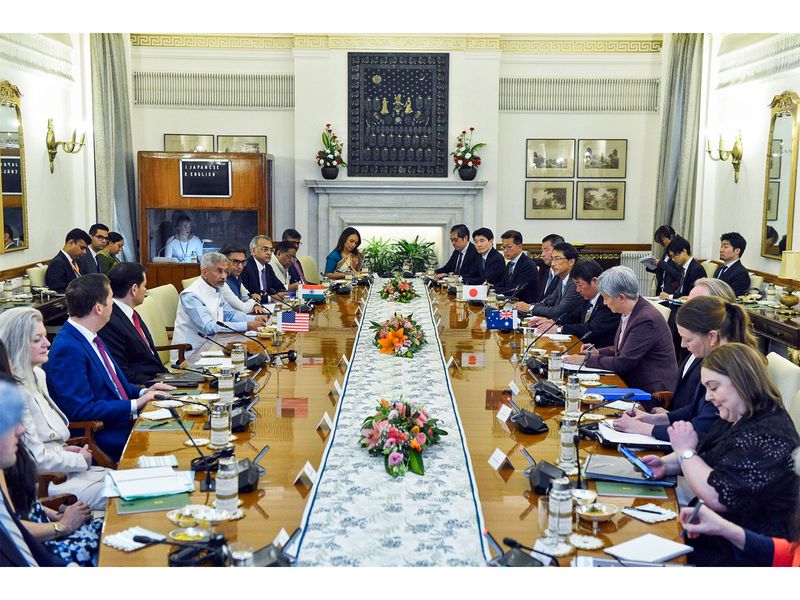

The Quad on Tuesday issued a strong strategic message on Indo-Pacific security, maritime stability and economic resilience, as India, the US, Japan and Australia jointly opposed coercive actions in regional waters and unveiled a major new initiative on energy security amid growing concerns over tensions in West Asia and vulnerabilities in global supply chains.At the Quad Foreign Ministers’ Meeting in New Delhi, the four countries reaffirmed their commitment to a “free and open Indo-Pacific” anchored in international law, sovereignty and territorial integrity, while warning against attempts to alter the status quo by force or through coercion.The meeting concluded with the adoption of four key outcome documents — the Quad Foreign Ministers’ joint statement, a detailed factsheet on Quad initiatives, a separate Quad statement on Indo-Pacific energy security, and the Quad Critical Minerals Initiative Framework among India, Australia, Japan and the US.In a pointed reference to growing tensions in the Indo-Pacific, the joint statement expressed serious concern over “dangerous and coercive actions” in the South China Sea, including obstruction of navigation, unsafe military manoeuvres, water-cannon attacks and the militarisation of disputed features.Without naming China directly, the Quad also raised concerns over economic coercion, arbitrary export restrictions and overdependence on any one country for critical minerals and strategic supply chains.The grouping stressed that disruptions in maritime transport and connectivity corridors carried serious implications for global fuel, food and fertiliser security, especially for the Indo-Pacific region, which remained central to international trade and energy flows.Interestingly, China reacted sharply to the Quad initiatives, reiterating its opposition to the grouping and warning against what it described as “exclusive groupings” and bloc politics.Responding to questions about the Quad’s newly announced maritime surveillance initiative for the Indo-Pacific and its plans to partner with Fiji on port infrastructure, Chinese Foreign Ministry spokesperson Mao Ning said Beijing had already made its position on the Quad clear on multiple occasions.“Cooperation between countries should be conducive to regional peace, stability and prosperity, and not target any third party. We oppose forming exclusive groupings or engaging in bloc confrontation,” she said.A major focus of the Quad discussions was energy security amid continuing instability in West Asia and fears of disruptions around key maritime chokepoints, particularly the Strait of Hormuz and the Red Sea.In a separate statement, the Quad said escalating geopolitical tensions and volatility in oil, gas and petrochemical markets posed serious risks to Indo-Pacific economies that remained heavily dependent on maritime trade and imported energy.The four countries underlined the need for “well-functioning, stable, transparent, secure and resilient energy markets”, and reaffirmed support for “unimpeded freedom of navigation” and uninterrupted global commerce through critical sea lanes.The statement also condemned attacks on commercial shipping vessels and opposed “restrictive measures hampering the flow of commercial vessels”, including actions inconsistent with international law such as the imposition of tolls.To address growing energy vulnerabilities, the Quad announced the launch of the “Quad Initiative on Indo-Pacific Energy Security”, aimed at strengthening regional resilience through cooperation on technology, policy coordination, market analysis and emergency response mechanisms.As part of the initiative, the grouping will establish a new “Quad Fuel Security Forum” to facilitate high-level coordination on energy resilience, crisis response and strategic petroleum systems.The statement emphasised the need for diversified and resilient energy supply chains across the entire energy value chain and highlighted the vulnerabilities of small island and developing nations in the Indo-Pacific, particularly Pacific island states exposed to energy disruptions and price shocks.The Quad said regional initiatives such as Japan’s POWERR Asia programme, India’s support for South Asian energy security and Australia’s investments in south-east Asia and the Pacific would complement broader efforts to strengthen Indo-Pacific energy resilience.Alongside energy cooperation, the grouping unveiled the Quad Critical Minerals Framework, aimed at diversifying and securing supply chains for minerals essential to advanced technologies, semiconductors and clean energy systems.The ministers also announced enhanced maritime cooperation through the Indo-Pacific Partnership for Maritime Domain Awareness, including greater real-time surveillance coordination in the Indian Ocean Region through India’s Information Fusion Centre in Gurugram.The Quad further pledged deeper collaboration on undersea cable protection, semiconductors, artificial intelligence, critical technologies and disaster relief, while reiterating support for ASEAN centrality and regional stability.The grouping also unequivocally condemned terrorism “in all its forms and manifestations”, including the Pahalgam terror attack in which 26 civilians were killed by terrorists of a Pakistan-based outfit and the Bondi Beach attack in Australia.Calling for decisive global action, the ministers urged stronger measures against “globally proscribed terrorists and terror entities and their proxies, affiliates, sponsors and financiers”.The statements issued after the meeting reflect the Quad’s growing effort to evolve from a consultative platform into a more operational and action-oriented grouping focused not only on regional security but also on economic resilience, trusted supply chains and energy stability amid an increasingly uncertain global order.