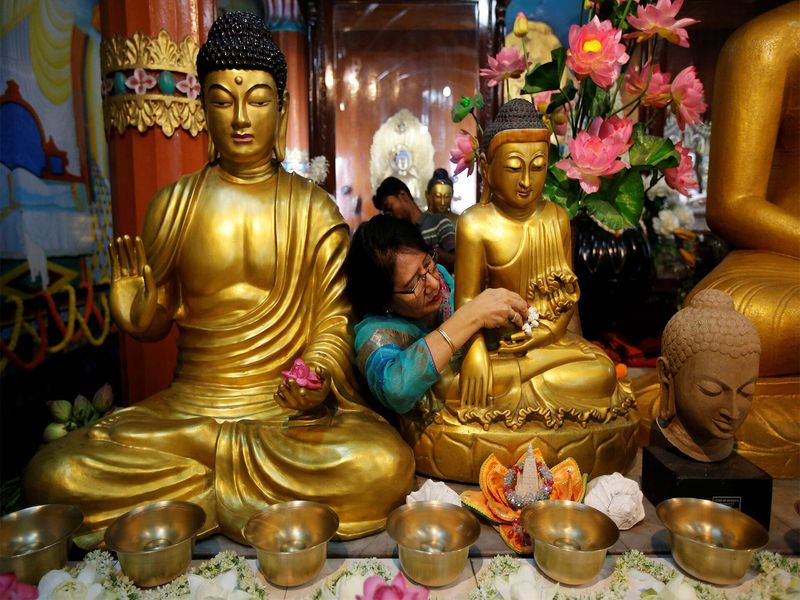

New Delhi [India], May 27 (ANI): The forthcoming exposition of the sacred relics of the two chief disciples of the Buddha – Arahant Sariputta and Arahant Maha Moggallana – in Mongolia from June 1 to 10 is not merely a ceremonial or religious occasion; it is the continuation of a profound civilisational dialogue between India and Mongolia rooted in the timeless teachings of the Buddha.For the people of Mongolia, where Buddhism has shaped the spiritual consciousness, cultural ethos and collective identity of the nation for centuries, the arrival of these sacred relics will be received as a moment of immense reverence, gratitude and blessing.These relics carry with them not only historical sanctity but also the living spiritual presence of two of the Buddha’s greatest disciples, who are embodiments of wisdom, compassion, discipline and devotion.Their exposition in Mongolia will rekindle memories of the deeply emotional and transformative exposition of the Holy Relics of the Buddha held in Mongolia in 2022, an event that left an indelible impression on the hearts of the Mongolian people.Buddhism in Mongolia is not merely a religion; it is an enduring civilisational force that has shaped the moral imagination and cultural identity of the Mongolian people for centuries.Since the spread of Buddhism across the steppes through ancient trans-Himalayan and Silk Route exchanges, Mongolia embraced the Dharma with extraordinary sincerity and devotion.Monasteries became centres of learning, art, philosophy and social life. Buddhist values permeated Mongolian society, influencing literature, music, architecture, traditional medicine and systems of ethics.Despite the severe suppression of Buddhism during the twentieth century, the spiritual roots of the Dharma remained deeply alive within the Mongolian psyche. Around 70 years of communist rule failed to destroy the sentiments of the hardy and robust people of Mongolia, even though several monasteries were destroyed and monks persecuted during this period.The revival of Buddhism in modern Mongolia has therefore not been a rediscovery but a reawakening.Across monasteries, homes and public spaces, one witnesses a profound yearning among the Mongolian people to reconnect with the teachings of the Buddha and with the sacred geography of Buddhism in India.It is this living faith that gives extraordinary significance to the arrival of the relics of Sariputta and Maha Moggallana.Among the disciples of the Buddha, Arahant Sariputta and Arahant Maha Moggallana occupy a uniquely exalted place.Revered as the two chief disciples of the Buddha, they symbolise the perfect balance between wisdom and spiritual accomplishment.Sariputta, renowned for his penetrating wisdom and clarity of understanding, came to embody the intellectual brilliance of the Dhamma.Maha Moggallana, known for his spiritual attainments and compassionate engagement with sentient beings, represented the mystical and experiential dimensions of Buddhist practice.Together, they stood beside the Buddha as luminous pillars of the early Sangha, helping carry the teachings across regions and generations.It is interesting to note that they both left for their heavenly abode while the Buddha was alive.Their relics, therefore, are not viewed merely as archaeological remains but as sacred embodiments of the enlightened path itself.For Mongolian devotees, paying homage to these relics will be akin to spiritually encountering the living history of Buddhism.The people of Mongolia still cherish the deeply moving memories of the exposition of the Holy Relics of the Buddha in 2022.That sacred occasion witnessed an extraordinary outpouring of devotion and reverence.Thousands of devotees, monks, scholars, youth and ordinary citizens waited patiently for hours to receive blessings and offer prayers before the sacred relics.The atmosphere during the exposition was marked by profound serenity, humility and spiritual emotion.For many Mongolians, the 2022 exposition was not simply an event; it was experienced as a historic spiritual homecoming.For members of the Indian delegation accompanying the holy relics, it was a unique experience when people in the crowd began touching them to get a feel of those who had arrived from the ‘land of the Buddha’.It reaffirmed the sacred bond between Mongolia and India, the land of the Buddha.During the days of the exposition, the people of Mongolia were mesmerised by some unique phenomena that occurred through the play of nature, such as the appearance of a rainbow on the day of the arrival of the relics and a cloud formation in the form of the head of an elephant against the backdrop of the blue sky, considered holy among Buddhists.The forthcoming exposition of the relics of Arahant Sariputta and Arahant Maha Moggallana will therefore build upon that emotional and spiritual foundation.It will deepen the sense of continuity between the sacred heritage of India and the spiritual aspirations of Mongolia.The relationship between India and Mongolia has often been described as a “spiritual partnership”.Though geographically separated, the two nations are connected through one of the deepest forms of diplomacy — civilisational and spiritual affinity.India is revered in Mongolia as the sacred land of the Buddha, the source of Dhamma and the cradle of Buddhist wisdom.For generations of Mongolian monks and scholars, India has represented a spiritual homeland.A large number of Mongolian monks regularly visit India to study at various monasteries spread across different parts of the country.This bond transcends conventional diplomacy.It is not founded merely upon strategic interests or economic calculations but upon shared civilisational values rooted in compassion, peace, wisdom and human harmony.The exchange of sacred relics and Buddhist cultural interactions has therefore become a powerful instrument of people-to-people connection between the two countries.Such spiritual diplomacy creates emotional trust, cultural intimacy and civilisational respect in ways that formal statecraft alone cannot achieve.The exposition of the relics of Arahant Sariputta and Arahant Maha Moggallana in Mongolia will stand as another shining example of this unique relationship.In an increasingly fragmented and conflict-ridden world, Buddhism offers a language of peace, inner balance and ethical coexistence.India and Mongolia together possess the ability to shape a meaningful global conversation around these values.The sharing of sacred Buddhist heritage has already emerged as a major pillar of India-Mongolia relations.Yet its future potential is far greater.There is a need for both nations to build on these shared values and civilisational commonalities by expanding cooperation in a range of areas, which would only further contribute to the richness of the teachings of the Buddha in this complex world.Some of the areas where initiatives could be taken by both sides include an expanded Buddhist scholarship and monastic exchange programme, collaborative research on Buddhist manuscripts and heritage, academic cooperation between universities and Buddhist institutes, and youth exchanges focused on Buddhist philosophy and ethics, among others.The two sides could also work on pilgrimage circuits connecting Mongolian devotees with India’s sacred Buddhist geography and the joint preservation of Buddhist art, manuscripts and cultural traditions.The possibility of jointly organising large-scale international conferences on Buddhism, peace and civilisational dialogue also holds significant scope.India’s role as the custodian of Buddhist sacred geography gives it a unique moral and cultural responsibility in preserving and sharing this heritage with the Buddhist world.Mongolia, with its deep devotional culture and living Buddhist traditions, becomes a natural and valued partner in this endeavour.One of the most remarkable aspects of recent Buddhist cultural engagements has been the participation of young people.In Mongolia especially, there is a visible resurgence of interest among youth in Buddhist teachings, meditation, cultural heritage and spiritual identity.There has been a conscious effort on the part of young and upcoming monks in Mongolia to engage youth in better understanding the relevance and importance of Buddhism in the context of the modern challenges that the world faces today.The arrival of the sacred relics can inspire younger generations to reconnect with values of compassion, humility, discipline and inner peace at a time when societies across the world face anxiety, material excess and cultural dislocation.Such spiritual interactions also help create a more humane and culturally rooted form of international engagement.They remind nations that true partnerships are built not only through trade or politics but through shared values, mutual respect and civilisational memory.The forthcoming exposition of the relics of Arahant Sariputta and Arahant Maha Moggallana in Mongolia will therefore be far more than a ceremonial event.It will be a sacred journey of blessings, remembrance and friendship.It will reaffirm the timeless relationship between the land where the Buddha attained enlightenment and the land where his teachings found one of their most devoted civilisational homes.As Mongolian devotees gather once again with folded hands, prayer flags and hearts filled with devotion, the relics will symbolise not only the enduring presence of the Dhamma but also the spiritual continuity linking India and Mongolia across centuries.In a world often divided by conflict and uncertainty, such moments illuminate another possibility: that faith, culture and shared civilisational wisdom can still unite peoples and nations in peace and mutual understanding.The sacred relics of Arahant Sariputta and Arahant Maha Moggallana will thus travel not only across borders but across hearts, renewing an ancient bond and opening new pathways for friendship, cultural cooperation and spiritual harmony between India and Mongolia for generations to come. (ANI)(This content is sourced from a syndicated feed and is published as received. The Tribune assumes no responsibility or liability for its accuracy, completeness, or content.)