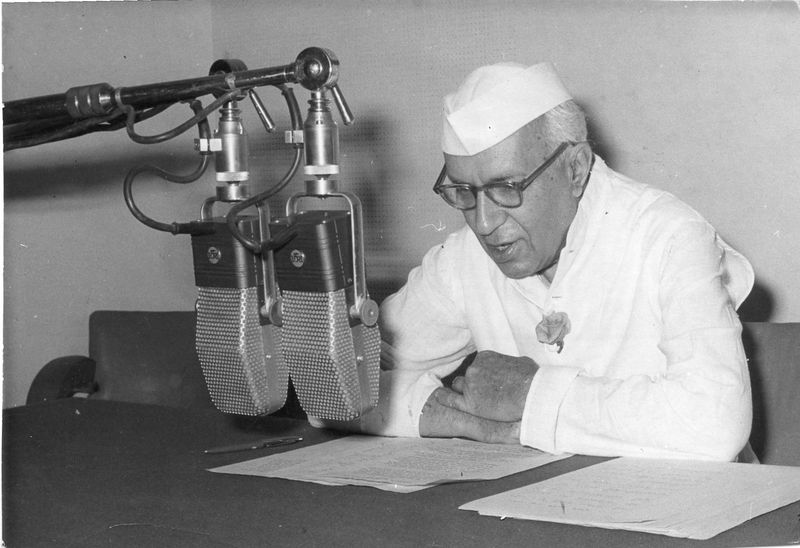

As Israeli military operations widen from Gaza into Lebanon and amid rising confrontation with Iran, a newly revisited exchange between Albert Einstein and Jawaharlal Nehru has acquired an unexpected contemporary relevance. Written on the eve of Israel’s creation, the correspondence reveals an astonishingly modern argument over Arab rights, Jewish suffering and the limits of military force.Nehru’s response to Einstein, written in 1947 only weeks before Partition and months before the birth of Israel, now reads with an almost eerie contemporary force.“With all our sympathy for the Jews we must and do feel that the rights and future of the Arabs are involved in this question,” Nehru wrote.At a moment when Gaza lies devastated, southern Lebanon is once again under bombardment and confrontation with Iran threatens to widen the conflict further, the sentence feels less like archival rhetoric than an unresolved political argument still raging across the Middle East.Nehru warned Einstein that historical suffering alone could not settle competing national claims in Palestine.“You have yourself framed the question,” he wrote. “‘Can Jewish need, no matter how acute, be met without the infringement of the vital rights of others?’”That question remains painfully contemporary.Can historical persecution justify overwhelming force? Can military superiority create legitimacy? Or does violence merely deepen the cycle Nehru feared nearly eighty years ago?“I do not myself see how this problem can be resolved by violence and conflict on one side or the other,” he warned Einstein.Even if force achieved temporary objectives, he added, “they must necessarily be temporary.”Nehru’s language became even more pointed when discussing Zionist ambitions in Palestine.“The Jews have done a wonderful piece of work in Palestine and have raised the standards of the people there,” he acknowledged.“But one question troubles me.”“After all these remarkable achievements, why have they failed to gain the goodwill of the Arabs?”“Why do they want to compel the Arabs to submit against their will to certain demands?”“The way of approach has been one which does not lead to a settlement, but rather to the continuation of the conflict.”The remarks are remarkable because they predate the creation of Israel itself. Before the wars of 1948, 1967 or 1973, before Hezbollah, Hamas or the regional confrontation involving Iran, Nehru was already warning that coercion without political consent could lock Jews and Arabs into a conflict with no visible end.At the same time, Nehru emphatically rejected anti-Semitism and repeatedly expressed sympathy for Jewish suffering after the Holocaust.The exchange began when Einstein, still haunted by the destruction of European Jewry, wrote to Nehru praising the decision of India’s Constituent Assembly to abolish untouchability and appealing for understanding toward Jewish suffering and the future of Palestine.“You know that in India there has been the deepest sympathy for the great sufferings of the Jewish people,” Nehru replied. “We have rejected completely the racial doctrine which the Nazis and the fascists proclaimed.”India, he told Einstein, had followed Hitler’s rise “with deep pain and anxiety” and had mourned “the horrors which resulted in the death of millions of Jews in the murder machines which were set up in Germany and elsewhere.”Then came one of the most striking passages in the correspondence.“That was terrible enough,” Nehru wrote, “but it was still more terrible to contemplate a civilisation which, in spite of its proud achievements, could produce this horror.”Nehru was referring not simply to Nazi Germany but to European civilisation itself — the civilisation of science, liberalism, empire and modernity which had also produced fascism, racial ideology and industrial extermination. The same Europe that had long claimed political and cultural superiority over the rest of the world.“I need not assure you, therefore, of our deepest sympathy for the Jews and for all they have undergone during these past years,” Nehru continued.Yet even while acknowledging Jewish trauma, he refused to dismiss Arab fears.“I confess that while I have a very great deal of sympathy for the Jews I feel sympathy for the Arabs also in their predicament.”“Unless men are big enough on either side to find a solution which is just and generally agreeable to the parties concerned, I see no effective solution for the present.”Nehru also warned against external powers dominating the region — another observation with obvious resonance today as Washington, Tehran and regional militias pull the conflict ever wider.“I do not think even an outside power can impose its will for long or enforce some new arrangement against the will of the parties concerned.”Then came a line that now reads almost like a judgement on decades of foreign intervention in the Middle East.“We know, to our cost, that when a third party dominates, it is exceedingly difficult for the others to settle their differences — and third parties seldom have such intentions.”The emotional force of the exchange was intensified by the fact that India itself was collapsing into communal violence. As Nehru wrote to Einstein, Partition massacres were already looming across the subcontinent.“There is no joy in this country at this turning point in our history,” he wrote bleakly.“The bitterness, the hatred and violence that have disfigured the face of India in recent months.”The correspondence has acquired additional significance because historians now believe it may have formed part of a longer Einstein-Nehru dialogue extending into the Cold War years.Their exchanges reveal a nearly forgotten political language — one that tried to recognise Arab rights, Jewish suffering and the dangers of permanent militarisation simultaneously.Today, with Gaza in ruins, southern Lebanon under bombardment and tensions escalating between Israel and Iran, the old Einstein-Nehru correspondence reads not like a historical curiosity but like a warning from another age — an age before the conflict hardened into one of the defining tragedies of the modern world.